
9 AI Recruiting Trends Shaping 2026
Recruiting is becoming cheaper to execute.
That does not mean it is becoming easier to win.
AI can already research markets, identify candidates, summarize calls, draft outreach, update databases, and increasingly execute multi-step recruiting workflows. Work that once consumed hours of recruiter capacity is moving toward near-zero marginal cost.
That creates a more important question than whether your firm uses AI:
When every recruiting firm has access to roughly the same intelligence, what will clients still pay a premium for?
In this post we will discover 9 latest AI recruiting trends shaping 2026, from agentic workflows and smarter sourcing to recruiter productivity, governance, and revenue growth.
Why 2026 is the inflection point
The AI adoption story is almost over.
The AI operating-model story is beginning.
Bullhorn’s 2026 industry research makes the separation visible. Only 29% of firms surveyed remain primarily in the generative AI stage, while 30% have already moved into some level of agentic AI. More importantly, firms using AI somewhere in their recruiting process were 3.5–4.5x more likely to have grown revenue. A year earlier, that gap was only 25–40%.
That does not prove that buying AI causes revenue growth. Better-run firms tend to adopt better technology too.
But the widening gap matters.
The market is beginning to separate firms that use AI to make existing work slightly faster from firms redesigning how work gets done.
That distinction sits underneath most of the top AI recruiting trends of 2026.
9 AI recruiting trends shaping 2026
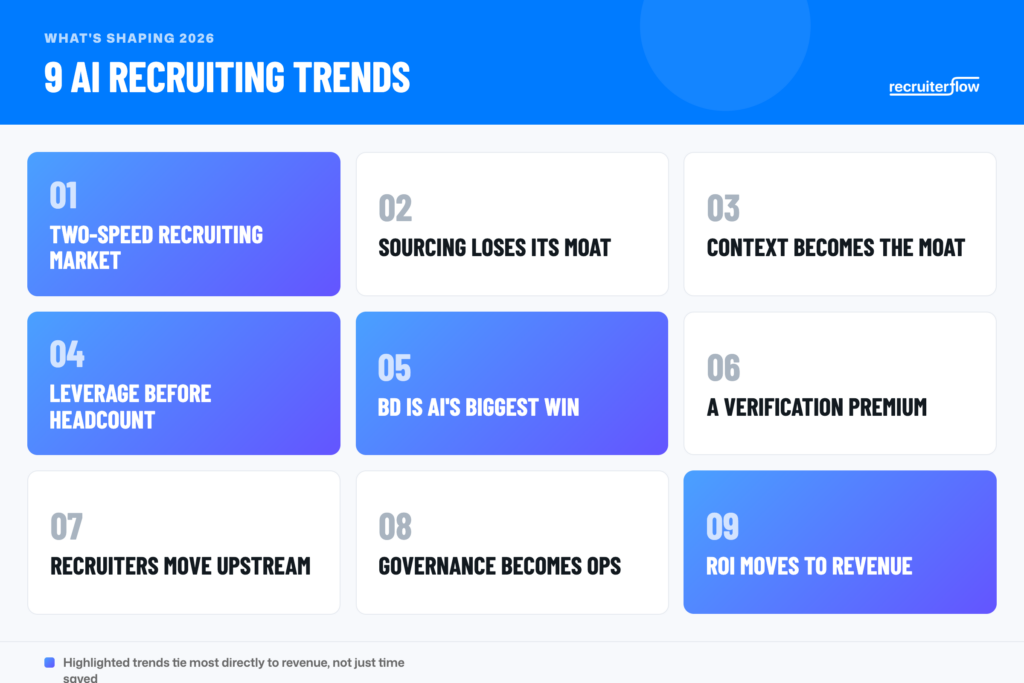
1. AI is creating a two-speed recruiting market
Soon, saying your firm “uses AI” will be about as differentiating as saying your team uses LinkedIn.
Almost everyone will.
The real separation is happening underneath the toolset.
One firm uses ChatGPT to write an email. Another uses a voice AI platform to capture a client call automatically, turn the conversation into structured context, updates candidate and company records, identifies relevant people, creates follow-up actions, and carries that intelligence into the next search.
Both can claim to use AI.
They are not running the same operating model.
That’s why the widening performance gap in Bullhorn’s data matters. The competitive advantage isn’t access to AI anymore. It is how deeply intelligence is embedded into the firm.
The broader future of AI in recruiting will be defined less by adoption and more by integration.
2. Sourcing is losing value as a competitive moat
For years, finding people was part of the recruiter’s scarcity value.
Knowing where to look, constructing the right search, maintaining expensive databases, and spending hours researching a market created information asymmetry.
AI is compressing that advantage.
LinkedIn says 73% of charter customers using its Hiring Assistant saved at least an hour of sourcing per role, with one user reporting a 20x increase in sourcing efficiency.
That doesn’t make sourcing irrelevant.
It makes access less scarce.
When a client, internal TA team, and competing search firm can all generate a credible longlist faster, the premium shifts elsewhere:
Who should actually be approached?
Why this person and not the 30 people who look similar?
What does their career trajectory tell you that their profile doesn’t?
Will they move?
Will the client buy the argument?
AI is making candidate discovery easier. That makes qualification, interpretation, and conviction more valuable.
The best AI recruiting tools will therefore be judged less by how many candidates they find and more by how much noise they remove before a consultant makes a decision.
3. The database moat is shifting from profiles to context
Here is the counterintuitive consequence of better AI search:
The easier the open web becomes to search, the more valuable proprietary recruiting data becomes.
A LinkedIn profile is available to everyone.
What isn’t available to everyone is the conversation your consultant had with that person three years ago. Their compensation expectations. The search they almost joined. Why they declined. The relationship with your partner. What a client said about them. The companies they would never consider. The moment their circumstances changed.
That is institutional knowledge.
And AI finally gives firms a practical way to use it at scale.
The CRM of the past stored records. The intelligent database of 2026 increasingly has to understand conversations, relationships, history, and changing signals.
The moat isn’t the candidate profile anymore.
The moat is the context around the candidate.
That changes the economics of AI in recruitment. Firms that have spent ten years building relationships may have a larger AI advantage than firms starting with the newest model but an empty institutional memory.
4. AI will change recruiter leverage before recruiter headcount
The lazy AI prediction is that firms will need fewer recruiters.
The more interesting question is:
How much more revenue can one excellent recruiter support?
The American Staffing Association’s 2026 productivity data points in an interesting direction. Recruiter call time hit 286 minutes per week in Q1 2026, its highest level in the dataset and double Q1 2024. Over the same period, average AI-tool usage also increased.
The pattern matters.
More AI did not coincide with recruiters disappearing from conversations. Recruiters were spending more time talking to candidates and clients.
That suggests the near-term economic shift is leverage.
If AI absorbs research, coordination, data capture, follow-ups, and administration, a recruiter can potentially manage more relationships and searches without degrading service.
The critical metric may therefore stop being headcount.
It becomes revenue per recruiter.
5. Business development may become AI’s highest-value use case
Most conversations about AI recruiting begin with candidates.
Search firms should be looking just as hard at clients.
A firm’s database contains thousands of potential commercial signals: a past candidate becomes a hiring manager, a client changes company, a former placement gets promoted, a leadership team changes, an old relationship moves into a mandate-owning role.
Historically, capturing those moments depended on someone noticing.
AI makes them machine-detectable.
This changes the CRM from a place where business development activity is recorded into a system that can help create the reason for the activity.
Recruiterflow customer Mercury Hampton offers a useful example. After using AIRA Job Change Alerts to monitor changes across its database, the firm attributed roughly £25,000 in revenue to Job Change Alerts alone.

That’s a more interesting AI story than writing an outreach email 40 seconds faster.
For recruiting firms, some of AI’s largest returns may eventually come from answering:
Who has a reason to buy from us right now?
6. Candidate abundance is creating a verification premium
AI has made it easier to find candidates.
It has also made it easier to manufacture candidate signals.
Greenhouse found that 91% of recruiters surveyed had encountered candidate deception, while 34% said they spent as much as half their week filtering spam and junk applications.
SHRM’s 2026 research shows the arms race is likely to intensify: 85% of recruiting executives expect candidate use of AI for applications to become more prevalent, while 74% expect greater AI use during interviews.
So AI produces a paradox:
More candidate information. Less certainty about what to trust.
That raises the value of evidence that is harder to synthesize: trusted relationships, prior interactions, references, structured assessment, reputation, verified career history, and consultant judgment.
When polished candidate signals become abundant, trusted signals command a premium.
For executive search in particular, that could strengthen rather than weaken the case for a high-context intermediary.
7. Recruiters are moving upstream into judgment and advisory
“AI will give recruiters more time to build relationships” is true.
It is also incomplete.
The more profound change is where the recruiter sits in the value chain.
Research, scheduling, summarization, database administration, and first-pass matching are moving downstream toward machines.
The recruiter moves upstream.
Into calibration.
Into search strategy.
Into convincing a client that the obvious candidate isn’t necessarily the right candidate.
Into reading motivation.
Into understanding the market behind the shortlist.
Into advising rather than retrieving.
LinkedIn’s data captures the shift. Talent professionals using generative AI reported saving roughly 20% of their workweek, while employers became 54x more likely to list relationship development as a required recruiting skill in 2024 versus 2023.
AI doesn’t reduce the importance of recruiter judgment.
It increases the percentage of the recruiter’s job where judgment is the point.
That’s why the most important recruiting trend may be a change in professional identity: from process manager to market adviser.
8. AI governance is becoming an operating capability
Governance is often treated as something legal reviews after the technology has been selected.
That model is becoming obsolete.
Under the EU AI Act framework, AI systems that materially rank, filter, or identify candidates for recruitment can fall into the high-risk category — including systems used by external recruiting firms.
The timeline for key workplace high-risk requirements has shifted, but the direction hasn’t: firms will increasingly need to know what AI is doing, what data informs it, where human oversight exists, and how an output influenced a decision.
That makes explainability an operating requirement, not merely a compliance feature.
A consultant should be able to understand why someone was surfaced.
A recommendation should support judgment rather than conceal it.
The winning model isn’t maximum autonomy.
It is maximum useful autonomy with accountable human judgment.
9. AI ROI is moving from hours saved to revenue created
“AI saved our recruiters five hours a week” was a useful metric when firms were experimenting.
It is not where the conversation should end.
Five hours saved has no intrinsic commercial value if those hours disappear into five more hours of internal work.
The questions that matter are downstream:
- Did recruiters run more conversations?
- Did the database produce more placements?
- Did consultants handle more searches?
- Did time-to-shortlist fall?
- Did conversion improve?
- Did revenue per recruiter increase?
Bullhorn’s 2026 research is notable precisely because the AI story is beginning to show up against revenue performance, not simply productivity surveys.
Recruiterflow has seen the same pattern at firm level. In Recruiterflow’s Andiamo search firm reported 4x revenue, 2x client submissions, and a 76% reduction in time-to-fill after redesigning workflows around Recruiterflow and AIRA.
The next generation of AI ROI will be measured on the P&L.
Not the stopwatch.
What these trends mean for recruiting and search firms
The strategic response to these AI recruiting trends isn’t “buy more AI.”
It is to redesign the firm around what becomes scarce when intelligence becomes abundant.
Capture context, not just records. Every candidate call, client conversation, search, objection, and outcome should strengthen institutional knowledge rather than disappear into personal notes and inboxes.
Compete on judgment, not access. Candidate discovery will continue getting cheaper. Understanding who matters, why they matter, and how to close them remains differentiated.
Turn the database into a revenue channel. A firm’s existing relationships should continuously produce candidate and commercial signals instead of waiting for someone to remember to search.
Measure leverage. Time saved is an input. Revenue per recruiter, conversion, placements, mandates, and margin are outcomes.
And above all, stop treating AI as another destination in the tech stack.
The advantage comes when intelligence travels with the work.
AIRA: what this operating model looks like in practice
That is the idea behind Recruiterflow AI.
AIRA is the intelligence layer running through Recruiterflow’s workflow rather than a separate AI destination.
AIRA Source expands research beyond the existing database. AIRA Matchmaker evaluates candidates against plain-English qualification criteria and explains the fit. AIRA Notetaker turns conversations into structured context and actions. AIRA Job Change Alert Agent identifies career moves that can become candidate or business-development opportunities.
The important part isn’t any individual agent.
It is what happens when the context is shared.
The conversation informs the record. The record informs the search. The search informs the next action. And the consultant stays where human judgment has the highest value.
That’s the practical difference between adding AI tools and becoming AI-native.

FAQs
What are the top AI recruiting trends for 2026?
The top AI recruiting trends in 2026 include agentic workflows, AI-driven candidate discovery, intelligent databases, recruiter productivity gains, AI-assisted business development, candidate verification, stronger governance, and ROI measurement tied to revenue. The larger shift is from individual AI tools toward AI embedded across the firm’s operating model.
Will AI replace recruiters in 2026?
No. AI is increasingly absorbing execution around recruiting rather than replacing the judgment at its center. As research and administration become cheaper, relationship building, assessment, persuasion, calibration, and advisory work become a larger part of the recruiter’s value.
How is AI different in recruiting firms vs. in-house HR teams?
Recruiting firms have two sides of the marketplace to optimize: candidates and clients. That makes AI valuable not only for research, matching, and administration but also for database rediscovery, relationship intelligence, business development, mandate identification, and increasing revenue per recruiter.
What AI recruiting tools should small firms adopt first?
Start with the workflow creating the most repeated friction rather than assembling a large AI stack. For many firms, contextual note-taking, database matching, research, and CRM updates create faster returns because they improve work recruiters already perform every day.
Are AI recruiting trends different for executive search vs. staffing?
Yes. Higher-volume recruiting can delegate more repeatable screening and process execution to AI. Executive search has a greater premium on research interpretation, calibration, trusted relationships, discretion, and consultant judgment, so AI is more valuable when it strengthens those capabilities rather than attempting to replace them.
How do you measure ROI from AI recruiting tools?
Measure commercial outcomes after the efficiency gain: revenue per recruiter, placements per recruiter, time-to-shortlist, database-sourced placements, recruiter conversations, client opportunities, conversion rates, and margin. Hours saved matter only when the firm converts that capacity into a better business outcome.
Recruitment
Ayusmita is a B2B storyteller who spends her time translating recruiting workflows into clear stories at Recruiterflow.


Ayusmita