
AI Washing in Recruitment: How to Tell a Product From a Demo
In 2024, 88% of recruiters said they were interested in AI. Fewer than 60% actually used it (Source: Recruitment Industry Analysis 2025-26).
That gap usually gets read as slow adoption. It is more often a product problem. The tools were bought. They were opened. Then they were quietly abandoned, because nothing in them survived contact with a Tuesday afternoon.
This post covers AI washing in recruitment: what it is, the three forms it takes, what it costs a firm that buys it, and the questions that surface it before you sign.
What AI washing actually is
AI washing is the practice of marketing a product on AI capability that does not hold up in daily use.
It rarely involves lying. The capability is usually real, in the sense that it exists and can be demonstrated. The distance between the claim and the reality is a distance between what a system can be made to do once, under favourable conditions, and what it does forty times a day on your own messy records.
That distance does not show up in an evaluation. It shows up in week six.
The three forms it takes
The capability that only performs on demo data
A demo environment is a curated database. Complete fields, clean formatting, no duplicates, no records entered by someone who left in 2021.
Real databases are none of those things. A matching or summarising capability tuned on tidy data degrades sharply on the real thing, and the degradation is invisible until your team is the one supplying the inputs.
The feature that moves work rather than removing it
This is the most common form and the hardest to spot, because the feature does work.
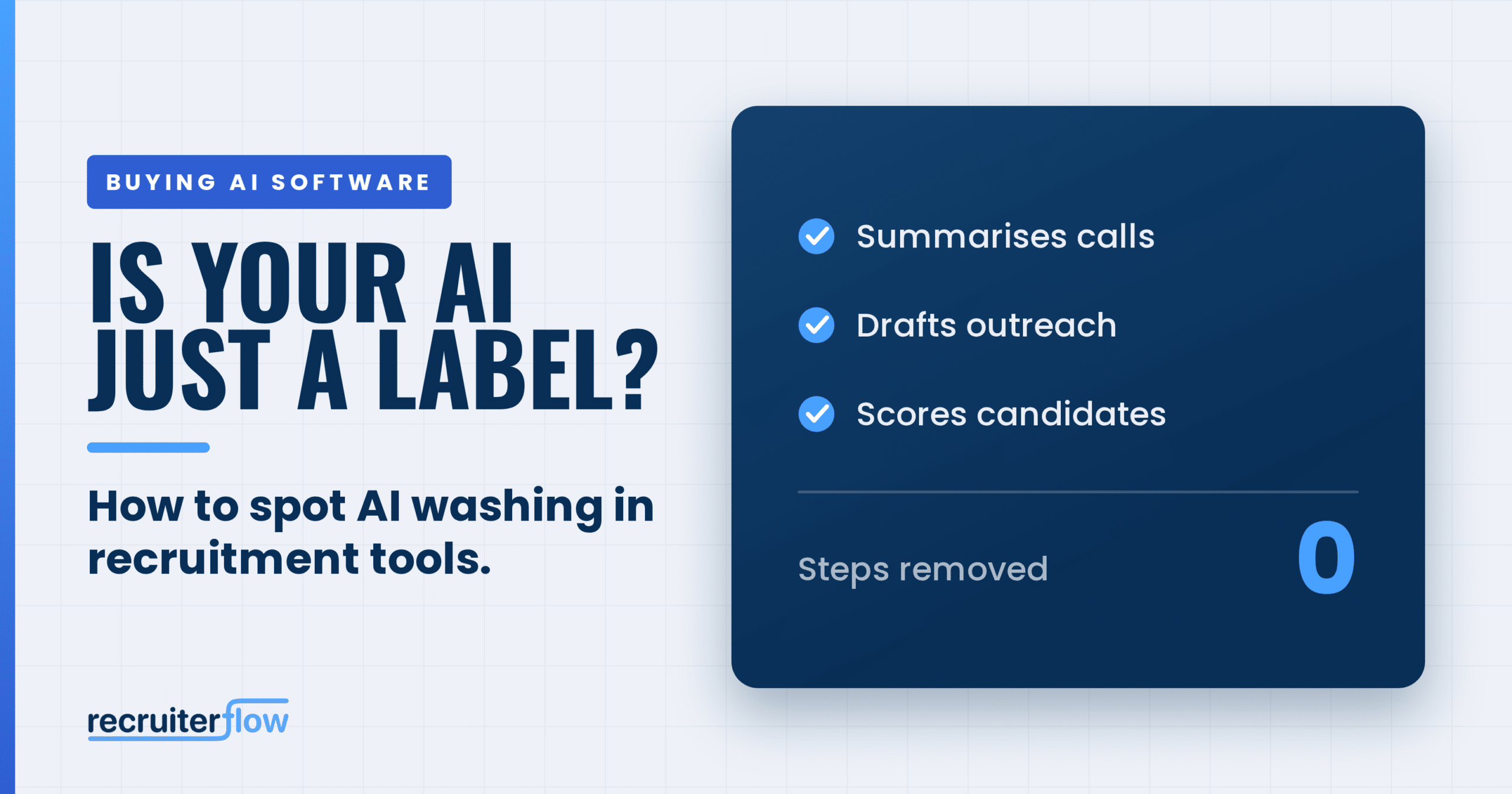
The test is not whether the output is good. It is whether the total number of actions went down. A capability that produces a draft you then have to check, correct and re-prompt has not removed the task. It has changed its shape and added a review step. Well-built recruitment automation is measured the same way: by the steps it takes out.
The roadmap sold as a product
Every vendor has a roadmap. The question worth asking is what arrived on it in the last twelve months, and whether anything on it came from a customer request rather than an internal plan.
A capability described in the future tense during a sales conversation is a plan. Firms routinely buy plans and then wait out a contract term for them.
What it costs
The licence fee is the smallest part.
The real cost is that the work does not go away, and now there is a system to maintain on top of it. Around 61% of recruiters experience burnout, and 45% attribute it to repetitive administrative tasks (Source: Recruitment Industry Analysis 2025-26). A tool bought to relieve that load, which instead adds a surface to manage, makes the problem it was bought to solve slightly worse.
The second cost is slower and more damaging. A team that has been sold AI once and found it hollow becomes harder to move the next time, including when something arrives that would have worked. Scepticism earned the hard way is expensive to undo.
The firm that ran the experiment
Stephen Joynes founded Joynes & Hunt in 2018, a UK technical recruitment firm placing across engineering disciplines. He built it around a simple idea: keep the work relationship-driven, and let the technology absorb the admin.
He had already moved his firm onto Recruiterflow in 2019. Then he left, for a product sold on much heavier AI.
“We were sold the dream for a very, very, very heavy AI CRM. It was a bit complicated and it was probably more messing about than it was actually getting work done.”
Stephen Joynes, Managing Director, Joynes & Hunt
That last clause is the whole diagnosis. Not that the AI did not exist. That operating it cost more than the work it replaced.
He came back. The firm now runs more than 200 active automations, with a 68% increase in candidate pipeline and roughly twice the recruiting activity (Source: Joynes & Hunt case study). The specific workflows behind that number are worth reading in full if you are building your own, and there is a detailed breakdown of seven automations his team runs.
What matters here is the sentence he uses to describe the difference.
“We find use for a lot of the AIRA agents. It’s been really good it’s not AI for the sake of AI, it’s AI to enable you to work.”
Stephen Joynes, Managing Director, Joynes & Hunt

What AI that survives contact with the work looks like
Three characteristics separate the capability that gets used from the capability that gets demoed.
It removes a step instead of adding a surface. AIRA Notetaker records the call, structures it, and updates the record, so the note is written by the act of having the conversation. Nobody opens a tool to make that happen. The strongest signal in any evaluation is a capability the recruiter never has to remember to use.
It runs on your data, not the vendor’s. Tidy demo records prove very little. What proves something is a capability pointed at your own database, including the records nobody has touched since 2022.
It compounds rather than repeats. There is a real difference between software that is smart but not proactive, automation that is proactive but not smart, and agents that are both. It is the distinction that decides whether AI in recruiting compounds or plateaus. Only the third category gets better as it runs, and only the third category is worth paying an AI premium for.
Underneath all three is the same principle: the recruiter still owns the judgement. The system owns everything standing in front of it. A vendor promising that AI will make the decisions is describing a product that either does not work or should not.
Five questions that surface AI washing before you sign
Can we run a trial on our own data, including the messy records? A confident vendor says yes quickly. Reluctance here is the single most reliable signal available to you.
What shipped in the last twelve months? Not the roadmap. What arrived, and who asked for it. Cadence is a better predictor of the next year than any feature list.
What does this remove? Make the vendor answer in terms of steps taken away rather than capabilities added. If every answer is additive, the work is not going anywhere.
Which customers use this daily, and can we speak to two? Daily is the operative word. A reference customer who has the feature enabled is not the same as one whose team opens it every morning.
What happens when it is wrong? Every AI capability is wrong sometimes. The useful question is whether the product is designed for that, with a visible correction path, or whether being wrong quietly becomes your team’s problem to clean up.
None of these require technical knowledge. They require refusing to evaluate a product on the version of it that was built for the evaluation.
See it run on your database, not ours
The fastest way past a demo is to stop watching one. Bring your own records, including the incomplete ones, and a live search you are working now.
Book a demo and we will point Recruiterflow at your data rather than ours, so what you judge is the version you would actually be buying.
FAQs
What is AI washing?
AI washing is marketing a product on artificial intelligence capability that does not hold up in real use. In recruitment software it usually means a capability that performs on curated demo data, or one that reshapes a task rather than removing it.
How do you tell if recruiting software is really AI-native?
Ask what the AI removes rather than what it adds, and insist on a trial using your own records. AI-native systems tend to do their work inside existing workflows, without the recruiter opening a separate tool or remembering to trigger anything.
Why do recruiters stop using AI tools they paid for?
Usually because the tool changed the shape of a task instead of removing it. If a capability produces output that still needs checking, correcting and re-prompting, the total number of actions has not fallen, so the shortcut wins within a few weeks.
What questions should you ask an AI recruiting software vendor?
Ask for a trial on your own data, what shipped in the last twelve months, what steps the product removes, which customers use the capability daily, and what happens when the AI gets something wrong. The answers separate shipped products from roadmaps.
Is AI in recruitment overhyped?
The capability is real and the claims around it often are not, which is a different problem. Interest has consistently run ahead of use, and the gap is better explained by products that disappoint in week six than by firms being slow to adopt.
Recruitment
Ayusmita is a B2B storyteller who spends her time translating recruiting workflows into clear stories at Recruiterflow.


Ayusmita