
ATS Pricing in 2026: What It Actually Costs Before You Sign
This post covers ATS pricing in 2026: the models vendors quote in, which ones publish a price and which make you ask, what sits inside the licence fee and what gets billed separately, and how to work out your real cost before you sign.
The four ways ATS pricing gets quoted
Most confusion in a ATS software evaluation comes from comparing two numbers that measure different things.
Per user, per month
The most common model, and the easiest to compare. Every person with a login costs the same. Watch for whether the quoted figure assumes annual billing, because the monthly rate is usually higher.
Per recruiter, or per full seat
Some vendors separate a full producing seat from a lighter admin or hiring-manager seat, then price them differently. This can work in your favour if you have support staff who only need read access, and against you if every seat is billed at the full rate regardless of use.
Per module
The licence covers a core product and each capability beyond it carries its own line: reporting, sequencing, texting, onboarding. Flexible on paper. In practice it makes the eventual invoice hard to predict at the point you sign.
Flat platform fee
A single fee for a band of users. Simple until you cross the band, where the step up can be steep.
Who publishes a price, and who makes you ask
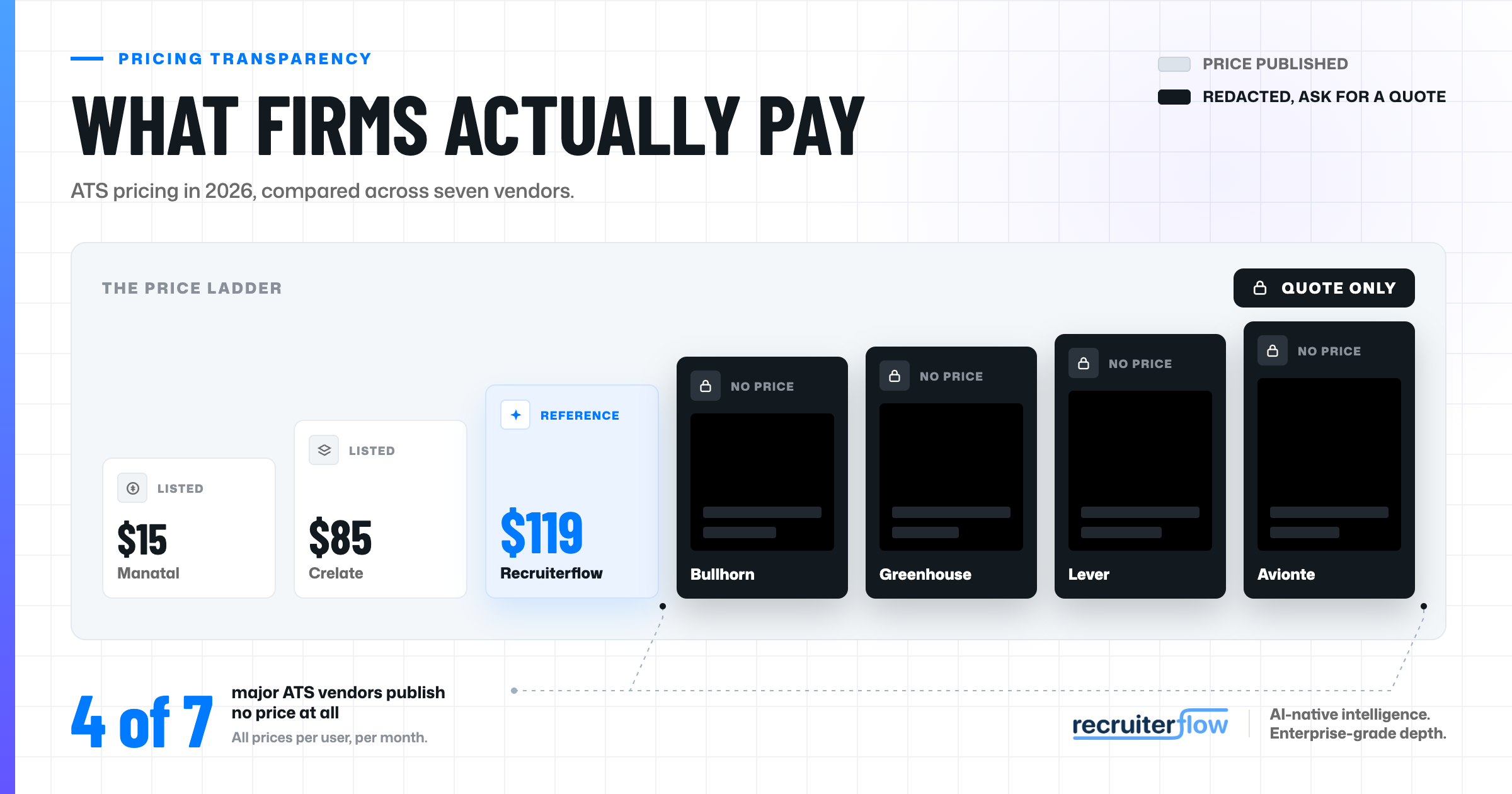
This is the sharpest dividing line in the market, and it tells you something before you have spoken to anyone.
| Vendor | Published entry price | Billing unit |
|---|---|---|
| Manatal | $15 | per user, per month, billed annually |
| Crelate | $85 | per user, per month |
| Bullhorn | $99 Starter, $165 Core | per user, per month |
| Recruiterflow | $119 annual, $149 monthly | per user, per month |
| Greenhouse | Not published | Quote only |
| Lever | Not published | Quote only |
Across the wider market the spread is enormous. SelectSoftwareReviews puts the range at $0 to $125,000 or more per year, which tells you how little a single average is worth.
Two things stand out. The cheapest published options are built for in-house hiring teams rather than firms running client work, so a $15 seat and a $119 seat are rarely doing the same job. And the published figure is almost always the entry tier. Bullhorn lists Starter and Core, but the two tiers above them, the ones carrying its AI, are not priced publicly at all.
A quote-only model is not automatically a bad sign, and complex products do need scoping. It does mean you cannot benchmark before a sales conversation, and that the first number you hear is rarely the floor.
What sits inside the licence, and what gets billed separately
The licence fee is the part everyone compares. The gap between vendors usually lives somewhere else.
AI capability
This is the fastest-moving line in ATS pricing and the least consistent. Manatal includes AI enrichment and recommendations in every tier, then sells its AI Interviewer as a separate add-on. Crelate includes an AI Assistant from its Essentials tier, then offers Insights Agents and Data Quality Agents a la carte.
Bullhorn is the clearest example of the pattern. Its published tiers are Starter at $99 and Core at $165, and neither carries AI. Amplify appears only at Pro, described on Bullhorn’s own pricing page as “Everything in Bullhorn Core, plus Amplify’s AI productivity capabilities”, with the agentic workflows a tier higher at Max. Both of those tiers are quote only, so the price of the AI is precisely the part you cannot look up.
Recruiterflow splits it by plan rather than by feature. The Platform plan is $119 per user per month billed annually, or $149 monthly. The AIRA plan runs from $150 to $300 per user per month depending on scope, and every AIRA agent is included in it, current and future, with nothing billed per feature on top.
The question to ask any vendor is not whether they have AI. It is whether the AI you saw in the demo is in the plan you were quoted, and what happens to your bill when they ship the next one. If you are still working out what AI-native actually means, settle that before you compare prices, because the two questions are related.
Texting, calling and channel costs
SMS is frequently metered separately, either by the vendor or by a telephony provider you connect yourself. Ask for the per-message rate and a realistic monthly volume, not just confirmation that the feature exists.
Integrations and job boards
Two-way email and calendar sync, job board posting and back-office connections can each carry setup or per-connection fees. Small individually, and they add up quietly.
The costs that land after you sign
Implementation and migration
Implementation is often quoted as a one-off percentage of year one. The larger risk is not the fee. It is what arrives on the other side, because a migration that drops notes, call logs and context leaves you paying for a database that no longer holds your institutional knowledge. Ask what gets carried across before you ask what it costs, and treat switching without losing candidate history as a scoping question rather than a technical one.
Contract length and renewal
Multi-year terms usually buy a discount. They also remove your leverage at renewal. If a vendor will not put a cap on renewal increases in writing, that is information.
Adoption
The most expensive ATS is the one your team works around. A firm paying $119 a seat with full adoption is getting more than a firm paying $35 a seat that half the desk ignores. Against the $168,000 annual revenue gap per recruiter between top-quartile firms and everyone else (Source: The Economics of Recruiting), a licence difference of a few thousand dollars a year stops looking like the main variable.
Working out your real number before you sign
Build a three-year figure
Take the licence across your expected headcount, add implementation, add metered channels at realistic volume, add any module you know you will need in year two. Compare that total, not the monthly seat rate.
Price per producing recruiter
Divide by the number of people who will actually bill on the system, not by total logins. Two vendors with identical seat rates can be very different numbers once you strip out seats that exist only to satisfy a licence minimum.
Put five questions in writing
- What is included in the quoted tier and what is not.
- What is metered and at what rate.
- What implementation covers and what it excludes.
- What happens to the price at renewal.
- What new capability costs when it ships.
Any vendor that answers all five in writing has told you something useful about how the next three years will go. A structured way to run that comparison is set out in our guide to evaluating an AI-native platform, and it is worth reading why firms stay with Bullhorn too long before committing to a long term anywhere.
The number that actually matters
ATS pricing looks opaque because it is quoted in units designed to resist comparison. Convert everything to one figure, a three-year total divided by producing recruiters, and most of the fog clears.
Recruiterflow publishes its platform rate and its AIRA range for exactly that reason. See what your number looks like at recruiterflow.com/pricing, or bring your current contract to a demo and we will work it out against what you are paying now.
FAQs
How much does SMS recruiting add to ATS pricing?
It depends on whether messaging is metered by the vendor or by a telephony provider you connect. Ask for the per-message rate and model it against your real monthly send volume, because the feature being included does not mean the messages are.
How does ATS pricing change for mid-sized firms?
Per-seat rates often fall as seat count rises, but minimum commitments and tier thresholds rise with them. The saving is real, and it usually comes attached to a longer term.
What does enterprise ATS pricing cost per user, per month?
There is no reliable public figure, because almost every vendor at that end quotes rather than publishes. Treat any single number you find as one firm’s outcome rather than a benchmark.
Does two-way email and calendar sync cost extra to set up?
Sometimes. It is commonly included in mid and upper tiers and charged as a connection or setup fee at entry level. Confirm which applies to the exact tier you have been quoted.
Is ATS pricing negotiable?
Usually, particularly on multi-year terms, seat volume and implementation fees. The renewal cap is often more valuable to negotiate than the year-one discount.
What do implementation and onboarding cost on top of the licence?
Most vendors quote this separately and few publish it. Ask what the fee covers, what it excludes, and how long the vendor expects you to be live, so you can compare scope rather than headline numbers.
Can you export your data if you leave, and does it cost extra?
Ask before you sign, and ask specifically about notes, call logs and attachments rather than contact records alone. Export terms are easy to agree at the start of a contract and very hard to negotiate at the end of one.
Recruitment
Ayusmita is a B2B storyteller who spends her time translating recruiting workflows into clear stories at Recruiterflow.


Ayusmita