
Can You Trust AI tools With Candidate Data?
You can trust an AI recruiting tool with candidate data when the vendor guarantees in contract that your data isn’t used to train shared models, stays isolated to your account, is encrypted, can be deleted on request, and only goes to named sub-processors. If a vendor can’t show that in writing, treat it as a risk.
This blog covers candidate data privacy in AI recruiting tools: where the data goes when AI touches it, whether pasting CVs into ChatGPT is safe, seven risks to raise with any vendor, an eight-point checklist, what GDPR, the EU AI Act and CCPA require as of late 2026, and how Recruiterflow answers the same questions.
Where does candidate data go when an AI tool processes it?
Every AI request copies candidate data at least once. Due diligence comes down to knowing where each copy lands, how long it lives, and which contract covers it.
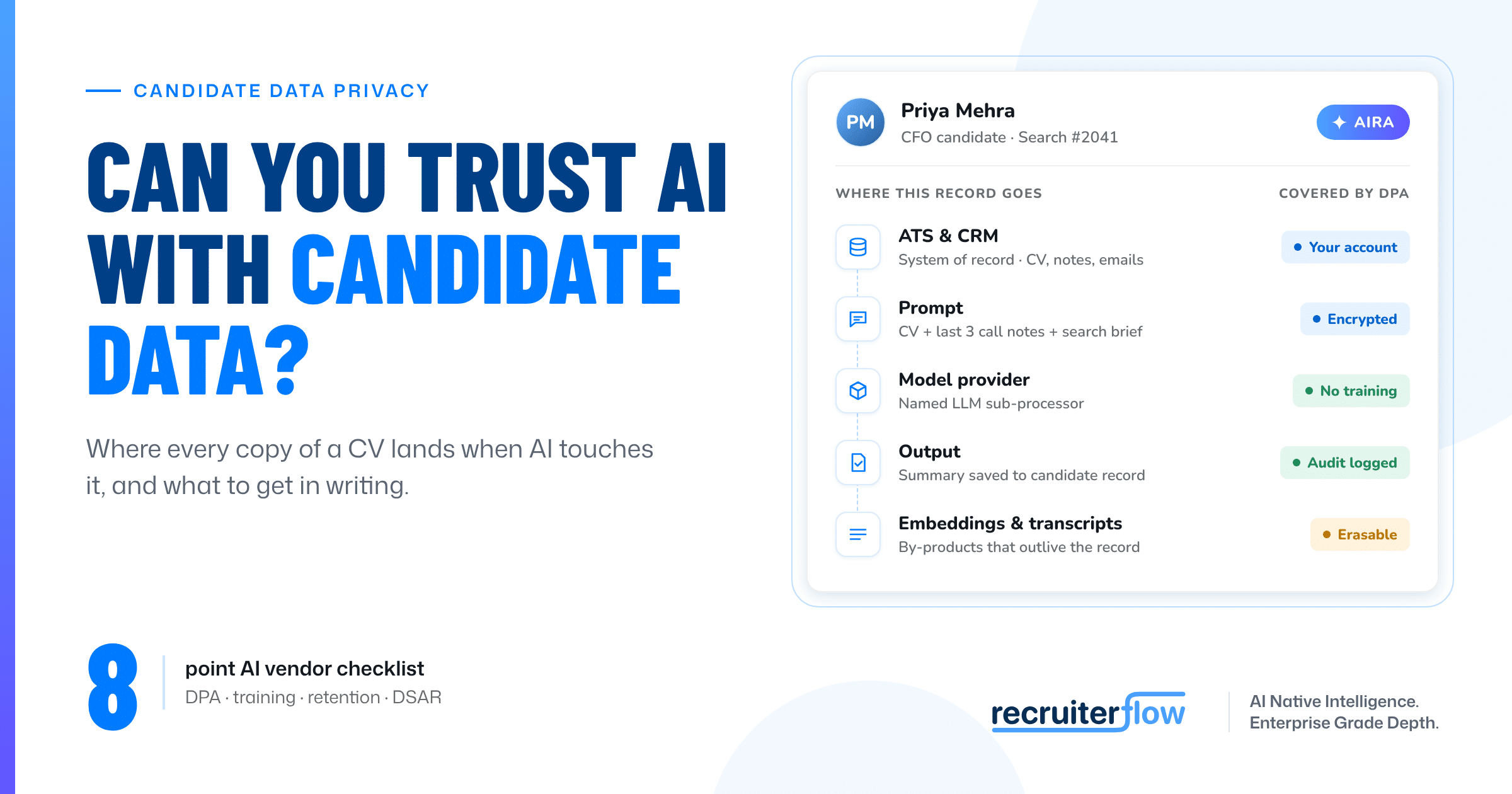
Here is the path a typical request takes, whether it’s a CV summary, a match score or a drafted email:
- Your system of record. The ATS and CRM hold the CV, call notes, emails and pipeline history.
- The prompt. The AI feature pulls the pieces it needs, say a CV, the last three call notes and the search brief, and packages them into a request.
- The model provider. Most vendors send that request to a large language model run by a third party. That provider is a sub-processor of your candidate data, and its contract decides whether the prompt is logged, for how long, and whether it can be used for training.
- The output. The summary, score or draft comes back and is usually saved against the candidate record.
- The by-products. Embeddings (numerical copies of text used for search and matching), call recordings, transcripts and system logs. These are easy to forget and often outlive the original record.
AI now runs through every stage of recruiting, from research to submission, so this path repeats hundreds of times a day inside a busy firm. A vendor you can trust names every stop on it and shows you the contract that governs each one.
What are the real risks?
- Model training: Vendors using your proprietary candidate database to train, fine-tune, or improve public or shared AI models without permission.
- LLM sub-processors: Passing sensitive candidate information to third-party AI companies without explicitly naming them in your data processing agreement (DPA).
- Retention: Third-party APIs holding onto your candidate data for 30 days or more instead of immediately discarding it after the prompt is processed.
- Cross-border transfers: Routing EU or UK candidate data to global servers without establishing localized data residency or proper legal transfer mechanisms.
- Over-sharing internally: Failing to implement strict RBAC (Role-Based Access Control) and SSO (Single Sign-On), allowing unauthorized staff to view AI-generated insights or sensitive profiles.
What does “safe” look like?
To safely process candidate profiles, your software procurement process should scrutinize AI vendors as closely as an ATS or core CRM system. Use this 8-point checklist and risk assessment table to vet any AI recruiting vendor.
The “Safe AI Vendor” Checklist:
- Robust DPA: A signed Data Processing Agreement explicitly covering AI operations.
- No-training clause: Written guarantee that customer data is never used to train the vendor’s or the LLM’s base models.
- Zero data retention: API agreements with LLM providers that ensure inputs are not stored after processing.
- Per-customer isolation: Architectural separation ensuring your data never crosses into another customer’s environment.
- Encryption: Comprehensive encryption at rest and in transit for all candidate records.
- SSO + Permissions: Enterprise-grade authentication with granular access controls.
- Audit logs: Readily available logs showing exactly who accessed, modified, or processed candidate data with AI.
- DSAR support: Tools to easily execute Data Subject Access Requests (DSAR) and the right to erasure across all AI sub-systems.
Vendor Evaluation Risk Table
| Risk Factor | What to Ask the Vendor | The Answer You Want |
| Model Training | “Do you or your underlying LLM providers use our data to train your models?” | “No. We have enterprise agreements that explicitly opt-out of all model training.” |
| Data Retention | “How long do your AI sub-processors store our prompt data?” | “Zero data retention. Data is deleted immediately after the API returns the result.” |
| Sub-processors | “Who actually processes the AI prompts?” | “We provide a full list of named LLM sub-processors in our DPA, and notify you before any changes.” |
| Data Residency | “Where is the AI processing actually taking place?” | “We offer localized data hosting (e.g., EU-only processing) to meet your compliance needs.” |
What do GDPR, the EU AI Act and CCPA require when AI processes candidate data?
Data privacy frameworks like GDPR and CCPA do not outlaw AI, but they do demand strict transparency, a clear lawful basis for processing, and proactive risk management (such as completing a DPIA—Data Protection Impact Assessment—before deploying new AI tools).
Under GDPR, recruiters must adhere to the following core articles regarding AI:
- Article 13: You must tell candidates exactly how you will process their data using AI when you collect it directly from them.
- Article 14: If you source the candidate data from a third party (like a job board), you must inform the candidate about the AI processing within a reasonable period, no later than one month.
- Article 22: You must ensure candidates are not subject to a decision based solely on automated processing (like an AI outright rejecting a CV) if it produces legal or similarly significant effects, without human oversight.
One thread runs through all of them: a consultant who reviews the output and makes the call keeps most AI use on the lighter side of these rules. That’s also how good search work already runs. When you use AI screening tools, keep the consultant’s decision on record.
Your vendor can make all of this easier. Choosing a lawful basis, sending Article 14 notices and signing off the DPIA stay with your firm, because under GDPR you’re the controller. Our SOC 2 and GDPR guide covers the controller’s obligations under GDPR in full.
This is practical guidance, not legal advice. Confirm your obligations with qualified counsel.
How does Recruiterflow handle candidate data in AIRA?
Recruiterflow is AI-native recruiting software, and AIRA is the intelligence layer that runs through it, so AIRA works on candidate data where it already lives: inside the unified ATS and CRM, under the same contract and controls as the rest of your database. There’s no second tool to paste into and no separate contract to negotiate.
Here is how Recruiterflow answers the checklist above.
| Question | Recruiterflow’s answer |
| Is there a DPA that covers candidate data? | Yes. The published Recruiterflow DPA names candidates and applicants as data subjects, addresses special category data in recruitment, and includes the EU Standard Contractual Clauses, the UK Addendum and a sub-processor list. |
| Who owns the data? | You do. Recruiterflow states that customers own their data, that it doesn’t share customer data with anyone else, and that you can export it through the API at any time. |
| What security standards apply? | SOC 2 and GDPR compliance, with role-based permissions and multi-brand controls. |
| Is customer data used to train models shared with other customers? | No |
The same design that makes AIRA, the intelligence layer, useful also makes it easier to govern. AIRA Notetaker, AIRA Matchmaker, AIRA Research Agent and AIRA Submission Agent all draw on one record per candidate, so a subject access request or an erasure has one place to start. That one record is also the institutional knowledge your firm has spent years building, and it stays yours.
There’s an honest trade-off for firms that already rely on a separate AI tool their team likes. Moving that work inside Recruiterflow means a change in habits. You gain one contract, one sub-processor list, and one set of permissions to answer for.
Answer the AI questionnaire before the client sends it
Clients are starting to ask search firms the same questions this guide asks vendors. The firms that can reply in one email, with a DPA, a sub-processor list and a clear line on training, will win the mandates where trust decides the shortlist.
See how AIRA runs inside the system where your candidate data already lives, under one DPA and one sub-processor list. Book a Recruiterflow demo.
The only software to future-proof your search business.
FAQs
Do AI recruiting tools sell candidate data?
Reputable vendors don’t, and their DPA should forbid it. The more common risk is reuse, where your data quietly improves a model other customers use. Ask for both a no-sale and a no-training commitment in the contract.
Can candidates ask to be excluded from AI processing?
Yes, in several ways. Under GDPR they can object to processing based on legitimate interests and ask for human review of solely automated decisions. From 1 January 2027, California’s rules add access, opt-out and appeal rights for significant decisions made without meaningful human involvement. Your system needs a way to flag the request and honour it.
Is using AI on CVs an “automated decision” under GDPR?
Only when the AI makes the decision with no meaningful human involvement and the outcome significantly affects the candidate, such as a rejection. Ranking or summarising CVs for a consultant to review generally falls outside Article 22. You still need a lawful basis and a privacy notice that mentions the AI.
What happens to my data if I cancel an AI recruiting tool?
Under GDPR Article 28, the vendor must delete or return your personal data at the end of the service, at your choice. Ask for the export format, the deletion timeline, and confirmation that backups, AI outputs and model-provider copies are covered.
Is it safer to use AI built into the ATS than a separate tool?
Usually, yes. Built-in AI means fewer copies of candidate data, one contract and one place for subject access and erasure to reach. You still need to check which model providers the ATS vendor uses and on what terms.
Can an AI vendor share my database with other customers?
Only if the contract allows it, so read the contract. Look for data isolation per account, no cross-customer training, and matching that only runs against your own records.
Recruitment

Abhishek holds 7+ years of experience in helping companies rank for over 1,000 commercial keywords with a data-driven approach. As the SEO lead at Recruiterflow, he drives strategies that boost organic visibility and ensure competitive growth. Outside of work, Abhishek is a dedicated father of two, finding balance between his passion for SEO and family life.
Abhishek Sharma