
The False Choice: Why Firms Are Told to Pick AI or Enterprise Depth

“AI vs. enterprise depth” has become accepted wisdom in this category, but it’s a cover story for two very different kinds of unfinished product.
Here’s where the framing actually comes from, what it’s covering for, and what it takes to prove it wrong.
What the choice sounds like in an actual sales call
Two pitches, and firms get told to pick a lane.
The first is an AI-first startup. New features every week, an interface that feels years ahead of the incumbents. The pitch is fast and confident, right up until someone asks about SOC 2, GDPR, or what happens once the platform holds 50,000 candidate records.
Then the answer gets vague, or it’s “on the roadmap.”
The second is an enterprise incumbent.
Certifications in place, a support team that picks up the phone, years of infrastructure behind it.
Ask what its AI actually does day to day, though, and it’s usually a chatbot sitting next to a pipeline the platform has run the same way for a decade. Take the chatbot away, and nothing about the workflow changes.
Neither vendor is lying about what they built. They’ve each just built half of it, and the sales pitch is built around not mentioning which half.
Why the industry keeps selling it this way
Security audits, migration tooling, and permissioning take years to build well. None of it shows up in a five-minute demo.
So a startup racing to ship features tends to leave that work for later. Later usually arrives as a customer’s security review, or in Eightfold AI’s case, as a lawsuit.
An enterprise incumbent has the opposite problem. It already has the certifications and the support infrastructure. What it doesn’t have is an architecture built around AI from the start, and rearchitecting a decade-old platform is slow, expensive, and doesn’t photograph well for a board deck.
A chatbot bolted onto the existing workflow is cheaper to ship. It also lets the vendor put “AI-powered” on the homepage without doing the harder work underneath.
Both companies get to call their gap a trade-off. Buyers just get told it’s a law of physics instead of two separate shortcuts.
The gap already cost someone
In January 2026, two job applicants filed a class action against Eightfold AI.
The claim: its hiring platform generated undisclosed AI “match scores” on candidates without the disclosures the Fair Credit Reporting Act has required since 1970 (“Groundbreaking Lawsuit Tests Whether AI Hiring Tools Trigger FCRA Compliance”, Ogletree, January 2026).
Nobody in the case claims the algorithm was biased.
The claim is narrower, and arguably worse for the industry watching it: the algorithm ran without the disclosures the law requires, on a platform that otherwise worked exactly as designed (“AI Hiring Under Fire”, Jones Walker, February 2026).
This is the specific risk enterprise depth exists to close: exposure a firm doesn’t see coming until it’s already inside it.
What has to be true on both sides
Most vendors are strong on one of these lists and quiet on the other.
For AI to be real, not decorative:
- It reads a firm’s full candidate and client record, not a partial sync. Most placements come from candidates already in the CRM before a job order even opens (Source: The Economics of Recruiting). An AI that only helps with new sourcing is solving the smaller half of the problem.
- It acts on its own, rather than just suggesting. Drafting a submission, updating a field, flagging a next step, without a person triggering each one by hand.

For depth to be real, not a certification wall:
- SOC 2 Type II and ISO 27001, audited over months, not a one-time snapshot.
- GDPR compliance, particularly where candidate data crosses borders.
- Migration transparency, in writing, before a contract gets signed. What moves over. What breaks.
- Role-based permissions and SLA-backed support that doesn’t route through a general ticket queue.
Buyers already treat this as table stakes. Across enterprise SaaS, 83% now require SOC 2 before signing (via Vanta’s State of Trust Report, 2025).
Two places worth reading next if you’re vetting a vendor against this list: our vendor checklist walks through the exact migration and certification questions to ask, and our breakdown of how AI agents actually work covers the act-vs-suggest test in more depth.
The trade-off is manufactured, not architectural
Depth and AI aren’t actually in tension. They come from the same underlying decision: whether a platform runs on one unified record, or on integrations stitched together after the fact.
One record is easier to secure. One data model to certify, once. One migration to get right, instead of a dozen sync points that can each quietly break.
Fragmentation is what makes AI and compliance both harder. Structure is what makes both easier, at the same time, which is the opposite of what the “pick one” pitch assumes.
Recruiterflow was built on that bet. AIRA runs inside the same ATS and CRM record a firm already operates on.
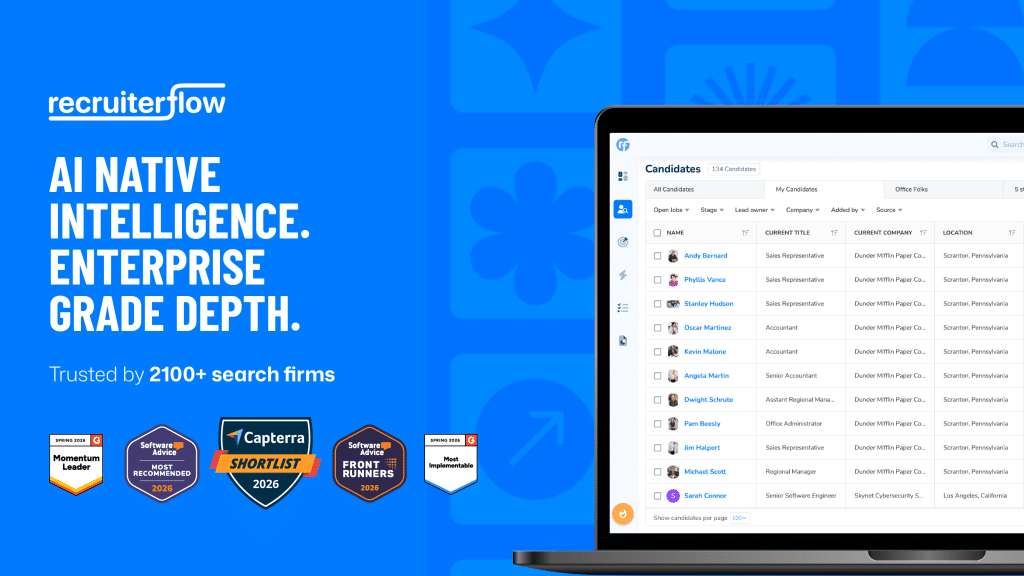
SOC 2, ISO 27001, and GDPR compliance were built in alongside it from the start, not added once a deal demanded it.
FAQs
Is there AI recruiting software built specifically for enterprises, or is it adapted from smaller tools?
Both exist. The label alone won’t tell you which one you’re looking at. Ask whether the AI and the compliance work were designed together, or added at different points in the product’s history.
How do AI recruiting platforms compare on enterprise readiness?
Check the specific list: SOC 2 Type II, ISO 27001, GDPR, migration transparency, and whether the AI reads the full record or only new sourcing. Marketing copy rarely spells this out.
Does this apply to staffing and contingent firms, or only retained and executive search?
The stakes scale with data volume and client sensitivity. The underlying test doesn’t change by search type: does the AI see the whole database, is the platform genuinely certified.
How much does enterprise-grade AI recruiting software cost?
Pricing tracks features and scale more than architecture. The hidden cost is structural. A bolt-on setup usually means a point solution plus the integration connecting it. A genuinely AI-native, enterprise-grade platform folds both into one system.
What’s the ROI of AI recruiting software for an enterprise-size firm?
It depends on whether the AI touches the existing database or only new candidates. Since most placements come from people already in the CRM, an AI blind to that data delivers a fraction of the possible return.
What’s the difference between SOC 2 and ISO 27001 for a recruiting platform?
SOC 2 is a US-centric attestation, audited over months against specific trust criteria. ISO 27001 is an international certification covering a broader security management system. Enterprise buyers increasingly expect both.
How long does migrating from a legacy ATS actually take?
Depends what “migrate” includes. Moving names and job titles can take weeks. Moving years of notes, activity logs, and relationship history intact takes longer, and it’s the part vendors tend to gloss over. Ask for specifics before signing.
Recruitment
Ayusmita is a B2B storyteller who spends her time translating recruiting workflows into clear stories at Recruiterflow.


Ayusmita