

7+ Best ATS With AI Agents in 2027: What Actually Ships
Two different products are being sold under the same phrase, and the difference decides what you spend for the next three years.
The first is an applicant tracking system that lets someone else’s agents reach your data: a good API, documented endpoints, maybe an MCP server. The second ships agents that already do the work inside the workflow your team runs today. Both are legitimate. Only one of them arrives working on day one.
This post covers the best ATS with AI agents in 2027: how we judged them, a comparison of eight platforms with published pricing and ratings, and the five questions that separate a shipped agent from a roadmap.
How we judged agent capability
Four criteria, in the order they matter to a recruitment firm.
Named agents, not “AI features”. A vendor that can list its agents by name and say what each one does has built something specific. A page that says “powered by AI” has not.
Agents that run without being asked. The strongest signal in any evaluation is a capability nobody has to remember to use. If every agent needs a recruiter to open a panel and press something, adoption decays within weeks.
What the agents cost. Included in the plan, metered by credits, or sold as a separate tier. This changes the economics more than the headline per-seat price.
A documented API and export policy. Connectivity is table stakes, and it is what lets you build your own agents later if you want to.
Prices below are as published by each vendor at the time of writing and change often. Ratings are from G2. Verify both before you sign anything.
Best ATS with AI agents: comparison
| Platform | Best for | Named AI agents | Pricing | G2 |
| Recruiterflow | Recruitment and search firms wanting agents included rather than metered | Notetaker, Matchmaker, Job Change Alerts, Submission, Task, Field Updates | Platform $149/user/mo; AIRA plan custom | 4.6 (206) |
| Bullhorn | Larger firms already standardised on Bullhorn | Amplify Digital Workers, Search & Match, Amplify Chat | Starter $99, Core $165/user/mo; enterprise by quote | 4.2 (1,231) |
| Loxo | Firms that want the widest named agent roster | Job Intake, Longlist, Shortlist, Outreach, Contact Info, Notetaker, Self-Updating CRM, Data Hygiene | Core $149, Professional $199/user/mo billed annually | 4.6 (182) |
| Crelate | Firms wanting AI on every tier rather than an upsell | Discovery Agent, Insights Agent, Co-Pilot | Essentials $85, Business $119/user/mo | 4.4 (221) |
| Access Vincere Evo | UK and APAC firms wanting agentic support across modules | Meeting Assistant, agents and autopilots | Core £95/user/mo; Pro from £85/user/mo | 4.5 (403) |
| Recruit CRM | Smaller firms wanting submission and formatting agents | Custom Field Parsing, Candidate Submission, CV Formatting, Candidate Pitching | Not published | 4.8 (128) |
| JobAdder | Firms wanting AI assistance without agent complexity | Adder Intelligence, Roi-AI automations | Not published, tailored proposal | 4.4 (146) |
| Manatal | High-volume hiring on a tight budget | AI Interviewer, AI Copilot | Professional $15, Enterprise $35, Enterprise Plus $55/user/mo annually | 4.8 (147) |
1. Recruiterflow
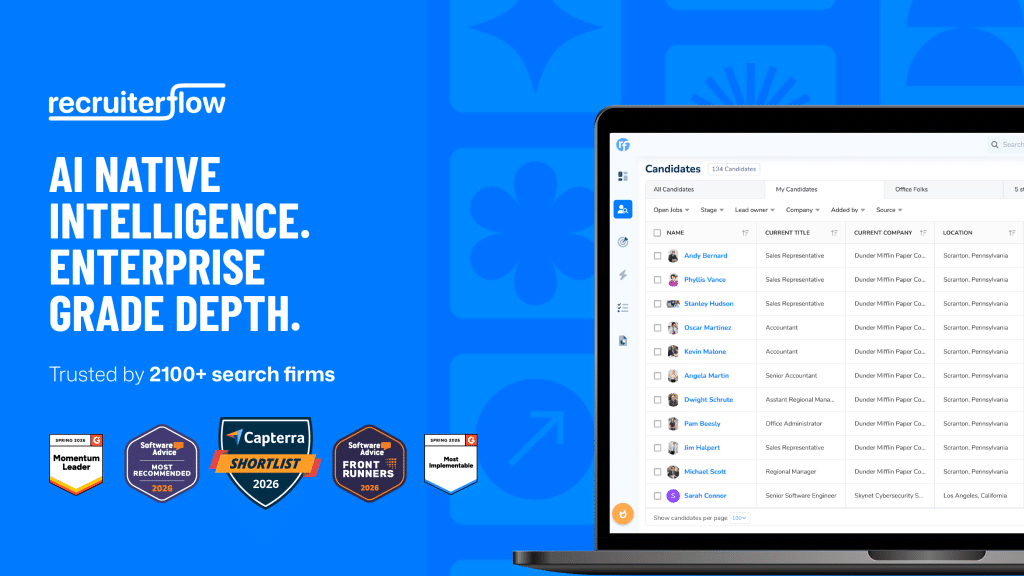
Recruiterflow is built for retained, contingent and executive search firms, with AIRA as the intelligence layer running through the workflow rather than a module beside it.
The agents worth knowing:
- AIRA Notetaker: records calls, structures them and updates the record, so the note is written by the act of having the conversation.
- AIRA Matchmaker: matches candidates to a role by meaning rather than keyword, against your existing database.
- AIRA Job Change Alerts: watches your database for contacts changing jobs or moving into decision-maker roles, which matters because around 71% of placements come from candidates already in the database before the job opened (Source: The Economics of Recruiting).
- AIRA Submission Agent: drafts a contextual submission in seconds rather than minutes.
- AIRA Task Agent and Field Updates Agent: extract actions from conversations and keep records current without anyone typing.
The commercial difference is how they are sold. The AIRA plan includes all current and future AIRA agents at no extra cost rather than metering them, which matters when usage grows. Connectivity is covered too: Randall Reilly’s technical team used the open API to build their own dashboards with goals tracking and real-time visibility updated twice daily (Source: Randall Reilly case study).
Pricing: Platform plan $149 per user per month. AIRA plan is custom.
2. Bullhorn: the incumbent with the largest install base
Bullhorn is the most widely deployed system in the category and its review volume reflects that, with over 1,200 G2 reviews against a 4.2 rating. If your back office, VMS and integrations are already built around it, that gravity is real and worth weighing.
Its AI sits under the Amplify banner: Digital Workers described as AI team members handling recruiting admin, Search & Match, and Amplify Chat built on a model trained for the recruitment industry.
Pricing: Starter at $99 and Core at $165 per user per month, with mid-market and enterprise pricing by quote. Amplify capability sits above the entry tiers, so the headline price is rarely the price. We covered what Bullhorn Amplify actually costs separately.
3. Loxo: the widest named agent roster
Credit where it is due, because this is the most extensive published agent list of any platform here. Loxo names a Job Intake Agent, a Skill DNA and JD writing agent, a Longlist Agent that screens up to 10,000 candidates, a Shortlist Agent ranking on seven dimensions, Outreach and Pursuit, Contact Information, an AI Notetaker, a Self-Updating CRM Agent and a Data Hygiene Agent. It also publishes an MCP server, which puts it ahead of most of this list on connecting external agents.
The thing to check is the metering. The agentic workforce sits on the Professional tier and above and runs on monthly credits, 2,500 included per user with paid boosts to 5,000 or 12,500. Model the credits against your actual volume before comparing per-seat prices.
Pricing: Core $149 and Professional $199 per user per month billed annually. Enterprise is a custom annual agreement.
4. Crelate: AI on every tier
Crelate makes a point of AI being native on every plan rather than an upsell, which is a different commercial stance from most of this list.
Named agents include a Discovery Agent for finding talent beyond your existing database, an Insights Agent for continuous database maintenance and recommendations, and a Co-Pilot inside records. The caveat is in their own wording: agents working your database continuously are available through Platform pricing, so the always-on behaviour is not on the entry tiers.
Pricing: Essentials $85 and Business $119 per user per month. Business Plus and Platform are custom.
5. Access Vincere Evo: agentic layer across modules
Now part of the Access group, Vincere Evo positions an AI layer running across every module rather than a discrete agent list, with a Meeting Assistant doing live transcription, CRM sync and follow-up drafts.
The trade-off is specificity. The pricing page describes agents and autopilots handling routine admin but does not name them individually, so an evaluation needs to pin down exactly what runs and when.
Pricing: Startup £150 a month for a single user, Core £95 per user per month for two to seven users, Pro from £85 per user per month above that, on 30-day rolling contracts.
6. Recruit CRM: submission and formatting agents
Recruit CRM holds the joint-highest rating on this list at 4.8, and its agents are aimed squarely at the parts of the job that eat afternoons: a Custom Field Parsing Agent, a Candidate Submission Agent, a CV Formatting Agent and a Candidate Pitching Agent.
That is a sensible selection for a smaller firm, because those are high-frequency, low-judgement tasks. Pricing is the friction point. The tiers are named but no figures are published, so a comparison requires a sales conversation.
Pricing: Not published. Monthly or annual billing, with a discount for annual.
7. JobAdder: assistance rather than agents
JobAdder is honest about what it is. Adder Intelligence covers Smart Summaries, Smart Sync, Smart Job Descriptions and Smart Floats, with Roi-AI powering advanced automations on the Pro tier.
This is assistance rather than an agent workforce, and for some firms that is the right purchase. If you want AI that speeds up work a recruiter is already doing rather than agents running unprompted, the smaller surface is a feature.
Pricing: Not published. Plans run Lite, Essential, Pro and Business, with a tailored proposal on request.
8. Manatal: the budget option with an AI interviewer
Manatal is the cheapest platform here by a wide margin and rates 4.8 on G2. Its headline agent is an AI Interviewer conducting video interviews around the clock and evaluating candidates, which is built for volume rather than search.
Worth knowing that LLM integrations sit on the top tier only. For firms doing high-volume hiring where speed matters more than depth of candidate relationship, the economics are hard to argue with.
Pricing: Professional $15, Enterprise $35 and Enterprise Plus $55 per user per month billed annually.
Five questions before you sign
Which agents run without a human starting them? Any vendor can name capabilities. Ask which execute unprompted, and watch how the list shortens.
Are agents included, metered or a separate tier? Credits are not a problem in themselves, but they are a variable cost that grows with adoption. Model them against your actual volume.
What happens when an agent is wrong? Every agent is wrong sometimes. The question is whether there is a visible correction path or whether cleanup quietly becomes your team’s job.
Can we trial on our own records? Including the incomplete ones. Curated demo data proves almost nothing about behaviour on a database that has been accumulating since 2019.
Which customers use the agents daily, and can we speak to two? Daily is the operative word. A reference with the feature enabled is not the same as one whose team opens it every morning.
None of these require technical knowledge. They require refusing to evaluate on the version built for evaluation, which is the core discipline in avoiding AI washing.
Run the checks on your own database
Bring your records, including the ones nobody has touched in three years, and a live search you are working now.
Book a demo and put the agents against your data rather than ours. The full AIRA agent roster is worth reading first so you know what to test.

FAQs
What is an ATS with AI agents?
An applicant tracking system where AI agents complete recruiting tasks inside the platform, such as capturing call notes, updating records, matching candidates or monitoring the database for job changes. It differs from an ATS that only exposes an API for external agents to connect to.
Which ATS has the most AI agents?
By published agent count, Loxo names the longest list, including intake, longlist, shortlist, outreach, notetaking and data hygiene agents. Agent count is not the same as value, since those agents run on metered credits above a monthly allowance.
Does an ATS need an MCP server to work with AI agents?
Not necessarily. An MCP server makes it easier to connect external agents, which matters if your firm intends to build its own. It says nothing about whether the platform ships agents that already do the work.
How much does an ATS with AI agents cost?
Published prices in this comparison run from $15 to $199 per user per month, with several vendors quoting on request. The bigger variable is whether agents are included in the plan, metered by credits or sold as a higher tier.
Are AI agents in an ATS worth paying extra for?
It depends on whether they remove steps or add them. An agent that completes a task inside an existing workflow saves time immediately; one producing output you must check, correct and paste elsewhere has changed the shape of the work rather than removing it.
Recruitment
Ayusmita is a B2B storyteller who spends her time translating recruiting workflows into clear stories at Recruiterflow.


Ayusmita