
What Bullhorn Amplify Actually Costs (And Why the Answer Isn’t on Their Pricing Page)
Your Bullhorn rep demos an AI that reads a call, updates the record and drafts the submission. It looks good. Then you ask what it costs, and the conversation changes shape.
That is not evasiveness. It is how Bullhorn has packaged the product. Amplify is not sold as a bolt-on you add to your current plan, so there is no add-on line item to quote you.
This post covers Bullhorn Amplify: what it includes, which tiers carry it, what is published about the price and what is not, and the questions worth putting in writing before you upgrade.
What Bullhorn Amplify Actually Is
Amplify is Bullhorn’s AI layer for recruitment. According to Bullhorn’s own product page, it is built to “orchestrate AI across your entire recruitment lifecycle, enabling your team to scale impact and revenue without adding headcount.”
Two things matter in that sentence for anyone evaluating it. Amplify is positioned as a layer across the workflow rather than a single feature, and the promised outcome is capacity, not cost reduction. That framing tells you which problem Bullhorn expects you to be solving when you buy it.
It is a serious piece of product, and any honest comparison should start there rather than with its gaps.
What Sits Inside Amplify
Bullhorn splits it into two parts.
Digital Workers
These are the agents that do the work. Bullhorn lists functions covering enrich, match, screen, outreach, present, prospect, transcribe, verify, audit and extract. That is a wide surface, and it maps onto the tasks that actually consume recruiter hours rather than the ones that demo well.
Amplify Chat
A purpose-built large language model that runs inside Bullhorn’s own secure environments rather than sending your data to a general-purpose assistant. For firms with client data protection obligations, where the model runs is often the first question procurement asks, so this is a meaningful design choice rather than a marketing line.
Neither of these is a small undertaking. The question is not whether Amplify is real. It is which tier of your contract contains it.
Which Bullhorn Tiers Carry Amplify
This is where the answer gets specific, and Bullhorn publishes enough to work it out.
Their small-firm pricing page lists four packages.
Starter and Core
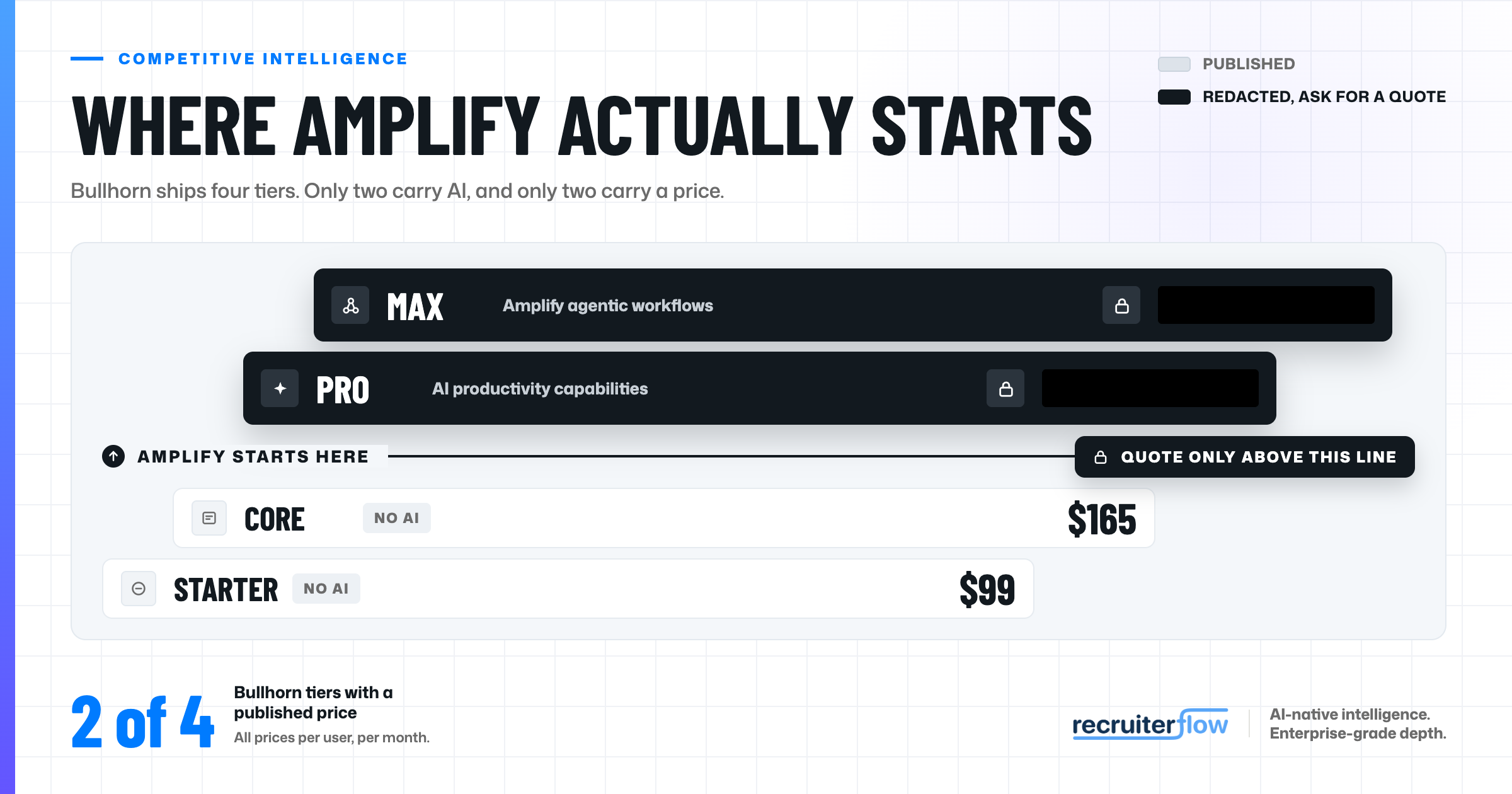
Starter is $99 per user per month. Core is $165 per user per month. Both prices are published. Neither package includes Amplify.
Pro
Pro is described on that page as “Everything in Bullhorn Core, plus Amplify’s AI productivity capabilities,” listing AI search and match, Amplify Chat, AI data enrichment, AI resume formatting and AI call transcription. This is the first tier where Amplify appears.
Max
Max adds what Bullhorn calls Amplify agentic workflows: agentic screening, agentic AI matching and multi-step AI outreach. The Digital Workers that carry the heaviest promise sit here.
So the entry point for Amplify is Pro, and the full agentic capability is a tier above that.
What Amplify Costs, and What You Cannot Find Out
Here is the part worth sitting with.
Bullhorn publishes the price of Starter and Core, the two packages without AI. It does not publish the price of Pro or Max, the two packages with it. Both are quote only.
That means the cost of the AI is precisely the number you cannot look up before a sales conversation. You can benchmark Bullhorn against the market on a $99 or a $165 seat. You cannot benchmark the thing you are actually evaluating.
How This Compares Across the Market
The packaging varies more than most buyers expect. Some platforms bundle AI into every tier and charge separately for advanced add-ons; others gate AI behind a mid-tier plan and sell specialized agents a la carte.
Recruiterflow splits by plan rather than by feature, and publishes both numbers. The Platform plan is $119 per user per month billed annually, or $149 monthly. The AIRA plan runs from $150 to $300 per user per month depending on scope, and every AIRA agent is included in it, current and future, with nothing metered per feature on top.
None of these models is inherently wrong. Tiering AI is a legitimate commercial decision, and Bullhorn is far from alone in making it. The difference that affects you is whether the tier you need has a number attached to it before you get on a call.
Questions to Ask Before You Upgrade
If Pro or Max is on the table, get these answered in writing rather than on a call.
- Which specific Amplify capabilities are in the tier I am being quoted. The gap between Pro and Max is the gap between AI that assists and agents that execute. Establish which side of that line your quote sits on, by name, not by category.
- What happens to the price when new agents ship. Amplify is an active product line. Ask whether future Digital Workers arrive inside your tier or trigger another upgrade, and get the answer in the contract rather than the proposal.
- What is the uplift from my current seat, per seat, over three years. A per-seat delta sounds small and compounds fast across a desk. Convert it to a three-year total before you compare it to anything.
- What happens at renewal. Introductory pricing on a new tier is common. A cap on renewal increases is the clause that decides what this actually costs you, and it is far easier to negotiate before you sign than after.
Firms that skip these questions tend to be the same ones that later find they have outgrown Bullhorn without moving, because the cost of re-evaluating always feels higher than the cost of staying.
FAQs
How much does Bullhorn Amplify cost?
Bullhorn does not publish a price for it. Amplify appears at the Pro and Max tiers, and both are quote only, while the two published tiers, Starter at $99 and Core at $165 per user per month, do not include it.
Is Amplify included in my current Bullhorn plan?
Only if you are on Pro or Max. Starter and Core do not carry it, so if your AI capability arrived without a contract change, confirm which tier you are actually on.
What are the alternatives to Bullhorn Amplify?
Most competing platforms now ship AI, but the packaging differs sharply. Some include it from their entry tiers, some price it as a separate published plan, and some publish no prices at all.
Daxtra versus Bullhorn Amplify, what is the difference?
Daxtra is specialist parsing and search technology that many firms run alongside an ATS, including inside Bullhorn. Amplify is a broader workflow layer, so the two are not straight substitutes and are often evaluated for different jobs.
Is Bullhorn Amplify worth it?
That depends entirely on the quote, which is the problem. Work out your three-year cost per producing recruiter for the tier you are offered, then compare it to what the same capability costs elsewhere as a published number.
What are Bullhorn Amplify’s limitations?
There is very little independent review coverage of Amplify specifically, as distinct from Bullhorn overall, so treat confident public verdicts with caution. The practical limitation for most buyers is commercial rather than technical: you cannot compare a price you cannot see.
The Tier Is the Real Decision
Amplify is a capable product, and the question facing most firms is not whether it works. It is whether the tier carrying it is priced in a way you can evaluate against anything else.
Before you upgrade, it is worth settling what AI-native actually means and running the same structured comparison you would apply to a replacement, not just an upsell. Our guide to evaluating an AI-native platform sets out that process.
Recruiterflow publishes both numbers, the platform rate and the AIRA range, so you can do the comparison before anyone books a call. See where your firm lands at.
Recruitment
Ayusmita is a B2B storyteller who spends her time translating recruiting workflows into clear stories at Recruiterflow.


Ayusmita