

One Question That Exposes Whether Your Software Is Actually AI-Native.

Here’s a test you can run on your current system in the next sixty seconds.
You have a hundred sales reps in your database. Find the one who billed over a million dollars last year.
It returns everyone with “sales” and “$1M” in a field, but misses the candidate whose CV says “130% of an $800K quota,” because it can’t do the math a recruiter does on instinct.
And it will never find the one who said the number out loud on a call.
If your software fails that test, it isn’t AI-native. It’s Boolean in a nicer outfit.
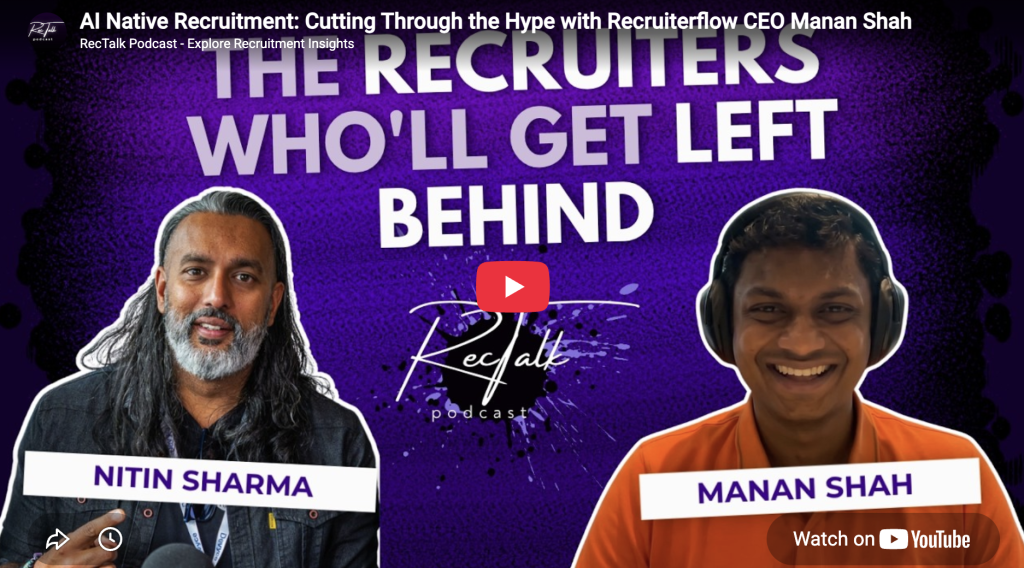
That test is how Manan Shah, founder and CEO of Recruiterflow, took apart the whole “AI-native” category on RecTalk with Nitin Sharma.
Most “natural language search” is Boolean hiding behind a chatbox
Manan named an uncomfortable truth on the show. A lot of what’s sold as natural language search does exactly one thing: it converts your sentence into a Boolean string behind the scenes, then hands you a list.
“Calling that natural language search is misleading at best. It’s old wine in a new bottle.”
It’s a useful convenience. It saves a junior recruiter the trouble of learning operators. But nothing fundamental has changed.
The system still only knows the tokens you typed. It can’t tell you why anyone on the list fits, because it never understood the question.
The gap isn’t a feature. It’s the architecture.
This is where it stops being a search problem and becomes a business one.
A system that genuinely understands the million-dollar brief has to reason across everything your firm knows about a person. Not just the CV, but the notes, the call transcripts, the context your team has been quietly banking for years.
It has to know that a million-pound biller selling high-volume, low-value widgets is a rarer find than one selling Boeing jets. It has to find the signal where it actually lives, then tell you why it surfaced who it surfaced.
You can’t bolt that onto a database built to store rows. Which is why Manan’s sharpest reframe wasn’t about software at all:
“It’s not that our software is AI-native. We help you become AI-native.”
The leading executive search firms already understand this. Some are pitching “AI-native” to boards as the reason to pick them over five other shops.
And it’s starting to show up in the numbers:
Roughly 71% of placements come from candidates already in your CRM before the role even opened.
Source: The Economics of Recruiting, Recruiterflow data from 2,100+ firms
Those are people Boolean will never surface, because you don’t know the string. The firms that can actually search that database are the ones pulling away.
Boolean finds rows. AIRA Search finds people.

3 Things You Shouldn’t Miss From The Episode
- The live version of the million-dollar test. Reading “it does the math” is one thing. Hearing Manan reason through the $800K quota, the $900K near-miss, and the widgets-versus-Boeing-jets nuance in real time is where it clicks.
- The vibe-coding reality check. Nathan asks the question every ops director is quietly asking: couldn’t we just build our own CRM now? Manan’s answer isn’t the defensive one you’d expect from a software CEO. What he says about where AI actually creates advantage is the most useful ninety seconds in the episode.
- Where he thinks the consolidation goes. The M&A predictions. Who gets acquired, why private equity money is circling recruiting right now, and what it means for the tools you depend on. That’s the part we deliberately left out.
If you run a search or recruitment firm and you’re making stack decisions this year, this is forty-five minutes that will change what questions you ask your next vendor.

Ayusmita is a B2B storyteller who spends her time translating recruiting workflows into clear stories at Recruiterflow.


Ayusmita