
Talent Rediscovery: The Sourcing Channel Hiding in Your Own CRM
Most firms treat sourcing as a hunt for new candidates: fresh job boards, fresh LinkedIn searches, fresh outreach lists. But the highest-converting source of candidates is already sitting in your database, untouched since the last role closed. This is talent rediscovery: resurfacing past applicants and silver-medalist candidates already in your CRM, instead of sourcing from scratch every time. For recruiting and executive search firms, it’s the cheapest, fastest sourcing channel available, and the one most consistently ignored.
In this blog, we’ll discuss what talent rediscovery is, why it consistently outperforms new sourcing, and how to build a repeatable process for mining your CRM before you ever open a new job board.
What Is Talent Rediscovery?
Talent rediscovery is the practice of surfacing and re-engaging candidates already in your database to fill current roles, instead of sourcing net-new every time.
Those candidates fall into a few familiar buckets:
- Past applicants who weren’t right for the role they applied to
- Previous submittals a client passed on
- Silver-medalist finalists who lost out to one other person
- Sourced-but-never-placed profiles you spoke to once and moved on from
For an in-house team, that database is a pool of past applicants to one company. For a recruiting or search firm, it’s something far richer: every candidate you’ve ever spoken to, screened, submitted, or placed, across dozens of clients and hundreds of roles.
Each of those people has a history, a skill set, and a career that keeps moving whether or not you’re paying attention. Talent rediscovery is the discipline of putting that history back to work.
Why Your Own CRM Is Your Cheapest Sourcing Channel
One benchmark reframes the entire sourcing question.
71% of placements come from candidates already in the CRM before the job even opened.
— The Economics of Recruiting, Recruiterflow’s benchmark across 2,100+ firms
Roughly seven in ten placements were people you already had. The only variable was whether you found them at the right moment.
The economics are lopsided
A net-new candidate costs money and time at every step: job board spend, LinkedIn licenses, sourcing hours, cold outreach, and the long odds of a stranger replying. A rediscovered candidate skips almost all of it. They’re already in your system, often already screened, sometimes already interviewed by a client.
Here’s how the two channels actually compare:
| Net-new sourcing | Talent rediscovery | |
| Cost to surface | Job boards, licenses, sourcing hours | Close to zero |
| Speed | Runs on someone else’s timeline | Available the moment you look |
| Vetting | Starts from scratch | Often already screened or submitted |
| Relationship | Cold | Already exists |
| Gets better over time? | No | Yes, with every role you work |
Speed is the second advantage
New sourcing runs on someone else’s clock: whether a stranger opens your email, whether a job board delivers. Rediscovery runs on yours. The candidate is there the instant you search.
For a firm competing to land a strong shortlist first, that head start is often the whole game. And the channel compounds: every role you work and every conversation you log makes the next rediscovery search richer. Most firms build that asset for years, then never mine it.
How AI Talent Rediscovery Works
Rediscovery stayed a good idea rather than a daily habit because the old tools made it painful. Keyword and Boolean search only find what you already know to look for. They match strings, not meaning, and they can’t tell you whether a two-year-old profile is still accurate.
AI talent rediscovery removes all three limits.
Matching by meaning, not keywords
Modern AI matching reads the role and the candidate’s full history and returns a ranked shortlist by actual fit. A search like “led a sales team past 20 people in mid-market SaaS with direct P&L ownership” returns the people who genuinely did that. It doesn’t return everyone whose profile happens to contain “SaaS” and “sales.” Nuance that a filter would flatten into a checkbox stays intact.
Freshness signals
A database decays the moment you build it. People change jobs, get promoted, relocate. Because rediscovery is only as good as the currency of the data, the best systems watch for change. When a candidate switches roles or steps into a decision-making seat, that stale record becomes a live, timely opportunity.
Enrichment
Profiles have gaps: a missing title, an outdated skill, a role the candidate never mentioned. Enrichment fills those gaps automatically from external signals, so the match works off a complete picture instead of whatever was true the last time someone updated the record by hand.
Together, these turn a static archive into a living, self-updating sourcing channel.
How to Build a Talent Rediscovery Workflow
Rediscovery pays off as a repeatable habit rather than a one-off database cleanup. Here’s a workflow any firm can run:
- Start every intake with a database search. Before spending a dollar on external sourcing, run the new role against your existing database. This becomes the reflexive first step, ahead of the job boards.
- Match by fit, then review the reasoning. Use AI matching to surface a ranked shortlist, and always check why each candidate matched before acting. The reasoning separates a real fit from a keyword coincidence.
- Check freshness before outreach. Confirm the candidate’s current situation. A job-change signal is both a data update and a reason to reach out: “Saw you moved into X, I’m working something that fits.”
- Re-engage with context. The whole advantage of a rediscovered candidate is the existing relationship. Reference the last conversation or the role they nearly landed. A generic template throws that advantage away.
- Log everything, then repeat. Every touch, note, and outcome sharpens the next search. The workflow only pays compounding returns if the data keeps flowing back in.
Talent Rediscovery Software: What to Look For
The category ranges from basic ATS resume search to AI-native rediscovery. Four capabilities separate a real rediscovery engine from a glorified lookup tool.
1. Semantic matching
If a tool only does Boolean, it can only do lookup, not rediscovery at scale. What you want is matching that reasons across a candidate’s full history instead of checking for keyword presence.
2. Freshness and job-change monitoring
A tool that surfaces candidates but can’t tell you who’s gone stale is only half a solution. Look for automatic change detection on the profiles you already own.
3. Native to your ATS and CRM
Rediscovery depends on complete context: notes, call logs, submittal history, client feedback. A bolt-on that only reads structured fields works with a fraction of the picture. A tool built into the system that captured all that context sees everything.
4. A one-click path to action
Surfacing the shortlist is only step one. The tool should move candidates straight into a pipeline or an outreach sequence without re-keying anything.
Where AIRA fits
AIRA, Recruiterflow’s AI-native layer, is built around exactly this job.
AIRA Matchmaker reads a role and scans your existing database, trained on half a billion data points, then returns a ranked shortlist with the reasoning behind each match, all from natural-language criteria rather than Boolean strings.

Job Change Alerts keep those profiles fresh, flagging the moment a candidate changes roles so a dormant record turns into a timely opening.
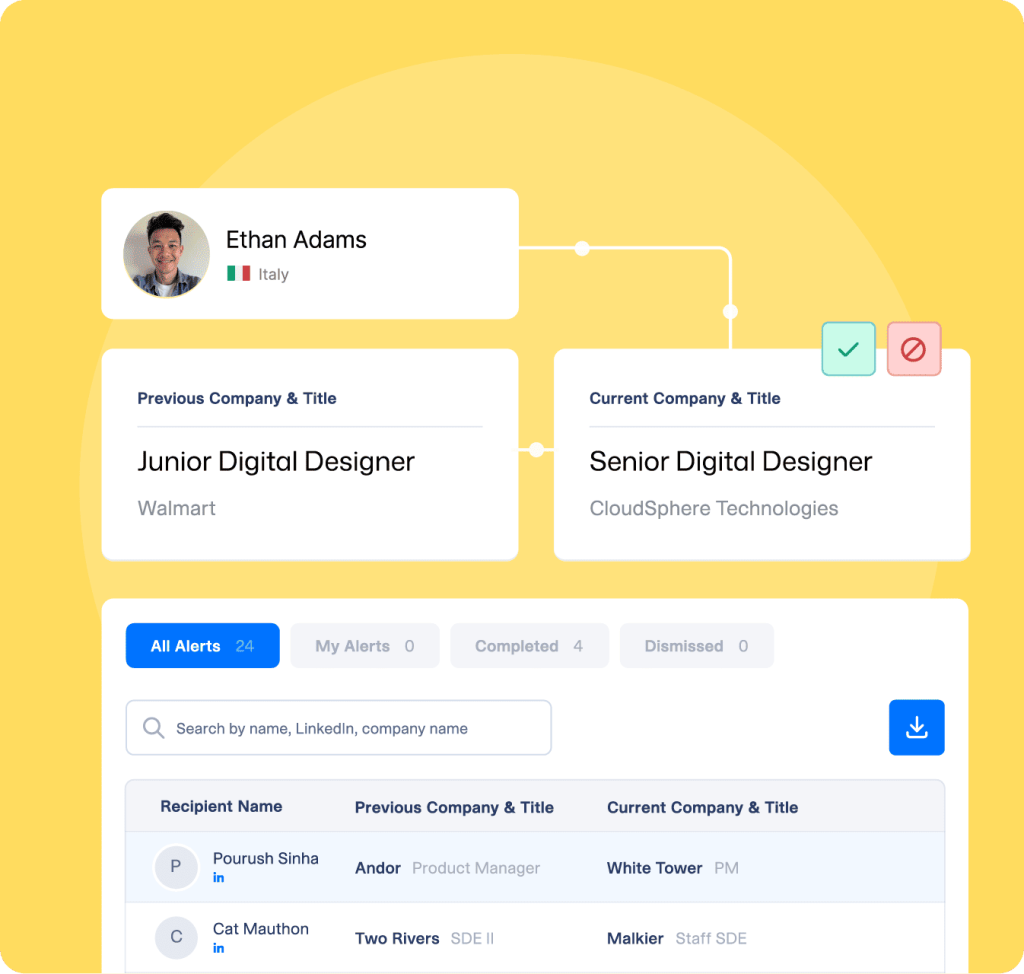
Because AIRA lives inside the same ATS and CRM that captured every note and conversation, it matches on the full history, not a handful of structured fields. Firms using Job Change Alerts cut time to first submittal by 34% and see 12% higher placements on average.

Frequently Asked Questions
Talent rediscovery vs. talent redeployment: what’s the difference?
Rediscovery surfaces past candidates in your database to fill external roles you’re recruiting for. Redeployment moves an existing employee into a different role inside the same organization, which is an internal-mobility practice. For recruiting and search firms, rediscovery is the one that matters: your candidate database is the asset, and rediscovery is how you monetize it.
What data does your ATS need for talent rediscovery to work?
The richer the record, the better the match. Resumes and contact history are the minimum, but the real advantage comes from notes, call logs, emails, submittal history, and client feedback, because AI matching reasons across all of it. Native, well-logged systems win here: they’ve captured the context that makes a match accurate.
Is talent rediscovery cheaper than sourcing new candidates?
Substantially. A rediscovered candidate carries no job board or license cost, needs little or no re-screening, and often arrives with a client relationship already in place. When the majority of placements already come from the existing database, that database is the highest-ROI channel most firms underuse.
Does talent rediscovery work for executive search?
Arguably better than anywhere else. A search firm’s relationship database, built over years of confidential conversations with senior people, is its single most valuable asset. The one difference: re-engagement stays high-touch. AI surfaces the right person at the right moment, but the outreach itself is a considered, relationship-led conversation rather than an automated sequence.
Is talent rediscovery GDPR compliant?
It can be, and this is general guidance rather than legal advice. Re-engaging past candidates requires a lawful basis, usually consent or legitimate interest. It also means honoring data-retention limits and any request to be forgotten. Keep records of consent, purge data you no longer have a basis to hold, and confirm your specific obligations with counsel or your data-protection lead.
How often should recruiters re-engage past candidates?
Let the trigger set the cadence, not the calendar. Re-engage when a relevant role opens and when a freshness signal fires, such as a job change or promotion. Between those moments, a light nurture touch every few months keeps the relationship warm without fatiguing the candidate.
Recruitment
Ayusmita is a B2B storyteller who spends her time translating recruiting workflows into clear stories at Recruiterflow.


Ayusmita