
The Evergreen Recruitment Automation Guide for Recruiting Firms in 2026
The firms closing $15M this year are winning on conversion, and they waste less time on admin, which a platform should be handling.
That’s the whole game. Recruiting is a conversion-driven business, not a volume one. And the biggest drain on conversion isn’t effort — it’s the hours lost to data entry, follow-ups, and CRM updates instead of conversations.
Recruitment automation is how the top quartile took that work off the desk.
This guide on recruitment automation covers what it is, the three types that matter, what you should never automate, the results one firm saw, and the top AI recruitment automation software to evaluate in 2026.
How Does Automation Work In Recruitment?
Recruitment automation uses technology — workflow rules, sequencing, and increasingly AI — to handle the repetitive, predictable work in hiring. The point is to free recruiters for what moves revenue: conversations, judgment, and relationships.
Three things get lumped under one word. They’re not the same:
- Rule-based automation — simple if-this-then-that logic. Candidate applies, acknowledgment sends. Useful, but it doesn’t think.
- AI — understands and predicts. Reads a CV, matches by meaning, summarises a call. But it waits to be asked.
- AI agents — understand context and act on it autonomously. The layer that compounds, because it removes work instead of just speeding it up.
The distinction matters. The recruiting workflow has too many steps for rule-based triggers alone, and too much nuance to leave generic AI unsupervised.
The firms seeing real returns treat automation as an intelligence layer running through every stage — not a feature bolted onto an ATS.
The Three Types of Recruitment Automation
One word, three different things. Knowing which is which tells you what to evaluate.
1. Recruitment process automation
The end-to-end engine. The full intake-to-placement lifecycle running as one connected flow instead of disconnected manual steps.
It moves a job from open requisition to longlist to client-ready submission without a recruiter stitching the stages by hand. The payoff: speed and consistency across the whole funnel.
2. Recruitment workflow automation
The rules underneath the engine — stage-by-stage triggers, handoffs, and reminders that fire automatically.
In Recruiterflow, these are Recipes:
- Follow up when a candidate goes quiet
- Notify the account manager on a submittal
- Create an onboarding task when a placement closes
- Flag a candidate interviewing with no recent activity
3. Recruitment marketing automation
Keeping candidates and clients warm over time: nurture sequences, re-engagement of dormant talent, employer-brand drip. Recruiterflow’s Multi Channel Sequences run these across email, SMS, and social.For the email channel specifically, sustained sequences only work if the messages reach the inbox — which is where sender reputation comes in as the underlying signal mailbox providers use to decide whether your nurture cadence lands in primary inboxes or quietly drifts to spam over time
Since most placements come from people already in your database, this is the type firms under-invest in — and pay for later.
What You Should Never Automate
Automation earns its keep by removing transactional work — not by replacing the parts of recruiting clients pay for. The line is judgment.
Keep these human:
- The close
- The qualification call where you read what a candidate isn’t saying
- The difficult client conversation and the counteroffer
- Consultative pushback on a hiring manager’s brief
AI cannot do these, and clients won’t respect a machine for trying.
Greg Savage puts it well: automation should absorb the mundane so recruiters can “revert to being true consultants, advisors, and advocates” — from “Do you have real ‘client relationships’?” (The Savage Truth, June 2025).
That’s the test. If a task builds trust or needs judgment, it stays with the human.
If it’s data entry, scheduling, or a reminder, hand it over.
Recruitment Automation in Practice: How Andiamo Scaled Revenue 4×
Andiamo is a boutique tech search firm out of New York. For 22 years it has placed the top 0.2% of technical talent at companies like Palantir, Amazon, and Duolingo.
President Daniel McAdams had run his desk on Bullhorn and JobDiva — one too complex, the other too shallow — with AI features that promised more than they delivered.
What changed the math was automating the admin without touching the craft:
- AIRA Notetaker joined every call, then wrote the summary and updated CRM fields automatically — ending the data-entry standoff between management and recruiters
- AIRA agents combined job descriptions with candidate history to draft client-ready fit narratives, so consultants submitted at twice the speed
- Recipes kept candidates informed across the funnel, so no one got ghosted
- Recruiterflow BI + BigQuery gave Daniel daily visibility into productivity and pipeline health
The results, year on year: 76% reduction in time-to-fill, doubled client submissions, and 4× revenue — documented in Andiamo’s case study.
Recruitment Automation Software at a Glance
| Tool | Best for | Pricing | G2 | Standout | Watch-out |
| Recruiterflow | Search & staffing firms wanting AI + depth | From $119/user/mo | 4.8 | Largest AIRA agent suite, AI-native | Built for firms, not in-house TA |
| Bullhorn | Large, complex staffing operations | Custom (opaque) | 4.0 | Deepest end-to-end lifecycle | Dated UI, steep curve, gated automation |
| Loxo | Solo/small firms chasing sourcing volume | Free–$209/user/mo | 4.6 | 1.2B-profile sourcing, free tier | Sourcing relevance, deliverability gaps |
| Gem | Corporate in-house TA teams | Custom (free trial) | 4.7 | Recruitment marketing + analytics | Built for internal TA, not firms |
| SourceWhale | Firms needing BD outreach at scale | Custom (no free trial) | —* | Best-in-class outreach personalisation | Outreach layer, not a full system |
| Sense | High-volume staffing (healthcare, logistics) | From ~$500/mo | 4.5 | Two-way SMS + chatbot engagement | Rides on top of an ATS; sync lag |
*SourceWhale has 260+ G2 reviews but does not consistently publish a star rating.
How We Chose These Tools
Every platform below was assessed against the criteria that decide whether automation actually pays off for a recruiting firm:
- Built for firms, not corporate HR — job orders, submissions, and client management, not internal-TA workflows
- Execution, not just suggestions — does the AI do the work, or hand it back to you?
- Native vs bolted-on — is automation built into the system of record, or stapled on through integrations?
- Independent review patterns — recurring strengths and gaps from verified G2 and Capterra reviews, not vendor marketing
- Honest fit — every tool has a job it’s best at; the goal is matching it to yours
Each card below leads with pricing, G2 rating, and who it’s best for — then the one strength and the one watch-out that matter most.
Top AI Recruitment Automation Software in 2026
#1 Recruiterflow
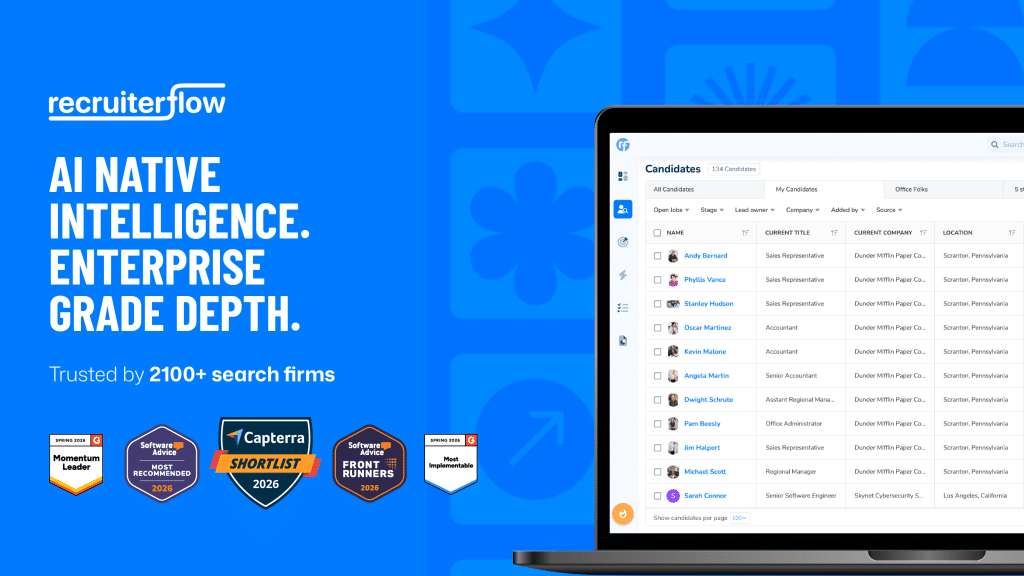
Pricing: From $119/user/month · G2: 4.8/5
Best for: Retained, contingent, and executive search firms that want AI depth and enterprise structure in one system.
- Standout: The largest AIRA agent suite — Matchmaker, Research Agent, Notetaker, Submission Agent, Job Change Alerts — running inside the workflow, plus Recipes and Sequences 2.0. AI-native, SOC 2 and ISO 27001 certified, with named outcomes like Andiamo’s 4× revenue and Believe Resourcing’s 676% job-order growth.
- Watch-out: Built for firms — more than an in-house team that only hires internally needs.
#2 Bullhorn
Pricing: Custom quote (opaque) · G2: 4.0/5
Best for: Large, complex staffing operations with the resources to administer it.
- Standout: The deepest end-to-end lifecycle on the market — CRM, ATS, placements, onboarding, time and expense, invoicing — plus its Amplify AI suite.
- Watch-out: Dated interface, steep learning curve, slow on large datasets, and much of the automation sits behind pricier tiers.
#3 Loxo
Pricing: Free tier; paid to ~$209/user/month · G2: 4.6/5
Best for: Solo recruiters and small firms prioritising sourcing volume.
- Standout: A 1.2-billion-profile sourcing database, clean drag-and-drop interface, and a free entry tier.
- Watch-out: AI sourcing can surface irrelevant results; occasional deliverability issues; thin for larger teams.
#4 Gem
Pricing: Custom quote (free trial) · G2: 4.7/5
Best for: Corporate in-house TA teams managing high inbound volume.
- Standout: Well-regarded recruitment marketing, talent rediscovery, and full-funnel analytics.
- Watch-out: Built for internal TA, not the job-order-and-submission rhythm of a recruiting firm.
#5 SourceWhale
Pricing: Custom quote (no free trial) · G2: 260+ reviews
Best for: Firms whose single biggest gap is consistent, personalised BD outreach.
- Standout: Best-in-class multi-channel personalisation at scale, with a strong LinkedIn Chrome extension.
- Watch-out: Some LinkedIn/InMail steps stay manual; it’s an outreach layer beside your ATS, not a replacement.
#6 Sense
Pricing: From ~$500/month · G2: 4.5/5
Best for: High-volume staffing firms in sectors like healthcare and logistics.
- Standout: Strong two-way SMS, candidate nurture, and a recruiting chatbot for engagement at scale.
- Watch-out: Rides on top of an existing ATS rather than being one; some sync lag reported.
For a deeper breakdown, see our guide to the best recruitment automation software.
The Bottom Line
Recruitment automation isn’t about doing more, faster. It’s about protecting the two things that drive revenue in a firm: conversion and judgment.
Automate the transactional work that caps your recruiters. Keep the human work that earns the fee. The gap between 1.38 and 5.21 placements per recruiter starts to close.
The old trade-off — an AI-native startup with no depth, or a legacy ATS with AI stapled on — was always a false one. Recruiterflow was built as both: an AI-native system with the AIRA agents to remove the admin and the enterprise-grade depth to scale without caps.
See what that looks like on your own desk.
Frequently Asked Questions
Is recruitment automation the same as AI recruiting?
No. Recruitment automation is the broader category — any technology that handles repetitive hiring tasks, including simple rule-based triggers. AI recruiting refers specifically to the intelligent layer — matching by meaning, summarising calls, drafting submissions — that makes automation context-aware rather than mechanical. Modern platforms combine both.
What’s the difference between an ATS and recruitment automation software?
An ATS is a system of record — it stores and tracks candidates through your pipeline. Recruitment automation is the layer of action and intelligence on top: sourcing, sequencing, triggers, and AI agents that do work rather than just store it. In AI-native platforms like Recruiterflow, the two are a single system, so automation has full context instead of pulling fragments through an integration.
How much does recruitment automation software cost?
Pricing varies widely by model. Loxo offers a free entry tier with paid plans to around $209/user/month; engagement platforms like Sense are oriented to larger budgets at several hundred dollars a month; Bullhorn is custom-quoted and tiered. Recruiterflow starts at $119/user/month with AI included rather than charged as add-ons.
Does recruitment automation work for small firms with 5–10 recruiters?
Yes — arguably more so. Smaller firms feel admin drag hardest because there’s no operations team to absorb it, so every hour automation returns goes straight back to billing activity — which is how a lean team like BardWood halved time-to-hire. The benchmark data shows top performance comes from conversion and database use, not headcount — exactly what automation strengthens.
What tasks should you never automate in recruiting?
Anything that depends on trust or judgment: closing candidates, qualification calls, difficult client conversations, counteroffers, and consultative pushback on a brief. Automate the data entry, scheduling, follow-ups, and reminders around those moments — never the moments themselves.
How do you measure ROI from recruitment automation?
Track the metrics automation is meant to move: hours returned per recruiter per week, time-to-fill, screen-to-submission rate, and placements per recruiter. Then tie them to revenue. A useful starting point is your recruitment analytics — if you can’t see the funnel, you can’t prove the gain.
Recruitment

Pragadeesh Natarajan is a content marketer with over four years of experience creating user-centric content for the B2B SaaS, HR tech, recruitment, and survey research industries.

13 min read
Pragadeesh Natarajan