
Retained vs Contingency Search: The Difference, and What Each One Demands
Retained search involves an upfront fee for a committed, structured hiring engagement, while contingency search pays only when a candidate is successfully placed. But payment timing is only the most visible difference. Recruiterflow’s time-to-fill benchmark analysis found that retained searches convert 77.9% of shortlisted candidates to interviews, compared with 44.3% for contingency searches, reflecting the greater alignment, research, and commitment behind each mandate.
The model changes what your firm is selling, how many searches it can manage at once, the depth of work expected, and whether it can be held accountable to a delivery timeline.
This guide compares retained vs contingency search from a recruitment firm’s perspective: how each model works, what each demands operationally, what a retained engagement includes, and what must be true before your firm can credibly charge a retainer.
The mechanical difference
Contingency: paid on placement
You work the role, and you are paid only if your candidate is hired. Nothing is owed if the role is filled by someone else, by an internal referral, or not at all. The client usually has several firms working the same requirement.
Retained: paid in tranches
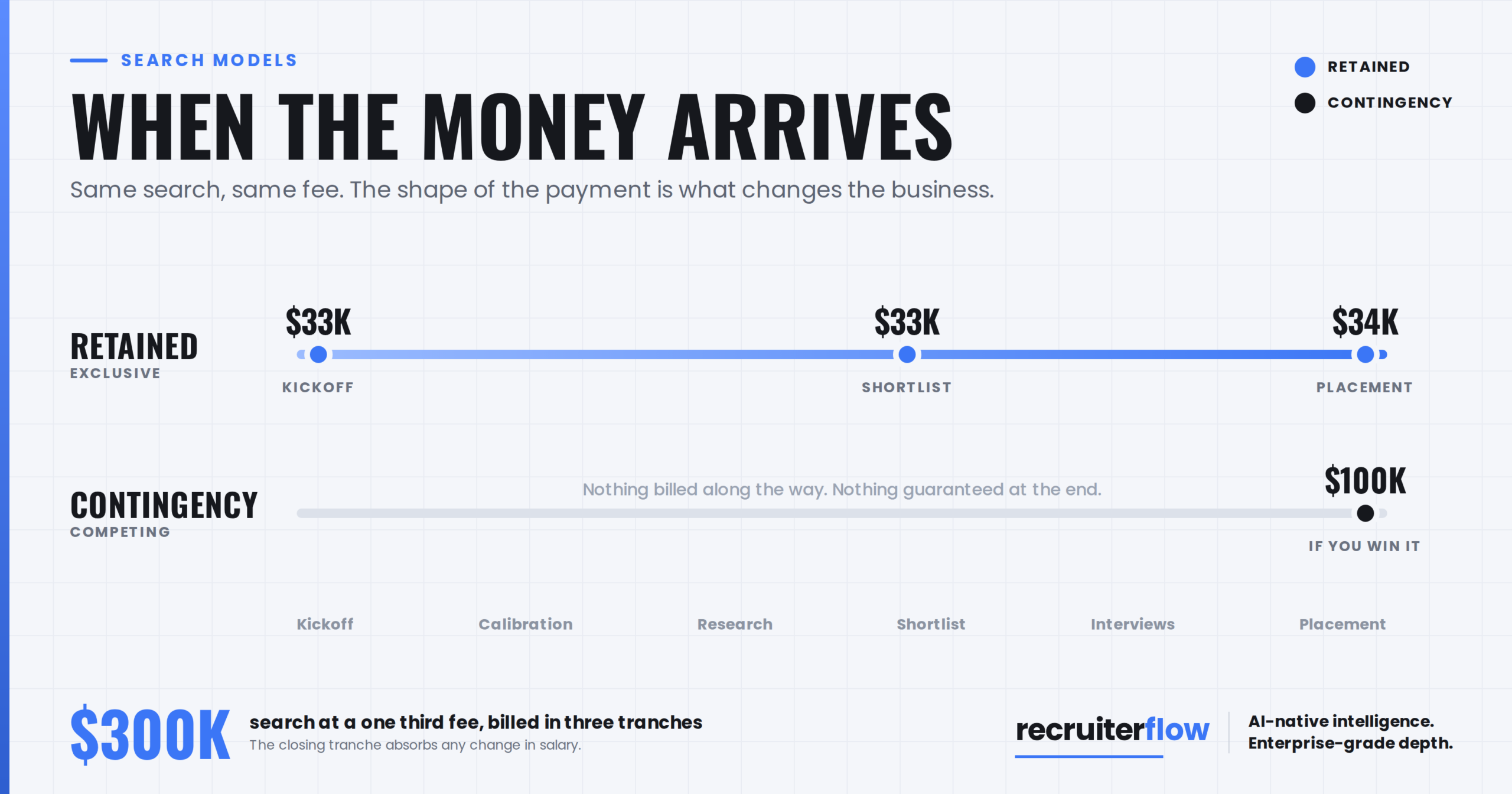
The client pays across the life of the engagement rather than at the end of it. The standard structure is three tranches: one at kickoff when the agreement is signed, one on shortlist delivery, and one on placement. Indeed describes the same shape from the client’s side.
Fees for retained work commonly sit between a quarter and a third of first-year compensation, which is higher than contingency, because the firm is being paid for the search rather than for the outcome.
The arithmetic is worth walking once. On a search at $300,000 with a fee of one third, the total is $100,000, so the tranches land at roughly $33,000, $33,000 and $34,000. If the final candidate negotiates to $360,000, the total fee becomes $120,000 and the closing tranche absorbs the difference at $54,000. Your billing needs to handle that adjustment without a spreadsheet.
Exclusivity is the real variable
Indeed’s guide puts it plainly: retained firms work on an exclusive basis, while a client running contingency can engage several firms at once. That single clause is what makes everything else possible. Exclusivity is what you are actually selling, and the retainer is what makes it enforceable.
What changes for the firm, not the client
Most comparisons are written for the client deciding how to engage. The more useful question is what the model does to the business running it.
Revenue arrives before the outcome
Contingency revenue is a lottery with good odds and terrible timing. Retained revenue arrives on a schedule you can forecast. That changes hiring plans, cash position and how long you can afford to be selective about which searches you take.
The work moves from volume to depth
A contingency desk wins by covering more requirements. A retained desk wins by covering one market completely. Those are different jobs, and the second one is research-led: mapping a market, identifying everyone credible in it, and approaching them individually.
Someone can hold you to a date
Retained firms promise delivery timelines, and clients hold them to it. A shortlist is typically expected within about three weeks of kickoff, and a senior search is often scoped at around fourteen weeks end to end. Tracking whether a search is on pace, rather than discovering it is not, becomes an operational requirement rather than a nice report.
What a retained engagement actually contains
This is the part that rarely appears in the comparison articles, and it is where firms moving upmarket tend to be caught out.
Kickoff and the search brief
The engagement opens with a kickoff meeting and produces a search brief, which is a document about the market and the mandate rather than a job description. It is written to be shown to a candidate who is not looking.
The calibration meeting
After kickoff, the team identifies five to ten people in the market and presents them to the client before approaching any of them. The client ranks them and corrects the profile. No other form of recruiting does this, and it is the step that converts a vague brief into a search you can actually run.
Research, long list, shortlist
Research produces the long list. The long list becomes a shortlist of four or five, and that is the deliverable the second tranche is attached to. The partner usually enters properly at this point.
Client deliverables
Formal search progress reports showing who was researched, who was approached and who is in process. These are contractual in spirit even when they are not in writing, and producing them by hand every fortnight is how firms lose their margin back.
Against a $168,000 annual revenue gap per recruiter between top-quartile firms and everyone else (Source: The Economics of Recruiting), the time spent rebuilding client reports manually is not an admin problem. It is the gap.

What has to be true before you can charge a retainer
- A market mapping capability, not a job board habit. Retained clients are buying coverage of a market.
- A search brief you can write and defend, distinct from a job description.
- An off-limits policy. You cannot approach people at your own client companies, and the system needs to enforce that rather than rely on memory.
- Billing that handles tranches, including a final tranche that adjusts when the salary moves.
- Reporting a client will accept, produced from the system rather than assembled by hand.
- A pipeline of clients who are buying the process, not the discount.
- Enough cash and enough conviction to turn down contingency work that would otherwise fill the same hours.
If several of those are missing, the retainer conversation will go badly, and the firm will conclude the market is not ready when the firm was not.
When contingency is the right answer
Retained is not simply the better model. It is a different one, and it fits a narrower set of situations.
Contingency works when the role is mid-level, when the client needs several of the same profile, when speed matters more than completeness, and when the client is unwilling to pay for process. Plenty of strong firms run contingency desks deliberately and profitably, and some run both with a clear rule about which searches qualify for which.
Worth naming one distinction: true executive search firms work retained as a practice, not as a preference. At VP level and above the candidates are not applying to anything, the client is buying discretion and market knowledge, and the engagement is advisory. The retained versus contingency decision belongs to contingent and mixed firms considering a move upmarket, not to firms already operating there.
FAQs
What is the difference between retained and contingency search?
Contingency firms are paid only when their candidate is hired and usually compete with other firms on the same role. Retained firms are paid in tranches across the engagement and work exclusively.
How much does a retained search cost?
Fees commonly sit between a quarter and a third of first-year compensation, billed across three tranches at kickoff, shortlist and placement. The final tranche usually adjusts if the agreed salary changes.
Is retained search better than contingency?
Neither is better in the abstract. Retained fits senior, confidential and hard-to-map searches where the client is buying coverage of a market. Contingency fits mid-level and volume hiring where speed matters more.
Can a firm run both retained and contingency?
Many do. The firms that manage it well have an explicit rule for which searches qualify for a retainer, rather than deciding case by case under pressure.
What is a calibration meeting?
A meeting after kickoff where the consultant presents five to ten potential candidates to the client before approaching them, so the client can rank them and refine the profile. It is specific to retained work.
How long should a retained search take?
Firms commonly commit to a shortlist within about three weeks of kickoff and a senior placement inside roughly fourteen weeks. The commitment is the point, so tracking pace matters more than the exact number.
The retainer is a promise about process
Clients do not pay a retainer for a better candidate. They pay it for a process they can see, on a timeline they can hold you to, with one firm accountable for the market.
If your firm is weighing the move, our piece on retained executive search covers the model in more depth, and why firms need both systems explains why the relationship layer matters more once engagements get longer.
Bring one live search to a demo and we will show you how the tranches, the off-limits rules and the client report come out of the system rather than out of your evening.


Ayusmita is a B2B storyteller who spends her time translating recruiting workflows into clear stories at Recruiterflow.


Ayusmita