
Quality of Hire: What It Actually Measures, and What It Cannot
A placement can look successful on day one and still fail six months later. The candidate accepts, the client is pleased, and the search closes. Whether that person performs well and stays is a different question.
That is the problem with measuring quality of hire. Shiran Danoch, CEO of Informed Decisions, defines it as the immediate and long-term value a new hire delivers, measured through performance and sustained tenure in “Talent 2026 Sneak Peek: Tying Quality of Hire to Real Business Results” (SHRM, February 2026). The definition is useful. The timing is difficult: a firm may need six to twelve months, and longer for senior roles, before it can judge the outcome.
So firms reach for numbers available sooner: 90-day retention, client satisfaction, or time to productivity. Those signals help, but none proves the hire will perform over time. The useful question is which signals a firm can measure now, which outcomes it must revisit later, and where its own influence ends.
What is quality of hire?
Quality of hire measures how well a new employee performs and stays in the role after joining. It helps a firm assess whether its recruiting and selection decisions led to a successful hire, though the full picture may take months to emerge.
For the measures and examples behind the term, see our quality of hire glossary
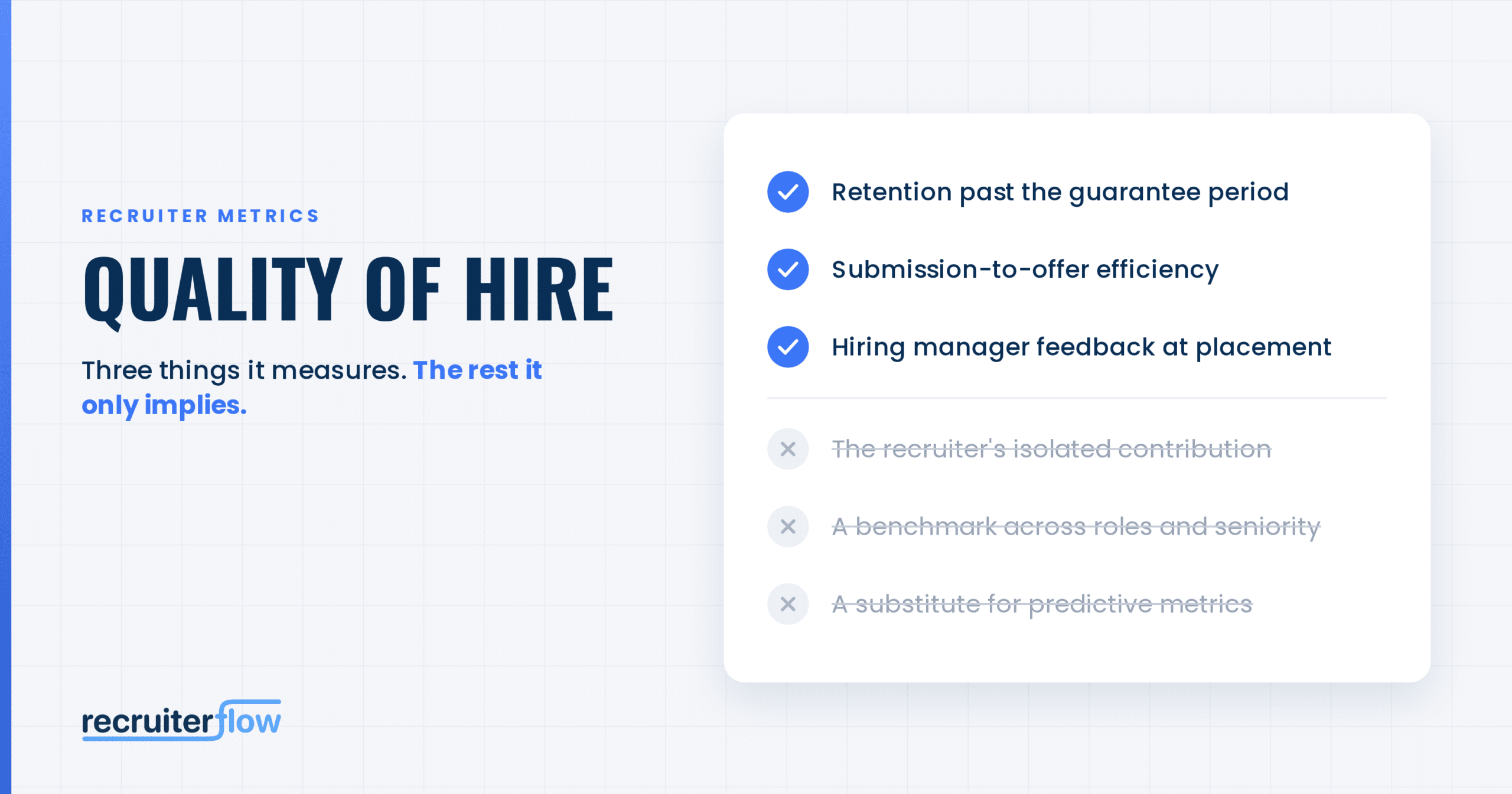
What quality of hire can actually measure
Strip away the ambition and three things are genuinely measurable, verifiable, and useful to a firm running placements at volume.
Retention past the guarantee period
A placement ending inside the client’s guarantee window triggers an immediate commercial question for the firm. Track that outcome, but do not assume every early departure proves poor selection or that every retained employee performs well.
Submission-to-offer efficiency
A firm whose recruiters average a high submit-to-interview and interview-to-offer rate is sending candidates who are genuinely aligned to the brief, not just technically matched on keywords.
Recruiterflow’s benchmark data shows top-quartile firms convert 50.1 percent of screens to submissions, compared with 36.1 percent for the rest. Top-quartile recruiters also make 5.21 placements per recruiter per year, against 1.38 for the rest. These are different measures, but together they show why stage conversion metrics deserve attention (Source: The Economics of Recruiting).
That is not proof of long-term hire quality. It is a timely measure of selection and pipeline efficiency.
Hiring manager or client feedback at placement
A structured, consistent feedback loop at the point of placement is not proof of long-term quality, but it is an early signal a firm can collect on a predictable schedule. Record what the client liked about the match and what still needs to be validated after the hire starts.
What quality of hire cannot measure, no matter how the dashboard is built
It cannot isolate the recruiter’s contribution from the client’s onboarding
A strong candidate placed into a chaotic first ninety days may underperform regardless of how well they were vetted. Attributing that outcome entirely to sourcing quality ignores the work environment.
It cannot be benchmarked meaningfully across roles or seniority levels
A quality-of-hire score built for a six-month contract technical hire is not comparable to one built for a VP search with an eighteen-month judgment window. A single blended number across the whole book can hide those differences.
It cannot substitute for the metrics that help diagnose selection
The screening-to-submission rate moves in real time and shows how selectively a recruiter advances screened candidates. It helps diagnose a funnel, but a high or low rate alone cannot establish whether hires will stay and perform.
Track it alongside submission-to-interview and interview-to-offer conversion. Then compare those early signals with outcomes after placement, rather than treating a funnel metric as a substitute for quality.
The market context that makes this urgent right now
Recruiterflow’s peer analysis of major recruitment and search platforms found revenue down 5.6 percent, gross profit down 8.6 percent, and EBITDA down 29.6 percent year over year, amid reduced demand and longer client decision cycles (Source: Recruitment Industry Analysis 2026-27).
When decisions take longer and margins compress, clients may scrutinize placements harder. Firms that can explain their submission discipline, conversion by stage, and documented feedback have a more useful conversation than firms relying on one retention percentage.
Building a version of the metric that holds up
A defensible framework combines leading signals and lagging outcomes, and reports them separately.
Track submission and conversion by recruiter, client, and role type each month. Record structured client feedback during selection, collect feedback again after the placement, and review guarantee-period retention quarterly. An interview scorecard captures selection evidence; post-hire feedback must still be collected separately. Neither the early indicators nor retention alone tells the full story.
Recruiterflow’s placement data shows why the database matters here too: 71 percent of placements come from candidates already in a firm’s existing database, rather than net-new sourcing (Source: The Economics of Recruiting).

A firm that does not connect candidate history in its database with later placement outcomes misses a substantial part of its own evidence.
Where this leaves a firm owner
Quality of hire is a discipline built from measures available today and outcomes that arrive months later. State which is which. That makes a client conversation more credible than a single score whose components are unclear.
If submission rates, stage conversion, and placement follow-up are scattered across spreadsheets and inboxes, they are hard to review consistently. See how Recruiterflow surfaces recruiting data for firms running this at volume.
Put it against your own placements
Take your last ten placements and check two things: how many are still in seat past the guarantee period, and what the submission-to-offer rate was on each search.
That is a starting point you can defend in a client conversation. It is still a proxy until you have evidence of performance after the person starts.
Bring those figures to a demo and we will show you where they sit against the benchmark data, and which part of the funnel is moving them.
FAQs
Is quality of hire the same as candidate quality?
No. Candidate quality describes how well a person matches a brief at the point of submission. Quality of hire describes how that person performs after joining, with retention and client feedback providing additional context.
What is a good quality-of-hire benchmark?
There is no single industry-wide number because the metric is not standardized across roles or seniority. Compare similar roles and observation periods, then follow your firm’s own trend in retention, performance feedback, and conversion.
Can quality of hire be measured before a candidate starts the job?
Only indirectly. Screening discipline and interview-to-offer conversion are early signals. Performance and sustained tenure can be assessed only after the candidate starts.
Why do most quality-of-hire dashboards fail?
A dashboard can mislead when it blends early and late signals into one score, averages incomparable roles, or assigns every post-hire outcome to the recruiter without accounting for onboarding and management.
Recruitment
Ayusmita is a B2B storyteller who spends her time translating recruiting workflows into clear stories at Recruiterflow.


Ayusmita