
High-Volume Recruiting Software: What to Look For in 2026
Most recruiting software is designed for searches that take six weeks and involve a handful of qualified candidates. High-volume recruiting is a different business. When recruiters are processing hundreds or thousands of candidates, the software needs to optimize for throughput, automation, and repeatable decisions—not just candidate tracking.
The warning sign is simple: if recruiters perform the same action 40 times a day, and the system makes them repeat it 40 times, you are paying recruiters to click instead of recruit.
This guide breaks down what high-volume recruiting actually means, the software features that matter most, which bulk actions can improve throughput, the metrics worth benchmarking, and how to evaluate recruiting platforms before you buy.
TL;DR
- High volume is about candidate-to-placement ratios, not company size. A recruiting team can be small and still operate at high volume. The real test is how many candidates, applications, and workflows the team must process for each placement.
- The right software removes repetitive work. Look for true bulk actions, automated screening, high-volume scheduling, multi-client pipelines, and channel-level reporting.
- Bulk actions need to preserve recruiting judgment. Updating 200 records at once is useful. Moving 200 unqualified candidates downstream faster is not.
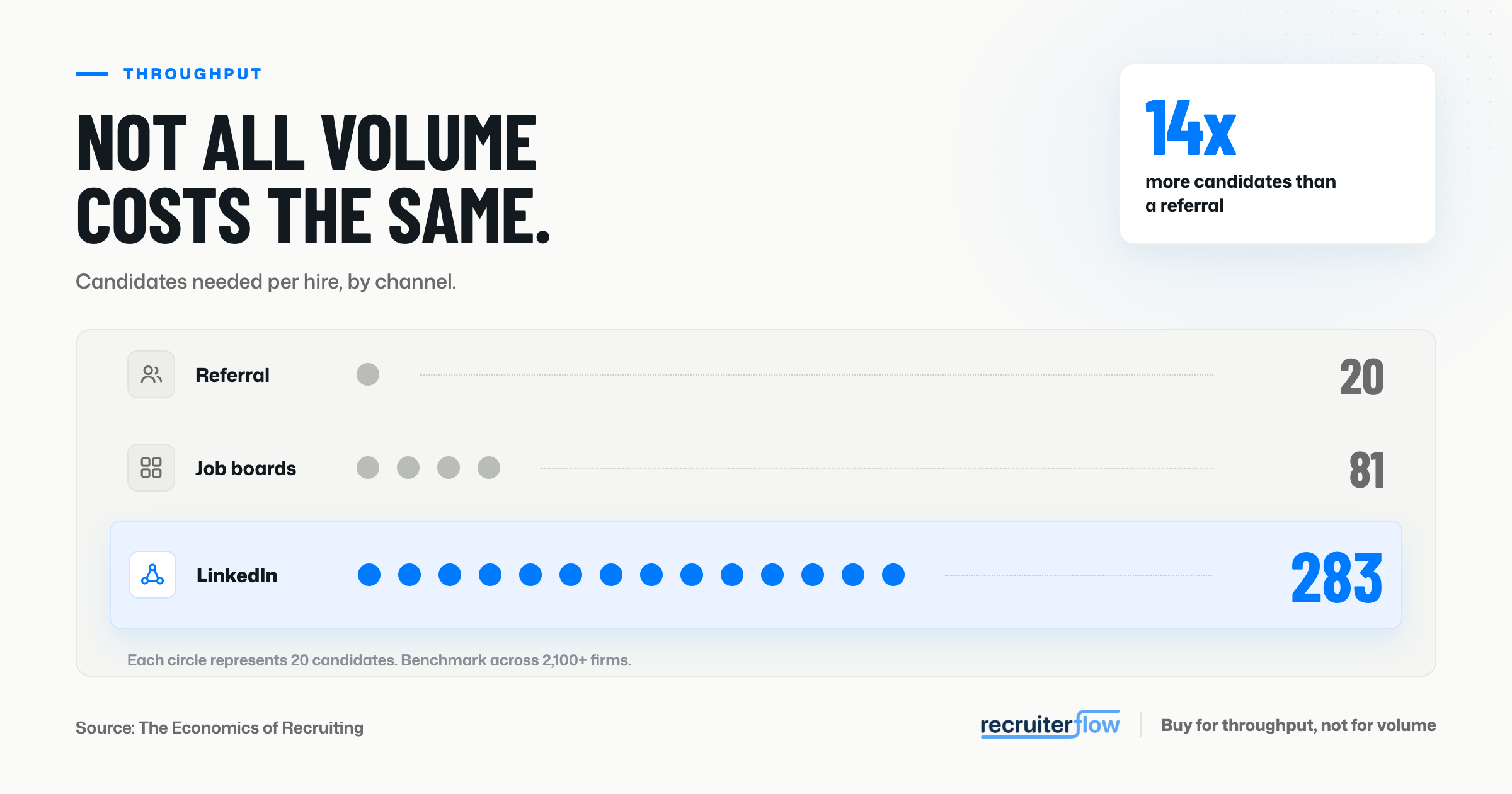
- Sourcing channels directly affect throughput. In the benchmark data used in this guide, job boards require 81 candidates per hire compared with 283 from LinkedIn—making channel mix a major lever for high-volume firms.
- The best firms optimize for output, not candidate volume. The top quartile adds fewer candidates than other firms while making nearly four times as many placements, showing why more candidates does not automatically mean more recruiting capacity.
What counts as high-volume recruiting
High volume is not about company size. It is about the shape of the funnel.
If you are working one search with a universe of forty people, that is specialist work. If you are filling forty near-identical roles from a pool of thousands, that is high volume, and the constraint moves from finding people to processing them without losing the good ones.
Our benchmark study across 2,100+ firms found the average firm sources 213 candidates per hire, with only about 3% of sourced candidates ever reaching submission (Source: The Economics of Recruiting).
At that ratio, small inefficiencies compound fast.
Why generic ATS tools break down
Most platforms are built around the single record. You open a candidate, you act, you close it. That model holds at ten candidates a day and collapses at two hundred.
The failure points are predictable: no true multi-select, screening that still requires opening each profile, scheduling that means a separate message per candidate, and reporting that cannot separate one client’s pipeline from another’s.
None of these are missing features exactly. They are design assumptions that stop being true at volume.
Must-have features in high-volume recruiting software
Judged against how volume work actually runs, these are the features worth paying for:
- True bulk actions across stage changes, tagging, assignment and disqualification, applied to a filtered set rather than one record at a time
- Automated screening that ranks and filters on criteria you define, so recruiters review a shortlist rather than a queue
- Scheduling at scale, including self-scheduling links and interview slots that do not require a message per candidate
- Multichannel sequences across email, SMS and call steps, because volume candidates do not reliably answer email
- Multi-client pipeline separation, so twelve concurrent campaigns do not become one undifferentiated list
- Channel-level conversion reporting, not just total applications
- Automatic data capture, so records stay current without recruiters typing after every call
- Bulk-safe permissions and undo, because the cost of a mistaken mass action scales with the same multiplier as the benefit
Two of those are worth expanding, because they are where buyers get it wrong.
Bulk actions that actually move the needle
Vendors demo bulk actions as a volume trick: select two hundred, click once. That is the easy half. The question is whether the action carries any judgment.
Bulk actions worth having
Moving a filtered, screened set to the next stage. Sending a sequence to candidates who match defined criteria. Disqualifying with a reason code that feeds reporting. Reassigning a departing recruiter’s pipeline. Updating fields across a client’s campaign after a brief changes.
What these share is that a decision was made once, deliberately, and then applied consistently.
Bulk actions that quietly cost you
Mass email to everyone who ever applied. Blanket stage advancement to clear a backlog before a review. Auto-rejection on a keyword rule nobody has revisited in a year.
These feel productive and push unqualified volume into the next stage, where a human has to deal with it. The bottleneck moves rather than clears.
Our benchmark data makes the point sharply: the largest funnel leak is screening to client submission, where only 11.3% pass through. Pushing more volume into that step does not increase placements. It increases screening load.
The throughput metrics that matter
Volume businesses tend to measure activity. The metrics that predict revenue are ratios.
The one most firms underuse is channel efficiency. Across the benchmark:
| Channel | Candidates per hire |
|---|---|
| Referral | 20 |
| Website | 33 |
| Job boards | 81 |
| Ads | 99 |
| 283 |
LinkedIn is a volume channel that costs 283 candidates to produce one hire. Job boards need 81. For high-volume work, that difference is the single largest throughput lever available, and it is a sourcing mix decision rather than a software one.
Beyond channel, track time from intake to first submission, time in stage, screening to submission conversion, and cost per placement by client. Total applications tells you almost nothing.
There is a counterintuitive finding worth holding onto. The top 25% of firms add fewer candidates per recruiter than the rest, roughly 800 against 930, and place 5.21 per recruiter against 1.38. Volume alone is not the strategy. Conversion is.
For the strategy side of this, our guide to high-volume recruiting strategies covers the process changes that sit alongside the tooling.
How to choose high-volume recruiting software
Start with your worst week
Not your average week. Ask the vendor to demo the day three clients each send fifty candidates. Average-volume demos hide exactly the behaviour you are buying against.
Test bulk actions on your own data
Load a real filtered set and run the actions you would actually run. Check what happens when one record in two hundred fails, whether the action is reversible, and whether the audit trail shows who did it.
Check the multi-client edges
Separate pipelines per client, permissions that let a recruiter see their campaigns without seeing firm margin, and reporting that slices by client and by consultant at once. Platforms built for corporate hiring tend to assume one funnel.
Ask how the data gets in
At volume, manual updating is the first thing to slip. If accuracy depends on recruiters typing after every call, your reporting will be wrong within a quarter. Wider guidance sits in our recruitment operations guide.
Where Recruiterflow fits
Recruiterflow combines the ATS, CRM, automation and reporting in one system, with bulk actions and recipes built for the multi-client reality of firm work rather than a single internal funnel.
For the screening bottleneck specifically, AIRA Matchmaker ranks candidates against a role by meaning rather than keyword, so recruiters open a shortlist instead of a queue. That is the difference between a bulk action that carries judgment and one that just moves records.
The proof point is Total Aviation, running 100 to 150 live job orders with four recruiters. They built 900 recipes, automated 69,306 emails and 48,400 text messages, recovered 980 human-hours and tripled productivity (Source: Total Aviation case study).
Buy for throughput, not for volume
Every platform will tell you it handles high volume. Most mean it will not fall over.
The better test is whether it removes decisions from the queue. Software that lets you act on two hundred records at once is table stakes. Software that helps you decide which two hundred is what changes the numbers.
If you want to see what that looks like on your own pipeline, book a demo and bring your busiest client.
Frequently asked questions
How does high-volume recruiting software actually work?
It replaces per-record actions with set-based ones. You filter a group by criteria, apply screening or ranking, then act on the whole set at once through stage changes, sequences or scheduling, with the system logging activity automatically.
What is the best recruiting software for high-volume hiring?
The right choice depends on whether you run one internal funnel or many client campaigns. Firms need multi-client pipeline separation, fee and margin visibility and bulk actions that respect client boundaries, which corporate hiring platforms usually lack.
What is the ROI of AI recruiting software for high-volume hiring?
The return comes from screening and coordination rather than sourcing. Total Aviation recovered 980 hours across four recruiters and tripled productivity. Measure it as recruiter hours redirected to conversion steps, not as messages sent.
What high-volume recruiting metrics should firms track?
Candidates per hire by channel, screening to submission conversion, time from intake to first submission, time in stage, and cost per placement by client. Total application volume is the least useful number available.
Is video interview software worth it for high-volume recruiting?
One-way video screening can compress early-stage review when roles are near-identical and volume is very high. It is poor value where roles vary or candidates are passive, because completion rates fall sharply.
How is high-volume recruiting different from standard workflows?
The constraint moves. In specialist work the hard part is finding qualified people. At volume they are already in front of you, and the hard part is processing them fast enough without letting the good ones drop out.
Recruitment
Ayusmita is a B2B storyteller who spends her time translating recruiting workflows into clear stories at Recruiterflow.


Ayusmita