
Best Candidate Outreach Tools for Executive Search in 2026

TL;DR
|
In late 2025, LinkedIn cut Open InMail from a practical ceiling of roughly 800 sends a month to under 100 — an 87% drop in outbound capacity almost overnight. For a search firm working passive C-suite candidates who barely respond on a good day, the tool underneath the outreach suddenly matters far more than it did a year ago.
Executive search outreach isn’t high-volume recruiting with a shorter list. A VP or C-suite mandate might have a global candidate pool under 100 people — most of them not looking, and none willing to reply to anything that reads like a template.
That changes what you actually need from a tool. Not send volume. Precision, personalisation at low volume, and enough visibility to run a disciplined cadence across a 12–18 month relationship without a single touchpoint slipping.
Below, we break down the candidate outreach tools that fit executive search — what each does well, where each falls short, and how to choose the right one for the way your firm runs its searches.
Outreach Tools for Executive Search, at a Glance

Before we jump into the automations, here’s a quick hygiene check into your outreach practices. Get the entire candidate outreach template below!

Features to Look for in a Candidate Outreach Tool for Executive Search
1. Native integration with your search pipeline.
Outreach that lives in a separate tool from your CRM means every reply has to be manually logged back into the search record. That’s an extra step on every touchpoint, multiplied across a 6-month search.
2. Multichannel reach.
Email alone underperforms for senior candidates who get hundreds of cold emails a year. A tool that combines email, LinkedIn, and calls into one cadence reaches candidates through whichever channel they’re actually paying attention to.
3. Confidentiality and off-limits controls.
Executive searches are frequently confidential, and consultants can’t approach candidates at client companies. An outreach tool needs to respect both without manual double-checking.
4. Search-stage awareness, not job-stage awareness.
Executive search runs through kickoff, calibration, research and outreach, shortlisting, and placement, not a generic hiring pipeline. Tools built for high-volume recruiting rarely reflect that structure.
5. Response tracking without manual admin.
If a candidate replies to an email, the system should update automatically rather than relying on a consultant to remember to log it before moving to the next task.
For a broader look at what response rates and cadence structure should look like across any recruiting channel, these outreach benchmarks are worth checking against your own numbers.
Best Candidate Outreach Tools for Executive Search
1. Recruiterflow
Pricing: Starts at $119/user/month · G2: 4.8/5 · Capterra: 4.7/5
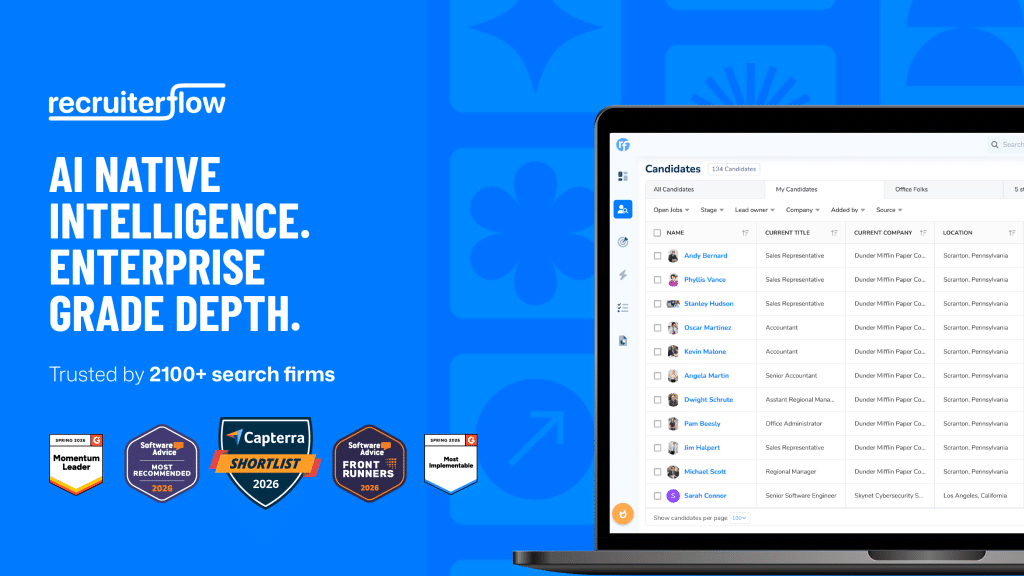
Runs email, LinkedIn, SMS, and call steps inside the same platform where consultants manage searches and client relationships, through Multichannel Sequences. Branching logic routes each contact automatically based on LinkedIn connection status.
Pros
- Native multichannel sequencing inside the CRM, not a bolt-on
- Branching logic routes LinkedIn vs. email automatically per contact
- Contact and candidate profiles sync, useful since the same person is often both
- Calibration-aware search stages and off-limits controls built in
Cons
- Newer to the executive search segment than 15–20-year incumbents like Invenias and Thrive TRM
- Full AI feature set (AIRA) is gated to a separate, higher-priced annual tier per some reviewer reports
- Reviewers note the mobile app is limited compared to desktop
Best for: Retained and boutique search firms that want outreach and CRM in one system rather than paying for a second tool.

2. SourceWhale
Pricing: Custom quote, roughly $200–290/user/month · G2: 4.8/5 · Capterra: 4.3/5
A dedicated multichannel outreach layer, email, LinkedIn, SMS, and calls, that sits on top of whatever CRM a firm already runs.
Pros
- Consistently high review volume and score across both G2 and Capterra
- Strong automation for running several campaigns at once
- Analytics show open and reply rates per sequence
Cons
- No candidate database of its own; pulls profiles via a browser extension
- Reviewers report integration friction syncing back to some CRMs, including Bullhorn
- Pricing is quote-only with no published tiers or free trial
Best for: Firms that already have a CRM they like and just need a dedicated cadence layer on top of it.
Also, read our blog on Benefits of Using AI in Recruitment
3. LinkedIn Recruiter
Pricing: Recruiter Lite ~$170/month (self-serve) · Corporate roughly $9,000–15,000+/seat/year (custom quote) · G2: Not independently confirmed · TrustRadius: 8.2/10
The default starting point for research and InMail outreach, since most executives maintain a LinkedIn presence even when not job hunting.
Pros
- Largest professional database available for direct outreach
- InMail response rates for recruiting lead most industries
- No separate database or contact tool needed for baseline research
Cons
- InMail credits are capped and expensive to buy beyond the plan ($10+ per extra credit)
- Late-2025 changes cut Open InMail capacity by roughly 87%
- Senior candidates are heavily oversaturated with generic InMail volume
- Single-channel; no native email or SMS sequencing
Best for: Research and qualification as a first step, with outreach cadence handled by a separate tool.
4. Invenias by Bullhorn
Pricing: Custom quote · Reviews are mixed with low volume
The longest-standing dedicated executive search platform, built around deep Microsoft Outlook integration and retained-search workflow.
Pros
- Nearly two decades of purpose-built executive search depth: longlists, client deliverables, GDPR tooling
- Tight Outlook integration for consultants who live in their inbox
- Used by 700+ search firms globally per Bullhorn’s own figures
Cons
- No native multichannel outreach; cadence requires a third-party tool like SourceWhale
- Multiple G2 reviewers report limited product development since Bullhorn’s 2018 acquisition
- No Zapier integration; reviewers cite manual workarounds for basic automation
- Reviewer feedback on UI and speed is notably mixed, with some describing it as dated
Best for: Large, established retained firms already committed to the Bullhorn ecosystem.
5. Thrive TRM
Pricing: Custom quote, enterprise-tier · G2/Capterra: Not listed
A talent relationship management platform built specifically around the long, multi-stakeholder cycles of executive search.
Pros
- Strong relationship mapping and search health reporting across years of re-engagement
- Automatically logs email activity via Gmail/Outlook extensions
- Purpose-built for retained search stages, not adapted from a generic ATS
Cons
- Outreach is logged, not originated; multichannel sequencing runs through a separate SourceWhale integration
- Reviewers describe the interface as busy without deliberate simplification
- Limited public review volume makes broader sentiment harder to verify independently
Best for: Established search firms or in-house executive talent teams prioritizing relationship history over native outreach automation.
How We Chose These Tools
We looked specifically at candidate outreach software for executive recruiters, not general sourcing or ATS platforms.
Each tool had to have a genuine outreach or cadence function (not just contact storage), documented use by retained search firms.
Choosing the Right Outreach Stack
The recurring pattern across this list is a trade-off: the platforms built specifically for executive search (Invenias, Thrive TRM) are strong on relationship history but weak on native outreach, while dedicated outreach tools (SourceWhale) are strong on cadence but sit outside the CRM entirely. Most firms end up paying for and reconciling two systems.
See how Recruiterflow keeps outreach, search stages, and client relationships inside one system, built for retained search from the ground up. Book a demo and bring your current search pipeline.
FAQs
What is a candidate outreach tool?
A candidate outreach tool manages and automates the messages consultants send to candidates across channels like email, LinkedIn, and phone. For executive search, the best ones tie that outreach directly to the search pipeline instead of running as a separate system.
What is the best candidate outreach tool for executive search?
It depends on whether a firm wants outreach built into its CRM or layered on top of one. Recruiterflow and SourceWhale both run native multichannel sequences; the difference is that Recruiterflow’s runs inside the same platform managing the search, while SourceWhale sits on top of a separate CRM.
How do candidate outreach tools work?
They combine a contact list with a sequence of scheduled touchpoints across channels, tracking opens, replies, and follow-ups automatically. The stronger tools branch the sequence based on candidate behavior, such as routing to LinkedIn if a contact is already connected there.
Can candidate outreach tools automate follow-ups?
Yes. The strongest tools automate timing, channel sequencing, and CRM logging while leaving the actual message personalized to the candidate. For executive search, that means the cadence stays consistent without turning into templated, obviously mass-sent messages.
What should recruiters include in a candidate outreach message?
A specific, genuine detail about the candidate’s background or trajectory, not a generic opener. Keep it short, and end with a low-friction ask like a brief call rather than a lengthy pitch.
Recruitment
Ayusmita is a B2B storyteller who spends her time translating recruiting workflows into clear stories at Recruiterflow.


Ayusmita