
Candidate Outreach Strategies, Messages & How to Automate In 2026

In late 2025, LinkedIn quietly capped Open InMail sends, dropping the practical monthly limit from around 800 to under 100 for most accounts. That’s an 87% reduction in outbound capacity overnight.
Most firms noticed. Not many adjusted.
The ones that did understood something the rest are still catching up to: volume-based outreach was already broken. LinkedIn just made it official. The only path that still works, the only one that was ever worth building, is relevance-based outreach, timed to the right moment, sent through the right channel, and personal enough to earn a reply.
Here’s everything that actually works in candidate outreach in 2026 — passive candidate strategies, LinkedIn message frameworks, automation workflows, and the benchmarks worth measuring.
What Is Candidate Outreach?
Candidate outreach is every proactive contact you make with someone who hasn’t applied, before a role is opened, while it’s live, or to keep a strong candidate warm for the right moment. For retained and contingent firms, it’s not a function separate from recruiting. It is recruiting.
For recruiting firms, outreach is where the sourcing pipeline either builds or stalls.
Want to skip ahead and download the good part straight into your device? Get the entire template guide below, pin it to your workflow, and beat the 87% in no time!

What Good Actually Looks Like: The Benchmarks
Before strategies, the numbers. Most outreach advice is written without them.
LinkedIn InMail: Recruiting and staffing leads all industries in InMail reply rate at 18–25%. Top performers hit 30–40% through personalised, multi-touch sequences. Generic templates reliably land under 5%. (Source: LinkedIn Industry Benchmarks / Cleverly, 2026)
Multichannel sequences: Campaigns combining LinkedIn, email, and phone outperform single-channel by 287%. It takes an average of five touchpoints to convert a prospect into a conversation. (Source: LinkedIn Benchmarks, 2026)
Message length: 50–70 word InMails get the highest response rates. Messages under 400 characters perform 22% better. (Source: LinkedIn Talent Blog, 2025)
Follow-up: 65% of InMail responses arrive within 24 hours, 90% within one week. Follow-ups increase reply rates by 50% or more. Yet most recruiters send one message and stop. (Source: LinkedIn / Optareach, 2025)
RF proprietary benchmark: Top-performing firms send 3,073 emails per recruiter annually. The rest send 1,738. (Source: The Economics of Recruiting) Volume isn’t the only difference — but the gap in output is real.
Passive Candidate Outreach: Where the Real Placements Are
70% of the global workforce are passive candidates, not actively looking, not on job boards, not responding to job ads.
For executive search and senior retained mandates, that number is closer to 90%.
This is where most firms’ outreach strategy quietly falls apart. The message designed to attract an active job seeker reads as noise to someone who isn’t looking. The tone is wrong. The timing is wrong. The ask is wrong.
Passive candidate outreach requires a different approach entirely.
What works for passive candidates:
Lead with the opportunity, not the role.
Don’t open with a job description. Open with a market observation, a career insight, or a specific reason this conversation might be worth 15 minutes — even if they’re not looking right now.
Trigger-based outreach is the highest-conversion approach.
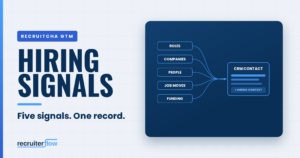
A promotion, a company restructure, a team change, a funding event — these are moments when even deeply passive candidates briefly reconsider. Recruiterfow’s Job Change Alert monitors every contact in your CRM and notifies you the moment something changes, so your outreach lands at the right moment without requiring manual monitoring. (Source: The Economics of Recruiting) Firms using job change alerts reduce time to first submittal by 34% and see 12% higher placements on average.
Nurture over pressure.
A passive candidate you can’t place today is a candidate you might place in 18 months. Building that relationship over time is what separates firms that thrive on referrals from those that restart from zero on every search.
Warm outreach converts better than cold.
Engaging with a candidate’s LinkedIn content before sending a message increases response rates by up to 3x. It’s not about being clever. It’s about not being a stranger.
How to Write Candidate Outreach Messages
Three principles that hold regardless of channel:
Short.
50–70 words on LinkedIn. A few sentences by email. If you need more space to make the case, the case isn’t ready yet.
Specific.
One genuine observation about the candidate’s background, work, or trajectory. Not “I came across your profile” — that’s what every other message says. What specifically caught your attention?
Low-friction ask.
“Would you be open to a brief call?” not “I’d love to schedule a 30-minute discovery call to discuss this exciting opportunity.” The ask should require a single-word reply to advance.
For cold email outreach specifically, this guide covers structure, subject lines, and follow-up cadence in depth.
How to Automate Without Losing the Reply
The question isn’t whether to automate candidate outreach. It’s what to automate and what to protect.
Automate:
the cadence, the follow-up timing, the CRM logging, the channel sequencing, the initial draft. These are logistics. They don’t require human judgment — they require human consistency, which automation is better at.
Protect:
the personalisation signal. The specific detail that tells the candidate this wasn’t sent to 400 people at once. The observation that only someone who’d actually looked at their profile could make.
The bigger structural issue:
most firms running sequences today are doing it across two or three tools — a CRM for contact management, Dripify or Lemlist for LinkedIn automation ($79–$87/user/month each), and email separately. None talk to each other reliably. A candidate who replies to an email still gets the LinkedIn step because the tools don’t sync fast enough.
Recruiterflow Multi Channel Sequences solves this at the architecture level. Email, LinkedIn, SMS, and call steps run inside the same platform where you manage candidates and clients — so responses update the contact record automatically and the sequence stops the moment a reply comes in.
The standout capability: branching logic.
MCS automatically routes each contact to the right channel based on LinkedIn connection status — connected contacts receive a LinkedIn message, unconnected contacts receive an email. No manual routing, no missed channel opportunities, no competitor currently does this natively.
The result: multi-channel sequences generate 2.3x more responses than email-only outreach.
Companies using AI-assisted messaging are 9% more likely to make a quality hire. (Source: LinkedIn Future of Recruiting 2025 Report) The combination of right channel, right timing, and right message is what Sequences is built to deliver — without requiring recruiters to manage it manually.

Frequently Asked Questions
What are the best candidate outreach messages to use on LinkedIn?
Short, specific, and low-friction. The sweet spot is 50–70 words with one genuine observation about the candidate’s background and an easy ask (“open to a brief call?”). Generic templates reliably underperform — recruiting and staffing firms that personalise InMails see 18–25% reply rates vs. under 5% for templated outreach.
How can I use AI for candidate outreach?
Use AI to draft the initial message structure and handle the follow-up cadence — it’s consistently better at staying concise. Keep the personalisation signal human or drawn from real CRM context. Recruiterflow’s AIRA Outreach Agent builds multi-channel sequences using your actual candidate history, so outreach feels personal without being manually written from scratch every time.
What are the most effective passive candidate outreach strategies?
Trigger-based outreach — timed to a job change, promotion, or company shift — consistently outperforms cold outreach. Lead with a market insight or career observation rather than a job description. Nurture over time rather than push for an immediate conversation. 70% of the global workforce are passive candidates, and the firms that win placements here are the ones that built the relationship before the role opened.
How do I automate candidate outreach without it feeling generic?
Automate the cadence, the timing, and the channel sequencing. Don’t automate the personalisation element — or ensure it’s drawn from real relationship context rather than a template. The difference between automated outreach that converts and automated outreach that gets ignored is whether the candidate believes a human looked at their profile before hitting send.
Recruitment
Ayusmita is a B2B storyteller who spends her time translating recruiting workflows into clear stories at Recruiterflow.


Ayusmita