
Interview Feedback: What to Write So the Next Round Is Faster
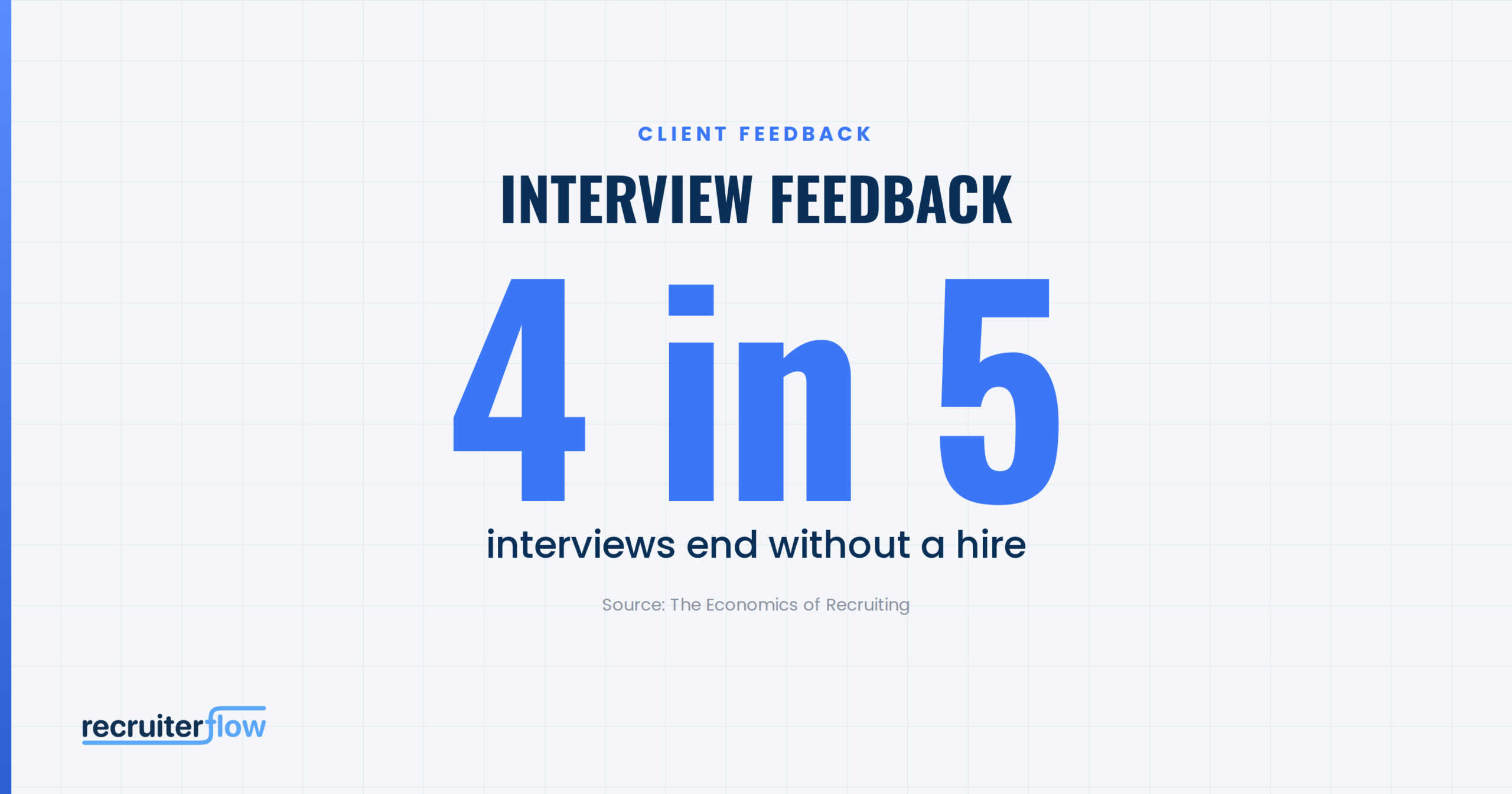
In retained search, 77.9% of shortlisted candidates reach a client interview. Only 17.4% of those interviews end in a hire (Source: The Economics of Recruiting).
Most interviews, then, end without a placement. Yet each one should make the next shortlist sharper. The client has seen the candidate against the brief. What they say afterward should tell the firm which criterion was met, which was missed, and what kind of evidence would change the decision.
Instead, feedback often arrives as “not quite the right fit” or “strong, but we are going to pass.” It closes the conversation with one candidate while leaving the search exactly where it was.
Here are interview feedback examples you can use with clients and candidates, what useful feedback must contain, and how to collect it while the details are still fresh. We will also cover the problems a well-written note cannot solve.
What interview feedback is actually for
Feedback has two audiences and they want different things.
The client’s feedback comes to you. Its job is to tell you what to change about the next candidate you send. If it does not change your next search action, it failed.
Your feedback goes to the candidate. Its job is to let them act, either on this process or the next one. If it only tells them the answer was no, it failed too.
Almost everything that goes wrong with interview feedback comes from writing one when you needed the other.
What good interview feedback contains
Four things, in this order.
The decision, stated first
Advance, hold, or pass. Put it in the first line. Feedback that buries the outcome under three paragraphs of context makes the reader hunt for it, and the hunt is where goodwill goes.
The evidence, tied to a criterion
Not “seemed junior” but “could not describe how they set the pricing model, only that the team did.” The criterion should be one everyone agreed before the interview, which is what an interview scorecard is for.
The counterfactual
What would have changed the answer. This is the part almost everyone skips, and it is the only part that tells you what to send next.
The next action, with an owner and a date
“We will confirm by Thursday” is feedback. “We will be in touch” is not.
Interview feedback examples
These are written the way they should actually be sent. Adapt the specifics, keep the shape.
Passing on a candidate, to your client
Passing on Ravi. His commercial exposure is narrower than the brief needs: he has owned renewals but never a new logo target, and the role carries one from day one. Would have changed the answer if he had run new business at any point in the last three years. Sending two profiles on Wednesday with that specifically covered.
The client learns what to expect next. You have documented the criterion for the rest of the search.
Passing on a candidate, to the candidate
The client has decided not to move forward. The gap was new business ownership, which the role carries from day one and your last three years have been renewal-led. Nothing about how you presented changed that. If you do pick up a new logo target, tell me, because the rest of your profile was the closest we put in front of them.
Specific, honest, and it leaves them something to act on. No hedging about culture fit.
Advancing a candidate
Moving Priya to final. Two of three interviewers scored her highest on the technical criterion; the third had a reservation about her stakeholder management that the panel did not resolve. Worth fifteen minutes on that in the final. She has a competing process at offer stage next Friday, so the timing matters.
The reservation is named rather than smoothed over, and the competing offer is stated as a constraint, not a threat.
Feedback on a split panel
The panel did not agree. Two rated her a clear yes on delivery; one rated her a no on the same evidence, reading the same example as reactive rather than decisive. That is a criteria disagreement rather than a candidate problem. Worth ten minutes on what “decisive” means for this role before we send anyone else.
Naming the disagreement as a criteria problem is what stops the search repeating it.
What interview feedback cannot do
This is where most feedback advice stops, and it is the more useful half.
It cannot recover criteria nobody agreed
If the client never said what a strong answer looked like, the feedback after the interview is a post-hoc rationalisation of a reaction. You can collect it, but you cannot act on it, because the next candidate will be judged against a standard that has still not been written down.
Feedback is downstream of the brief. Vague feedback is almost always a briefing problem wearing a communication costume.
It cannot settle a disagreement it was not designed to surface
When three interviewers write free-text notes, you get three impressions and no way to compare them. The disagreement is real but invisible, so the search drifts. Fixed scales on shared criteria make the disagreement visible in the first five minutes of the debrief, which is the only place it can be resolved. The same logic applies to your structured interview process earlier in the funnel.
It cannot substitute for the debrief
Written feedback records a conclusion. An interview debrief tests the reasoning behind it. The reasoning that changes a decision almost always comes out in conversation, when somebody says “wait, I read that answer completely differently.”
Firms that replace the debrief with a feedback form get faster paperwork and slower searches.
It cannot be compared across roles
A five on communication for a research analyst and a five for a sales director are not the same five. Feedback is useful within a search and misleading across a portfolio. Treat it as evidence, not as a metric to average, and keep the averaging for your recruitment metrics.

How to get feedback a client will actually write
Clients are not withholding feedback. They are busy, and a blank text box at the end of a long day produces a blank answer.
Three things move the response rate more than chasing.
- Ask before the interview, not after. Agree the criteria at kickoff, and the feedback form writes itself.
- Ask for less. Three scored criteria and one free-text line beats a form with eleven fields, because the eleven-field form comes back empty.
- Ask within the day. Feedback collected 48 hours later is a memory of an impression, and it converges on whatever the loudest interviewer said in the corridor.
The pattern that holds across all three: the quality of feedback is set before the interview happens, not after. The same is true of the screening questions you standardise at the front of the process.
Run this on your last five interviews
Pull the feedback from your last five client interviews and check one thing: for each, can you name the specific criterion that decided it, and what would have changed the answer.
If you can do that for fewer than three of the five, the problem is not that your clients write poor feedback. It is that nobody agreed what the interview was testing.
Bring one of those searches to a demo and we will show you what it looks like when the criteria, the scores and the debrief all live on the same record, and the next shortlist is built from what the last interview actually said.
FAQs
What should interview feedback include?
The decision first, the evidence tied to an agreed criterion, what would have changed the answer, and the next action with an owner and a date. The counterfactual is the part most feedback omits and the part that tells you what to send next.
How do you write interview feedback to a candidate?
State the outcome, name the specific gap, and confirm that nothing about their delivery caused it if that is true. Give them one thing they can act on, either for this process or a future one.
How quickly should interview feedback be given?
Within 24 hours while the detail is still recoverable. After roughly two days the feedback describes a memory of an impression rather than the interview, and it tends to converge on whatever the most vocal interviewer said first.
Why do clients give vague interview feedback?
Usually because the criteria were never agreed, so there is nothing specific to be vague about. Vague feedback is a briefing problem rather than a communication problem, and it is fixed at kickoff rather than after the interview.
Can interview feedback be compared across different roles?
No. A score on one search reflects that search’s criteria and that panel’s calibration, so averaging across roles produces a number with no meaning. Use feedback as evidence within a search and keep portfolio-level comparison for conversion metrics.
Should you give feedback to candidates you reject at screening?
Yes, briefly. A two-line note naming the specific gap costs a minute and keeps the candidate reachable for the next search, which matters because most placements come from people already in the database.
Recruitment
Ayusmita is a B2B storyteller who spends her time translating recruiting workflows into clear stories at Recruiterflow.

10 min read
Ayusmita