
Do You Need More Recruiters or a Better Recruitment Workflow?
When a recruitment team reaches capacity, hiring another recruiter feels like the obvious answer.
Sometimes it is.
But sometimes the team is not out of capacity. Its capacity is buried under manual follow-ups, unnecessary clicks, disconnected reporting and workflows that depend on recruiters remembering every next step.
Adding another recruiter to that system does not solve the problem. It gives the problem to another user.
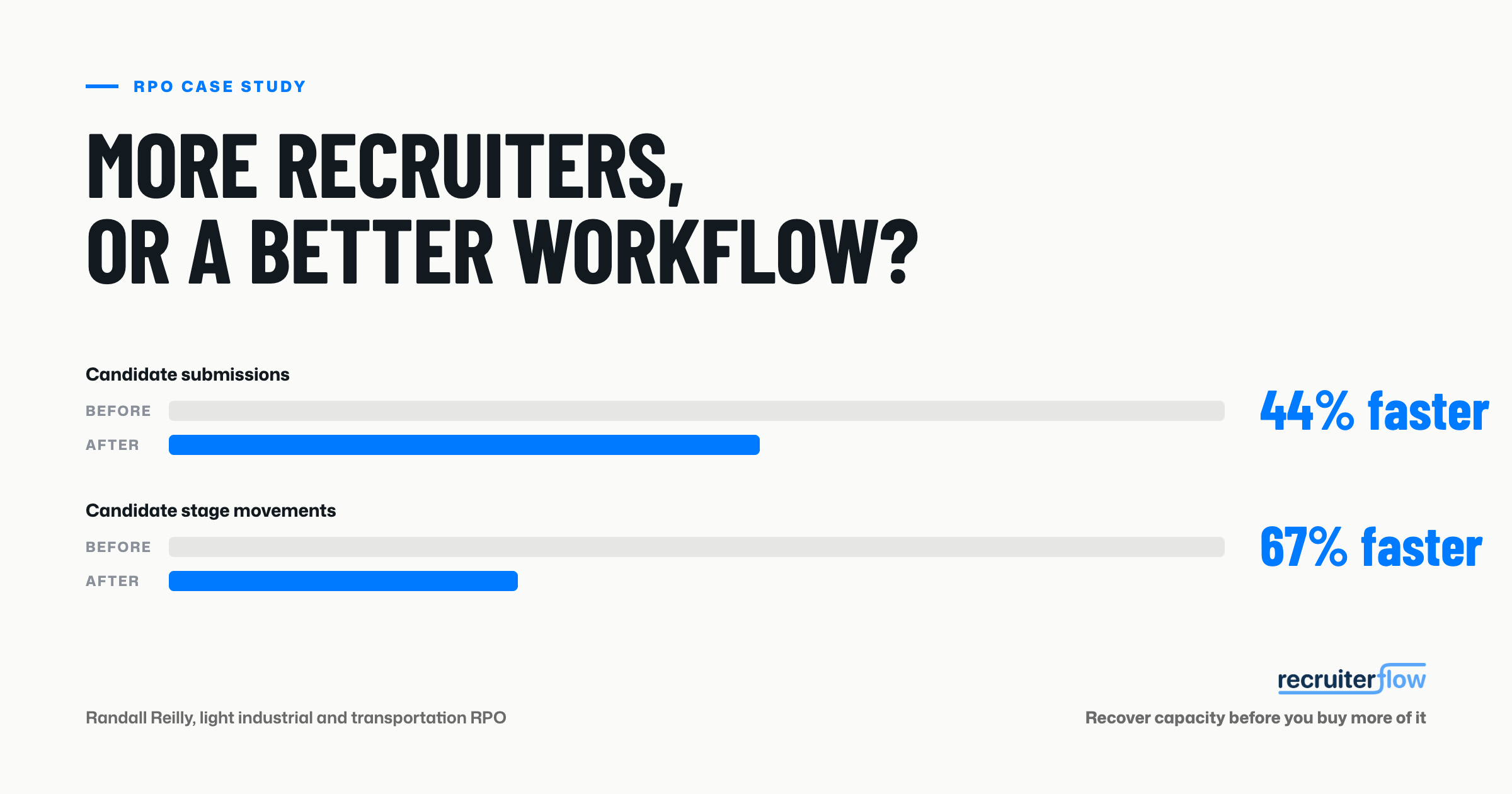
Randall Reilly discovered the difference. Using Recruiterflow to redesign and automate its recruitment workflows, the RPO made candidate submissions 44% faster and candidate stage movements 67% faster, without adding more work to the recruiter’s desk.
The lesson is not that recruitment agencies should stop hiring. It is that they should recover wasted workflow capacity before buying more headcount.
Is it a headcount problem or a workflow problem?
A headcount problem exists when an efficient team still has more valuable work than it can handle.
A workflow problem exists when recruiters are at capacity because the process creates avoidable work.
The symptoms look similar: follow-ups slip, candidates move slowly, reporting becomes unreliable and recruiters say they have no time. The difference is where their time goes.
If recruiters spend most of the day speaking with candidates, advising clients and making placements, additional headcount may be justified.
If they spend it triggering routine messages, updating multiple systems and rebuilding reports, hiring simply scales the inefficiency.
Randall Reilly’s recruiters were working around the system
Randall Reilly recruits truck drivers, mechanics and other light industrial professionals across the US and Canada. It runs both direct-hire and full-RPO services for companies in trucking and transportation.
These candidates are not always browsing job boards or checking their inboxes. Reaching them requires persistent, well-timed follow-up at scale.
Randall Reilly’s existing system made that difficult. Routine actions took too many clicks. Outreach depended on recruiters manually triggering each touchpoint. Reporting was difficult to build and often had to be reconstructed from incomplete exports.
“Every time we wanted to push the limits, it just held us back. You had to do 20 clicks just to do one thing in the system.”
Vincent Oram, Randall Reilly
Twenty clicks is not merely a usability problem. Repeated across every candidate, stage and recruiter, it becomes a limit on how much business the team can support.
Recruiterflow removed work from the workflow
Randall Reilly mapped its repeatable outreach processes and rebuilt them using Recruiterflow’s campaigns and recipes.
Campaigns handled consistent candidate outreach. Recipes triggered predefined actions as candidates moved through the pipeline. Recruiters could initiate a coordinated workflow through a simple stage update instead of manually managing every subsequent touchpoint.
“With the recruiter doing one simple action of moving the step, that candidate is going to get 3 emails. A recruiter can make 4 step updates to a candidate, and over the lifetime of that workflow, the candidate is going to get 7 outreaches.”
Matt O’Donell, Head of RPO Business, Randall Reilly
Recruiters still owned the conversations and decisions. Recruiterflow carried more of the predictable coordination around them.
The effect was measurable:
| Outcome | Improvement |
|---|---|
| Candidate submissions | 44% faster |
| Candidate stage movements | 67% faster |
(Source: How Randall Reilly scaled business outcomes without adding recruiter workload)
The team did not move faster because people were told to work harder. Fewer steps depended on someone remembering and finding time to complete them.
Reporting stopped being a reconstruction exercise
For more than two years, Randall Reilly struggled to build useful reports. Exports were difficult, data was incomplete and meaningful analysis repeatedly had to be assembled from scratch.
Recruiterflow’s open API gave the technology team access to the endpoints it needed to build comprehensive dashboards. Recruiters gained live visibility into candidate status, while managers could monitor individual and team performance through data refreshed twice daily.
“The tech team found Recruiterflow and said getting data and being able to build reports would be a whole lot easier. After struggling for 2.5 years, it was hard to say no.”
Matt O’Donell, Head of RPO Business, Randall Reilly
Once Randall Reilly could see how candidates moved through the process, it could identify delays and improve the workflow instead of relying on activity totals or anecdotal feedback.
How to find trapped capacity in your recruitment agency
Before opening another recruiter role, audit four parts of the current process.
1. Count the actions behind one candidate submission
Include messages, reminders, status changes, field updates, data entry and reporting. If a submission depends on dozens of low-value actions, remove or automate those actions before adding people.
2. Measure candidate time in stage
Total activity does not show where candidates are waiting. Track the time from role intake to first submission and the average time candidates spend at each stage. These recruitment metrics reveal workflow bottlenecks that calls and email totals hide.
3. Identify predictable communication
Routine acknowledgements, reminders, stage-based follow-ups and internal notifications should not depend entirely on recruiter memory. These are strong candidates for recruitment automation.
Automate the coordination around the relationship, not the relationship itself. Qualification, advice, negotiation and sensitive feedback should remain recruiter-led.
4. Calculate the cost of reporting
If managers have to export, clean and combine data before they can understand performance, reporting is consuming capacity as well as describing it. Reporting should show where work is slowing down without becoming another manual workflow.
How Recruiterflow helps agencies recover that capacity
Recruiterflow combines the ATS, CRM, outreach automation and reporting required to run agency recruitment workflows in one platform.
Agencies can use it to:
- Run structured, multi-touch candidate campaigns.
- Trigger actions through recipes when candidates move or events occur.
- Configure pipelines around different clients and recruitment models.
- Keep candidate activity, communication and pipeline context together.
- Build reporting through Recruiterflow’s dashboards and open API.
The value does not come from automating one email. It comes from reducing how often recruiters must stop, determine what happens next and manually make it happen.
That is what changed at Randall Reilly. Recruiterflow turned repeatable work into a connected workflow, helping the team submit candidates 44% faster and move them through stages 67% faster.
Recover capacity before you buy more of it
Recruitment agencies will eventually need to add people. But new recruiters should inherit a system worth scaling.
Before hiring, ask:
- Are recruiters spending most of their time on candidates and clients?
- Does routine follow-up still depend on memory?
- Are candidates waiting between stages?
- Is reporting assembled manually?
- Would another recruiter inherit the same bottlenecks?
Randall Reilly did not improve performance by demanding more activity. It used Recruiterflow to remove work from the path of the outcomes recruiters were already trying to produce.
The result was not simply a cleaner operation. Clients received candidates faster, candidates moved more consistently and recruiters could manage the workload without absorbing more administration.
See how Recruiterflow can remove repetitive work from your recruitment workflow.
Frequently asked questions
Can a recruitment agency scale without hiring more recruiters?
Yes. If recruiter capacity is being consumed by repetitive communication, data entry and manual reporting, an agency can support more work by simplifying and automating those processes. Additional hiring becomes necessary when demand exceeds the capacity of an already efficient workflow.
What should recruitment agencies automate first?
Start with frequent, predictable and low-judgment work: routine follow-ups, reminders, stage-based communication, internal notifications and recurring record updates. Keep qualification, relationship-building, advice and negotiation recruiter-led.
How do you measure recruitment workflow capacity?
Track the manual actions required per submission, time to first submission, candidate time in stage, follow-up completion and the time spent compiling reports. These measures show whether recruiter time is producing candidate progress or supporting administration.
Recruitment
Akshad is a marketer with 8 years of experience who firmly believes in the power of storytelling to build brand awareness and drive revenue. He is also a watch enthusiast and a podcaster in the making.
6 min read
The Recruiter’s Time Audit: Where 980 Human-Hours Go (and How to Reclaim Them)
Recruitment
Akshad