
How to Achieve 100% Recruiter CRM Adoption

“Please update your candidates in the CRM.”
This reminder works for about three days. Then the notes drift back into inboxes, notebooks, and people’s heads, and the CRM slides back to half-empty.
The nagging fails because you are asking them to do work the system should be doing for them.
This post covers how to get recruiters to actually use the CRM without nagging: why they avoid it in the first place, the five moves that fix adoption for good, and how to measure whether it is working without turning into surveillance.
Why recruiters avoid the CRM
Ask a recruiter why the CRM is out of date and you will hear versions of the same four answers:
- It is double work. They already wrote the note in an email, a calendar invite, or their head. Logging it again is pure tax.
- It gives nothing back. Data goes in and nothing useful comes out, so the effort feels one-directional.
- The form is too long. Twenty fields, half of them mandatory, most irrelevant to the next action.
- Nobody agrees on what “used properly” means. The expectation is “update everything,” which is another way of saying nothing.
None of these is a motivation problem. Every one is a friction problem, and friction can be engineered away.
Recruiterflow’s report How AI Agents Can Help Recruiters Reduce Burnout and Bill More found that 61% of recruiters report burnout, and 45% of them trace it to repetitive admin. Every extra field you make mandatory is one more thing stacked on someone already at their limit.
The recruiter CRM adoption playbook
Five moves, in order. Each one lowers the cost of using the CRM or raises the payoff, until keeping it current is the path of least resistance.
1. Remove the typing
The single biggest lever is to stop asking recruiters to enter data by hand. Recruiterflow’s AIRA Notetaker turns a call into an updated record and assigned tasks on its own, and the AIRA CRM Update Agent fills missing profile fields from emails, calls, and activity.
When the system captures the interaction, the recruiter is free to focus on the conversation. That same report puts the time saved at 10 to 15 hours per recruiter each week, most of it clawed back from admin you can now let agents handle.
2. Make the CRM pay before it asks
A recruiter keeps using a tool that hands them placements.
According to The Economics of Recruiting, Recruiterflow’s study of 2,100-plus firms, 71% of placements come from candidates already in the database before the role opened. Surface those people: AIRA Matchmaker shortlists existing candidates against a live role by meaning, so opening the CRM produces a shortlist instead of a chore.
3. Turn the database into a live signal
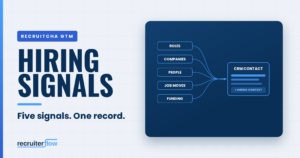
Records are worth keeping current when they trigger real work. Recruiterflow’s AIRA Job Change Alert Agent watches the database and flags when a contact moves, turning a stale profile into a warm opening.
Firms acting on those job change alerts cut time to first submittal by 34% and placed 12% more candidates, per the same benchmark. Now there is a direct reason to keep the record accurate: it pays the recruiter back.
4. Require only the fields that drive revenue
Data hygiene is not “fill in everything.” It is the three or four fields the next action depends on: current status, owner, last contact, and the one or two custom fields your desks actually filter on.
Make those required and leave the rest optional.
A short form that stays complete beats a long form that stays half-empty.
5. Coach with leading indicators
Once capture is automatic, usage stops being about logins and starts being about signal. Track whether new candidates get a status within a day, whether active roles have live shortlists, and whether flagged contacts get worked.
Those tell you if the CRM is driving the desk, which is the entire point.
What good recruiter CRM adoption looks like
Adoption is working when the data stays current on its own and the desk runs on it. Concretely:
- New candidates and contacts get a status and an owner within a day of entering the system.
- Every active role has a live shortlist that taps the existing database before fresh sourcing.
- Flagged contacts, from job changes to re-engagement triggers, get actioned rather than ignored.
- Your reporting is trustworthy enough to make decisions from.
There is no universal “good” percentage, because a login-based adoption rate measures the wrong thing.
The firms that win are the ones whose CRM quietly compounds.
Top performers pull a larger share of placements from their existing database and place several times more per recruiter, a gap The Economics of Recruiting ties to roughly $168,000 in revenue per recruiter. Adoption is the on-ramp to that number.
FAQs
How do you fix low CRM adoption in a recruiting firm?
Stop trying to make people enter more data and remove the data entry instead. Automate capture from calls and emails, require only the few fields the next action needs, and make sure opening the CRM returns something useful like a shortlist or a job-change alert. Adoption follows value and low friction rather than reminders.
Can automation increase CRM adoption?
Yes, and it is the most reliable lever. When tools log calls, update fields, and surface candidates automatically, the recruiter no longer carries the admin, so the record stays current as a byproduct of the work. Automation removes the reason recruiters skip the CRM in the first place.
Should using the CRM be mandatory for recruiters?
Mandates tend to produce the minimum: fields filled to avoid a reprimand rather than because the data mattered. A small set of required fields is reasonable, but if you need heavy enforcement, that usually means the system is asking for too much. Fix the friction before you reach for the rule.
What’s a good CRM adoption rate to aim for?
Login-based adoption rates are a weak target because they measure attendance, not value. A stronger bar is behavioral: new records get a status and owner within a day, active roles have live shortlists, and flagged contacts get worked. If those hold, the exact percentage matters far less.
How long does it take to improve CRM adoption?
With automated capture in place, friction drops immediately and behavior shifts within a few weeks, because the CRM stops costing the recruiter time. Culture and trust in the data take a quarter or two to fully settle. The order matters: reduce the work first, then reinforce the habit.
What’s the difference between CRM adoption and data hygiene?
Adoption is whether recruiters use the system; data hygiene is whether the information inside it stays accurate and current. They are linked, because automatic capture drives both: data entered by the system is cleaner than data typed in under time pressure. Strong adoption with poor hygiene is just a busy database nobody trusts.
Recruitment
Ayusmita is a B2B storyteller who spends her time translating recruiting workflows into clear stories at Recruiterflow.


Ayusmita