

7 Best AI-Native ATS for Executive Search Firms (2026)

A retained mandate runs for months. One consultant carries several at once, each confidential, each built by headhunting senior people who aren’t looking and may never have applied to anything in their lives.
The candidates overlap with past searches, sit behind off-limits rules, and expect a level of discretion a job-board pipeline never demands.
A standard applicant tracking system was built for none of that. It was built for req-and-fill volume: post a role, collect applicants, move them through stages. Point it at retained search and the mismatch shows immediately.
This guide ranks the 7 best AI-native ATS options built for executive search, using one lens: how native the AI actually is. For a broader catalogue of search tools beyond the ATS itself, our executive search software guide goes wider. This page is about picking the system of record you’ll run your searches on.
The Best AI-Native ATS Options for Executive Search
1. Recruiterflow
Best for: Retained, contingent, and blended search firms wanting one AI-native system
G2 Rating: 4.6/5
Capterra Rating: 4.7/5
Pricing: From $119/user/month (published).
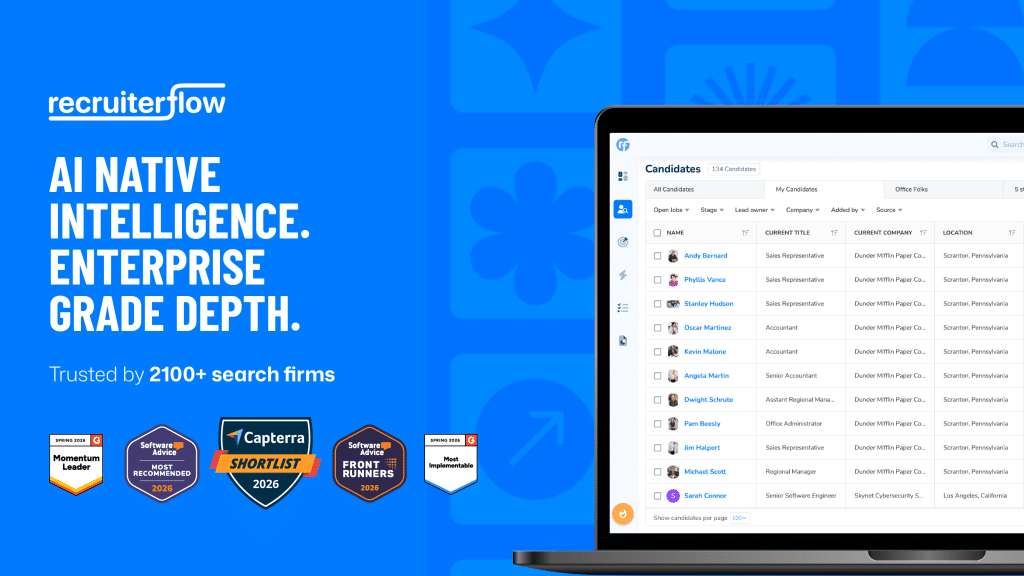
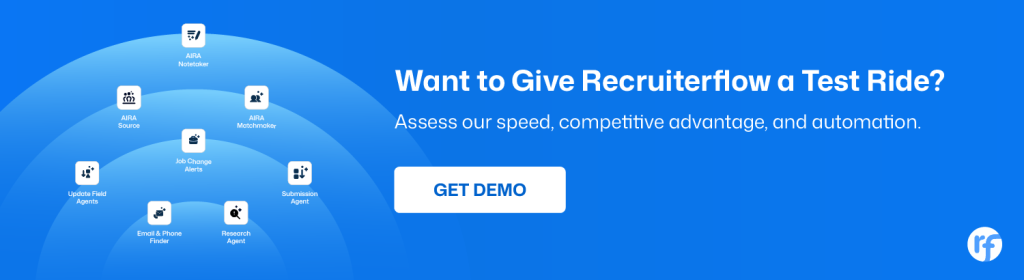
Recruiterflow is an AI-native ATS and CRM built for recruiting and executive search firms. Its intelligence layer, AIRA, runs through sourcing, matching, outreach, and data hygiene rather than sitting beside them. AIRA Matchmaker reads a mandate and surfaces best-fit candidates from your database with the reasoning behind each match, Job Change Alerts flag when a senior contact moves, and AIRA Notetaker captures calls and updates records automatically. Because the AI works from the full relationship history, it matches on context rather than keywords, which is exactly what long-cycle search depends on.
Pros:
- Genuinely AI-native, with intelligence running through the workflow rather than bolted on.
- Handles retained, contingent, and blended models in one system with transparent published pricing.
- Surfaces candidates from your existing database, the highest-value asset a search firm holds.
Cons:
- Broader than a pure retained-only tool, so single-mandate boutiques may not use every capability.
- Newer to market than legacy incumbents, with some enterprise integrations still expanding
2. Loxo
Best for: Search firms wanting a large built-in sourcing database alongside AI
G2 Rating: 4.6/5
Capterra Rating: 4.6/5
Free Trial: Available
Pricing: Free entry tier; paid tiers from around $119/user/month.
Loxo pairs an ATS and CRM with a large built-in candidate database and AI-assisted sourcing, positioning itself as a talent-intelligence platform. It suits search firms that want sourcing and workflow in one place, with AI weighted toward finding candidates rather than managing the full retained lifecycle.
Pros:
- Large built-in sourcing database, unusual among search-capable tools.
- AI-assisted sourcing and outreach in one platform.
- Free entry tier lowers the barrier to trying it.
Cons:
- Retained-specific workflow depth is lighter than purpose-built search tools.
- Reviewers note pricing can climb at renewal.
Also, check our blog on AI-Native vs AI-First: Why the Difference Decides Which ATS CRM Wins
3. Talentis
Best for: Modern boutique search firms wanting AI sourcing built into a search CRM
G2 Rating: 4.3/5
Capterra Rating: 4.2/5
Free Trial: Available
Pricing: Demo-led.
Talentis, from the team behind FileFinder, is one of the more modern purpose-built options. Its TalentGraph feature gives one-click access to a large database of public profiles, pairing search-firm CRM functionality with AI-assisted sourcing that reduces the empty-platform problem new firms face on day one.
Pros:
- Built-in sourcing via TalentGraph, rare among purpose-built search tools.
- Modern interface focused on senior-level search.
- Reduces manual data entry through public-web signals.
Cons:
- Thinner independent review base than established competitors.
- Demo-led pricing with no public figure.
4. Thrive TRM
Best for: Enterprise retained firms with deep, long-term relationship databases
G2 Rating: 4.6/5
Capterra Rating: 4.6/5
Free Trial: Not Available
Pricing: Demo-led; starts around $209/user/month, enterprise tiers higher.
Thrive TRM is a relationship-intelligence platform for long-cycle, relationship-heavy searches. It manages talent networks, collaborative candidate evaluation, and compensation benchmarking, and suits firms where board-level connections and referral-based sourcing drive candidate quality. Its intelligence centres on relationship data rather than generative AI sourcing.
Pros:
- Purpose-built for retained and senior-level executive search.
- Strong collaborative evaluation workflow for longlisting and shortlisting.
- Compensation benchmarking and relationship intelligence most CRMs lack.
Cons:
- Premium pricing puts it out of reach for smaller firms.
- No native generative-AI sourcing; bring your own candidate pipeline.
5. Ezekia
Best for: European firms prioritising GDPR, multi-office deployment, and configurable workflows
G2 Rating: 4.6/5
Capterra Rating: 4.5/5
Free Trial: Available
Pricing: From around £120/user/month; demo-led.
Ezekia is a configurable platform that lets firms define their own workflows, fields, and reporting rather than enforcing one process. Its GDPR controls and multi-office support make it a common first demo for European search practices, with AI features layered onto a configurable retained-search core.
Pros:
- Highly configurable workflows, fields, and reporting.
- Strong GDPR compliance and multi-office deployment support.
- Outlook integration and weighted income projections built in.
Cons:
- Configurability can mean a longer setup for firms without defined processes.
- Less suited to high-volume, contingency-style recruiting.
6. Clockwork Recruiting
Best for: Boutique retained firms where the client-collaboration experience matters most
G2 Rating: 3.6/5
Capterra Rating: 4.4/5
Free Trial: Not Available
Pricing: Demo-led; reported around $149–400/user/month depending on tier.
Clockwork was built by a former executive recruiter around the way retained firms run projects: structured research, disciplined longlists, clean shortlists, and a real-time client portal. That portal is its signature, and even firms that chose competitors often describe it as the best they demoed. Its AI and reporting depth lag the newer platforms, which community threads flag.
Pros:
- Purpose-built for the retained executive search workflow.
- Best-in-class client portal for longlist progress and automated reporting.
- Structured, consistent search process that scales across a firm.
Cons:
- Community threads flag aging technical foundations and lagging native AI.
- Limited LinkedIn integration and some duplicate-data effort.
7. Invenias by Bullhorn
Best for: Firms committed to the Bullhorn ecosystem and Microsoft Outlook
G2 Rating: 4.2/5
Capterra Rating: 4.3/5
Free Trial: Not Available
Pricing: Demo-led; roughly $129–189/user/month, no free tier.
Invenias is Bullhorn’s own executive search product, built around longlists, assignment tracking, client portals, and the deepest Outlook integration in the category. It suits firms already embedded in Bullhorn’s ecosystem, though it’s the most legacy option here, with AI added onto an older core rather than built in.
Pros:
- Handles off-limits rules, confidentiality, and decades of relationship history.
- Deepest Microsoft Outlook integration of the purpose-built tools.
- Backed by Bullhorn’s enterprise infrastructure and marketplace.
Cons:
- Independent reviews converge on slow support and a dated interface.
- Analytics and some capabilities cost extra, and AI is not native.
Executive Search ATS Compared
| Platform | Best for | Pricing | AI approach | Native sourcing DB |
|---|---|---|---|---|
| Recruiterflow | Retained, contingent & blended | From $119/user/mo, published | AI-native | Via AIRA + integrations |
| Loxo | Sourcing-heavy search | Free tier; from ~$119/user/mo | AI-forward sourcing | Yes |
| Talentis | Modern boutique search | Demo-led | AI sourcing (TalentGraph) | Yes |
| Thrive TRM | Enterprise retained | From ~$209/user/mo | Relationship intelligence | No |
| Ezekia | European / configurable | From ~£120/user/mo | AI layered on core | No |
| Clockwork | Boutique retained, client portal | Demo-led (~$149–400/mo) | Limited | No |
| Invenias by Bullhorn | Bullhorn/Outlook-committed | ~$129–189/user/mo | Bolted-on | No |
How to Choose
The right ATS depends on your firm’s size and model as much as its feature list. Three profiles cover most search practices:
Boutique retained (1–15 consultants).
You want a fast learning curve, transparent pricing, and AI that gives a small team leverage without a large ops function behind it. AI-native platforms and modern purpose-built tools fit best; heavy enterprise systems are usually overkill.
Enterprise retained (large, multi-office).
Configurability, multi-office controls, deep relationship history, and mature client reporting matter most. This is where the established purpose-built platforms earn their premium pricing.
Blended (retained plus contingent).
If you run search alongside contingency or contract desks, a single platform that handles both saves the most, since the alternative is paying for two systems and losing context between them. This is the strongest case for an AI-native platform with real depth across models.
Frequently Asked Questions
What is the best ATS for executive search firms?
It depends on your model. For firms wanting one AI-native system across retained and contingent work, Recruiterflow leads. For pure enterprise retained search, Thrive TRM and Ezekia are strong purpose-built options, and Clockwork stands out for client collaboration. The right choice comes down to firm size, how much you value native AI, and whether you run retained work only or blended.
Do executive search firms need a different ATS than staffing firms?
Generally yes. A standard staffing ATS is built for high-volume req-and-fill work, while retained search needs assignment-driven workflows, confidentiality across competing mandates, off-limits tracking, and years of relationship history. Some modern platforms handle both models, but a generic volume-focused ATS will frustrate a retained practice.
What’s the difference between an ATS and a CRM for executive search?
In executive search the line blurs, because relationships matter as much as active searches. An ATS tracks candidates through a search; a CRM manages long-term relationships with candidates and clients. The best search platforms combine both, since a senior contact you can’t place today may be the ideal candidate two years from now.
What is an AI-native ATS, and why does it matter for retained search?
An AI-native ATS is built around AI from the ground up, so the intelligence runs through the whole workflow rather than being added later as a feature. For retained search it matters because native AI can work from years of relationship history to surface the right person and flag when a dormant contact becomes reachable, which is exactly what long-cycle search depends on.
What’s the best executive search ATS for a boutique firm?
Boutique firms usually benefit most from a fast learning curve, transparent pricing, and AI that gives a small team leverage. AI-native platforms like Recruiterflow and modern purpose-built tools like Talentis fit that profile better than heavy enterprise systems, which carry cost and configuration overhead a small team rarely needs.
How much does executive search software cost?
It varies widely. Transparent options like Recruiterflow start at $119/user/month, while purpose-built platforms such as Thrive TRM (around $209/user/month) and most others are demo-led with no published price. On total cost, an all-in-one that includes AI and sourcing can undercut a lower-priced core system that needs paid add-ons to match it.
Recruitment
Ayusmita is a B2B storyteller who spends her time translating recruiting workflows into clear stories at Recruiterflow.


Ayusmita