


How Top Recruiting Firms Are Doing AI Candidate Sourcing Faster

Recruiters today aren’t struggling to find candidates. They’re struggling to find the right ones — fast enough, with enough context to submit confidently.
LinkedIn has a billion profiles. In-house teams now have the same databases you do. The access advantage is gone.
What remains is the signal problem: finding the candidates actually worth pursuing inside a database that’s mostly noise.
That’s the problem AI candidate sourcing solves — using machine learning and automation to qualify and prioritise candidates from your existing data and real-time signals, not keyword matches and gut feel.
Here’s how the top recruiting firms are doing AI candidate sourcing faster — and consistently winning the submit-to-interview race.
2026 Sourcing Is Different. Here’s Why
Three shifts have made the old sourcing model structurally insufficient.
LinkedIn’s signal quality has degraded.
Profile inflation — candidates stuffing keywords, inflating titles, listing tools they’ve touched once — has made Boolean search less reliable. A search for “Python, 5 years, fintech” returns 4,000 results. Maybe 80 are actually relevant. The rest is manual filtering that your recruiters shouldn’t be doing.
In-house teams now have the same tools.
AI sourcing tools are no longer the exclusive domain of specialist firms. Internal TA teams at mid-size companies are running the same platforms. The competitive edge for external recruiters has shifted from access to speed of qualification and quality of submission. If your candidate gets to the hiring manager a week late with a weaker pitch, you’ve lost.
The cost of a missed submission has gone up.
Elongated decision cycles mean clients are scrutinising every submittal more carefully. One weak candidate in a shortlist of three can cost you the mandate. Recruiters who submit on instinct rather than context are getting punished for it in a way they weren’t three years ago.
The firms pulling ahead are removing the manual steps that slow down qualification and submission — and that’s precisely where AI earns its place.
6 Things AI Does in Candidate Sourcing That Manual Can’t
1. Search by meaning, not keyword
Natural language search lets recruiters describe a role the way they’d explain it to a colleague — “CFO who’s taken a Series B SaaS company through an IPO” — and surface candidates whose profiles match the intent, not just the words. Boolean gets brittle in niche searches. Natural language doesn’t.
2. Surface your own database before you go external
According to Recruiterflow’s analysis of 2,100+ recruitment firms, 71% of placements come from candidates already sitting in the CRM before the job order even opens.
Most firms skip straight to LinkedIn anyway. Not because their database is empty — because they don’t trust it. AI-powered database search fixes that — cross-referencing role requirements against historical candidate data, conversation notes, and past submissions automatically. Your recruitment database is your highest-conversion sourcing channel. It just needs to be worth searching.
3. Enrich and update profiles automatically
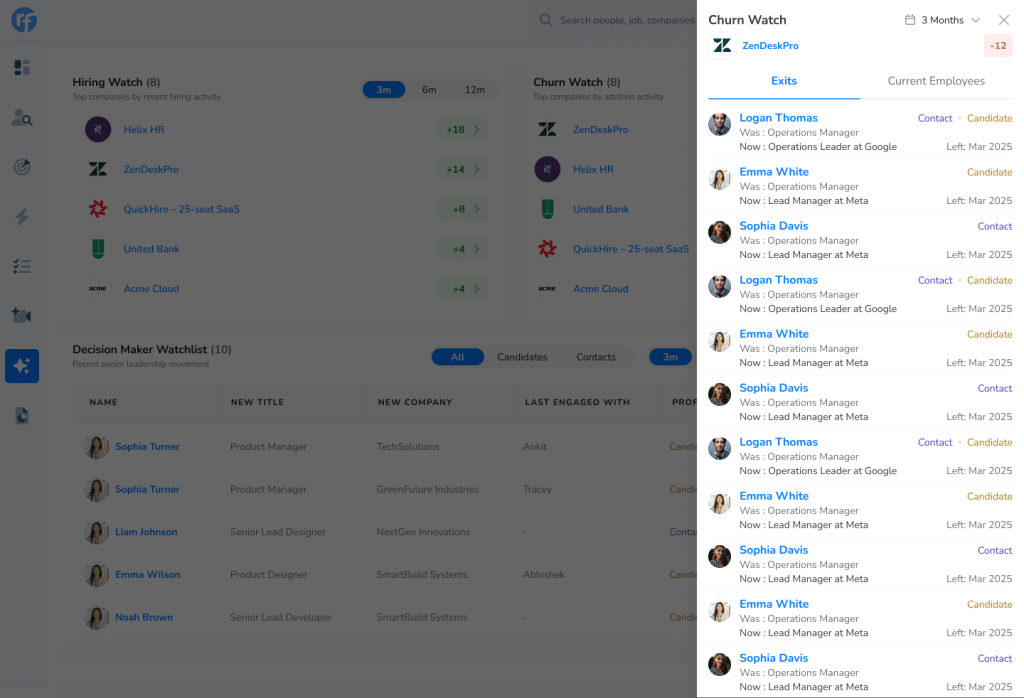
Candidate data goes stale fast — job changes, promotions, new skills. Job Change Alert continuously enriches profiles using public data signals, so when a recruiter opens a record, they’re looking at current information rather than a 2022 snapshot. This matters most for niche talent pools where your existing relationships are your real competitive advantage.
4. Score and rank by fit, not recency
Traditional ATS search returns results by last activity or alphabetically. AI-powered ranking scores candidates against the specific requirements of a live role — weighting experience, trajectory, location, and previous engagement history. Recruiters see the best-fit candidates first, not the most recently added ones.
5. Generate client-ready candidate narratives
This is where Andiamo saw the biggest operational change. Instead of recruiters writing individual candidate pitches from scratch, AIRA combines the job description with the candidate’s history, call notes, and profile to generate a client-ready narrative explaining fit and value. Andiamo doubled their client submissions YoY and reduced time-to-fill by 76% — not by sourcing more candidates, but by submitting the right ones faster with better context. (See the full case study)
6. Monitor your database for re-engagement triggers
The best sourcing lead is often someone you already know. AIRA’s Job Change Alert Agent monitors your candidate relationships for role changes — when a placed candidate gets promoted, changes firms, or moves into a hiring position, it surfaces automatically as a sourcing or BD signal. Most firms miss these entirely because they’re not watching.

Best AI Candidate Sourcing Tools in 2026
1. Recruiterflow

Best for: Retained, contingent, and executive search firms that need sourcing, outreach, and pipeline management in one system.
It’s rated 4.8/5 on G2 and starts from $119/user/month.
Where most sourcing tools focus on finding new candidates, Recruiterflow is built around a different insight: roughly 71% of placements come from candidates already in your CRM. AIRA’s sourcing agents are built around that — activating your existing database before you spend time going external.

AIRA Research Agent enriches and updates profiles automatically, AIRA Matchmaker surfaces candidates against open roles by meaning, not keyword, and AIRA Notetaker captures call context and updates records so your database stays current without recruiter admin. The result: faster qualification, better submissions, and a CRM that actually compounds in value over time.
Andiamo — a boutique search firm placing the top 0.2% of tech talent at Palantir, Amazon, and Visa — doubled client submissions and cut time-to-fill by 76% after switching to Recruiterflow. Revenue grew 4X. (Read the case study)
Pros: Full workflow in one platform (sourcing, ATS, CRM, outreach). AI runs through every stage, not just top of funnel. No integration overhead.
2. hireEZ
Best for: In-house sourcing teams running high-volume outbound across multiple platforms.
It’s rated 4.6/5 on G2 and starts from $149/user/month.
Aggregates 800M+ profiles from LinkedIn, GitHub, Stack Overflow, and 45+ other sources. Strong AI search filters, diversity sourcing tools, and outreach sequencing. Genuinely useful for niche or hard-to-fill roles where breadth of external coverage matters.
Pros: Wide external profile reach. Solid DEI sourcing filters. Clean ATS integration.
Cons: Email-heavy outreach — limited true multi-channel depth. Works as an add-on layer rather than a standalone system for search firms.
3. SeekOut
Best for: Specialist searches where standard profile data isn’t enough — technical talent, academic researchers, leadership roles.
It’s rated 4.5/5 on G2 with enterprise pricing on request.
Goes beyond LinkedIn-equivalent profiles to index patents, publications, open-source contributions, and academic output. If you’re searching for a VP of ML with specific research credentials or a niche biotech executive, SeekOut surfaces candidates most tools miss entirely.
Pros: Depth of candidate intelligence for specialist roles. Strong diversity pipeline access. Semantic search filters.
Cons: Expensive — built for enterprise teams with large sourcing budgets. Data can lag on profile updates since it relies on periodic scraping rather than live feeds. Not built for search firm workflows.
4. Loxo
Best for: Firms that want sourcing and pipeline management integrated, without building a separate tech stack.
It’s rated 4.7/5 on G2 and starts from $119/user/month.
Integrated ATS/CRM with Loxo Source searching your internal database and external profiles simultaneously. Natural language search is a genuine differentiator — you can describe a candidate the way you’d brief a colleague rather than writing Boolean strings.
Pros: Internal and external sourcing in the same platform. Natural language search works well for niche roles. Free ATS entry tier for smaller teams.
Cons: AI sourcing depth is thinner than dedicated tools like SeekOut or hireEZ. Full functionality pricing (£200+/user/month) adds up quickly for larger teams.
5. Findem
Best for: Large enterprises running diversity-focused or skills-first hiring strategies.
It’s rated 4.2/5 on G2 with enterprise pricing on request.
Attribute-based search — finds candidates by characteristics (career trajectory, tenure patterns, diversity attributes) rather than job titles or keywords. Strong for organisations trying to move away from title-matching toward actual capability assessment.
Pros: Powerful attribute search for complex talent profiles. Strong diversity sourcing filters. Integrates with major enterprise ATS platforms.
Cons: Built for in-house enterprise TA, not search firms. Pricing is enterprise-tier and reflects it. Overkill if your bottleneck is conversion speed rather than candidate discovery.
How to Add AI to Your Sourcing Without Breaking What’s Working?
The firms that struggle with AI sourcing adoption almost always make the same mistake: they buy a new tool before fixing their data.
Step 1: Audit your database first
AI is only as good as the data it runs on. Before you turn on any AI sourcing feature, run a data hygiene pass — deduplicate records, fill missing fields, tag historical candidates by specialism. A clean recruitment database with 10,000 well-structured records outperforms a bloated one with 100,000 incomplete ones.
Step 2: Start with re-activation, not external sourcing
Your existing database is the highest-ROI sourcing channel you have. Map your placed candidates from the past three years: who’s been promoted, who’s changed firms, who’s in a role they mentioned wanting to leave. Run AI search against live mandates before going to LinkedIn. Most firms find 20–30% of their searches can be closed from internal data alone.
Step 3: Automate the admin, not the judgement
The highest-value AI sourcing use case isn’t picking candidates for you — it’s removing the work that prevents good decisions. Auto-enrichment, call note capture, CRM updates, candidate narrative generation. Recruiters’ judgement is the competitive moat. AI should protect their time for it, not replace it.
Step 4: Measure submission quality, not sourcing volume
The wrong metric for AI sourcing is “candidates identified.” The right one is submittal-to-interview rate. If AI is working, your recruiters are submitting fewer candidates who get declined and more who move forward. Track that number from week one.
Ending Note
Andiamo built their tech sourcing practice on reputation — every submittal to Palantir, Amazon, and Visa had to be interview-worthy.
AIRA didn’t change that standard. It gave their recruiters the context and speed to meet it consistently, at scale: 76% faster time-to-fill, twice the submissions, four times the revenue.
Book a Recruiterflow demo and see how AI sourcing works inside an AI-native recruiting CRM.
Frequently Asked Questions
Is AI replacing recruiters in sourcing?
No — and the firms treating it that way are getting worse results, not better. AI removes the manual filtering and admin work that consume recruiter time. It surfaces candidates faster, generates better candidate narratives, and keeps databases current. The judgment calls — who to back, how to position a candidate, how to read a client’s real requirements — remain entirely human. The recruiters at risk aren’t being replaced by AI. They’re being outcompeted by recruiters who use it.
How much does AI candidate sourcing software cost?
It varies significantly by capability tier. Standalone AI sourcing tools like hireEZ or SeekOut typically run $5,000–$20,000+ per year depending on seat count and database access. Integrated platforms like Recruiterflow that include AI sourcing, CRM, ATS, and outreach in one system are generally more cost-efficient for firms that would otherwise stack multiple tools. The better question is cost per placement improvement — a 76% reduction in time-to-fill changes the unit economics significantly.
Is AI-powered candidate sourcing biased or compliant with hiring laws?
It depends on how the AI is built and what it’s trained on. The risk areas are AI ranking systems trained on historical hiring data that perpetuates past biases, and automated screening that makes adverse impact decisions without human review. Tools built on profile matching rather than demographic inference carry lower risk. The practical safeguard: AI should surface and rank candidates, not accept or reject them. Human review at every selection stage is both the ethical standard and the legal one in most jurisdictions.
How long does it take to implement AI candidate sourcing?
For a firm with clean data and an existing ATS, meaningful AI sourcing capability can be live within 2–4 weeks. The longer timelines (2–3 months) are almost always data migration and hygiene work, not the tooling itself. Firms that skip the data audit step and go straight to AI activation typically see poor early results and blame the technology. The sequencing matters.
Recruitment

Ayusmita is a B2B storyteller who spends her time translating recruiting workflows into clear stories at Recruiterflow.

Ayusmita