
Marketing Automation for Recruiters: How to Do It Right in 2026?
Scaling your search business is about repeatability – and that’s what separates the top firms from the rest. The work gets done — but only when someone remembers to do it, has time to do it, and does it consistently enough to compound.
Marketing automation for recruiters doesn’t change what you do. It makes sure it actually happens — at the right time, to the right person, without a consultant manually tracking 200 touchpoints across 15 active searches.
This guide covers where the friction lives, what to automate first, and which tools are worth your attention in 2026.
What Is Recruitment Marketing Automation?
Recruitment marketing automation is the use of software to execute, personalise, and track recruiter communications and workflows — without manual effort at every step.
It covers outreach sequences, candidate nurture campaigns, job distribution, CRM updates, email campaigns, workflow triggers, and reporting.
Done well, it compresses the time between first contact and placement — and makes sure no candidate falls through the cracks because someone forgot to follow up.
New to recruitment marketing entirely? Start with our guide to recruitment marketing before diving into automation.
Why Manual Recruitment Marketing Is Now a Competitive Disadvantage
Three forces make automation non-negotiable in 2026:
Volume without headcount. Firms are expected to do more with the same team. Automation is how you scale output without scaling costs.
Passive candidate engagement. Most of the candidates worth placing aren’t actively looking. Nurturing them — consistently, over weeks or months — is a marketing problem. Manual outreach doesn’t solve it.
Speed as competitive advantage. The firms placing fastest aren’t working harder. They’ve removed the friction between decision and action. Automation is that removal.
See how leading firms are approaching this: Recruitment Automation — What It Is and How to Use It
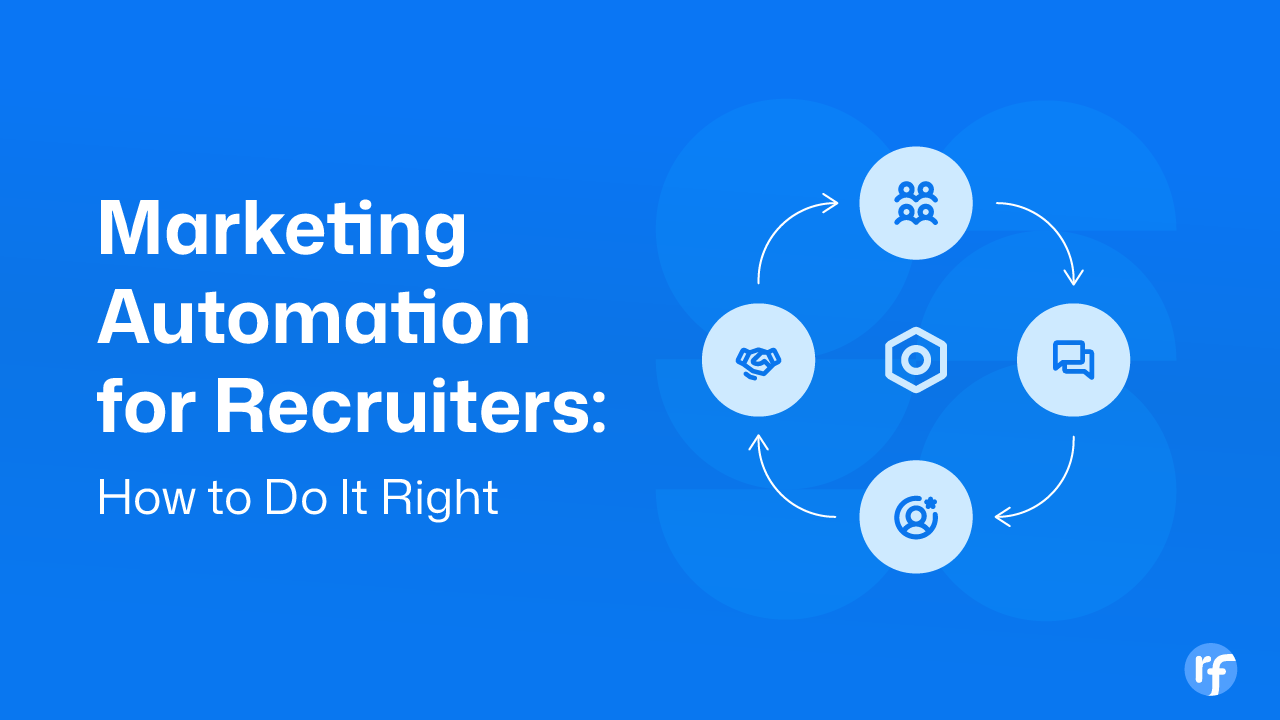
The Recruitment Marketing Automation Funnel
Think of recruitment marketing automation as a funnel with four stages. Each one has specific jobs to do — and specific places where manual effort bleeds time unnecessarily.
Stage 1: Attract — Get on the Right Radar
This is the top of the funnel. You’re building awareness with candidates who don’t know you yet — or who know you but aren’t actively engaging.
Automated job distribution pushes your roles to LinkedIn and niche job boards in one click. Branded career pages and email templates ensure every touchpoint looks consistent and professional.
The goal is volume and visibility — without a consultant manually posting to five platforms every time a new role opens.
Stage 2: Engage — Start the Conversation
A candidate who visits your career page or opens your email isn’t a placement. They’re a signal.
Multichannel outreach sequences — email, SMS, LinkedIn, phone — turn that signal into a conversation.
The best sequences are personalised by role type, seniority, and engagement history. They run automatically, with the right message at the right interval, until someone responds or opts out.
Recruiterflow’s multichannel sequences increase response rates by up to 60%. That’s not a marginal improvement — it’s the difference between a warm pipeline and a cold database.
Stage 3: Nurture — Stay Relevant Until They’re Ready
Most candidates aren’t ready to move the first time you reach them. Or the second.
The firms that compound over time aren’t the ones with the most candidates in their database. They’re the ones maintaining the right relationships — including the ones that didn’t convert the first time.
Three automations most firms aren’t running but should be:
A strong candidate gets submitted but the client passes — they automatically enter a nurture campaign, a touchpoint every six months until the next search opens.
A great candidate gets disqualified because the timing was wrong — tag them, drop them into a “rockstar engage later” campaign, stay in touch on a rolling cadence.
A candidate makes it to final interviews then withdraws — nurturing late-stage withdrawals is one of the highest-return automations in exec search. Almost nobody does it.
The candidates who placed somewhere else were reachable. Just not nurtured.
Looking for inspiration on what to send? See our recruitment marketing ideas guide.
Stage 4: Convert — Close Without Friction
Automation doesn’t close placements. Consultants do.
But automation removes every piece of friction between a warm candidate and a signed offer.
Here’s what that looks like in practice. A candidate moves to Client Submission. Without anyone lifting a finger, the client gets a branded email with a link to the full candidate portal — context, profile, everything they need to make a decision. No formatting. No attaching PDFs. No chasing.
The Submission Agent in Recruiterflow does this in a single click. What used to take three hours takes fifteen minutes. That time goes back into the search.
Workflow triggers handle the rest — moving candidates through stages, assigning tasks, firing prep communications before client interviews, updating the CRM after every interaction. Your consultants walk into every conversation with full context, not a blank screen.
Want the full playbook on automation triggers, templates, and scripts your team can use today? Download the AI & Recruitment Automation Playbook — free templates and email scripts inside.
Best Recruitment Marketing Automation Tools in 2026
In our Automations playbook, we noted that 60% of organizations already use AI to manage talent. The question isn’t whether to automate anymore — it’s what to consolidate onto.
Most tools do one thing well. The best ones connect the whole workflow.
Here’s what’s worth your attention in 2026.
Recruiterflow — AI-First, Built for Agencies
Recruiterflow is the platform built specifically for recruitment agencies that need to run lean and place fast.
The automation stack covers the full funnel:
AIRA Matchmaker surfaces candidates from your existing database using natural language search — before you touch LinkedIn or a job board. If you’ve been building your database properly, a significant portion of your pipeline is already in there.
Multichannel Sequences run personalised outreach across email, SMS, LinkedIn, and phone — automatically, with response tracking and CRM sync built in. Response rates increase by up to 60%.
Workflow Recipes are pre-built automation triggers that move candidates through stages, assign tasks to consultants, and fire communications based on actions — without anyone having to manually manage the pipeline.
Job Distribution pushes roles to LinkedIn and niche boards in one click. No more logging into five platforms. No more copy-paste job descriptions.
AIRA Job Change Alert notifies you the moment a candidate or client changes roles — triggering outreach at exactly the right time, not six months after the signal passed.
AIRA Enricher keeps your database current — automatically updating candidate and company profiles with the latest context so your research starts from accurate data, not stale records.
Real-Time Analytics show you what’s working across every sequence, campaign, and sourcing channel — so you’re optimising based on data, not instinct.
Firms using AI at any stage of their process are 3.5–4.5x more likely to have grown revenue year-over-year.
Comparing options? See our guide to best recruitment automation software and best recruitment marketing tools.
Ending Note
The firms pulling ahead in 2026 aren’t the ones working longer hours.
They’re the ones who’ve removed the friction. Automated the sequences. Built the nurture. Let the platform handle the admin while their consultants handle the relationships.
Frequently Asked Questions
What is recruitment marketing automation?
Recruitment marketing automation is the use of software to handle repetitive recruiter tasks — outreach sequences, CRM updates, job distribution, candidate nurture — without manual effort at every step. It lets recruiters spend time on the conversations that require human judgment, while automation handles everything that doesn’t.
How does marketing automation help recruiters?
It compresses time, increases response rates, and keeps candidates engaged across a long process without relying on a consultant to remember every follow-up. Recruiters using multichannel automation sequences see response rates increase by up to 60%. More practically: it removes the 70% of recruiter time currently spent on admin and puts it back into the work that actually closes placements.
What tools automate recruitment marketing?
Recruiterflow is the most complete option for recruitment agencies — covering outreach sequences, job distribution, candidate nurture, CRM automation, and AI-powered sourcing in one platform. Other tools in the space include Bullhorn, Loxo, and Beamery, each with different strengths depending on firm size and use case.
What is automated recruitment marketing?
Automated recruitment marketing is the broader practice of using software to attract, engage, and nurture candidates — the same way a marketing team would use automation to attract and nurture leads. The difference is that recruitment marketing targets candidates rather than customers, and the conversion event is a placement rather than a purchase.
Recruitment

Ayusmita is a B2B storyteller who spends her time translating recruiting workflows into clear stories at Recruiterflow.
Ayusmita