
Executive Search Business Development For Boutique Firms

Unlike contingency recruiting, where Business Development is often reactive, retained executive search requires proactive, long-cycle relationship building — often 12 to 18 months before a mandate materialises.
Here’s what actually works for executive search Business Development in 2026: from building a targeted client pipeline to converting cold contacts into retained clients, and using your existing placements as a compounding BD engine.
BD in Executive Search Is a Different Game
Most BD frameworks are built for transactional sales. Executive search isn’t transactional. The differences are structural.
The fees are high and the scrutiny is higher.
Retained executive search fees run at 25–35% of first-year total compensation, with minimum engagement fees around $80,000 at established firms. (Source: SHRM, 2025) Clients don’t write those cheques for firms they don’t know. The sale doesn’t begin with a pitch — it begins with a relationship.
The sales cycle is measured in months, not weeks.
A C-suite buyer who doesn’t have a leadership vacancy today may have one in 14 months. Most firms that win that mandate were already in conversation well before the brief existed.
Most mandates are never advertised.
CEO succession rates climbed to 12.5% in 2025 — up from 9.8% the year before, according to the Conference Board and Egon Zehnder. That’s a significant volume of leadership movement. The vast majority of those searches happen through relationships, not RFPs.
40% of C-suite executive searches fail.
(Source: Alvaro Carcel Ribes, Senior Leadership Advisor)
Clients who’ve been burned know the difference between a firm that runs a search and a firm that consults on one. BD in executive search increasingly means demonstrating that distinction before the engagement.
Executive Search BD Strategies That Win Mandates
Build a named target account list — not a sector.
“We work with PE-backed industrials” is a positioning statement. A named list of 40 firms where leadership transitions are likely in the next 18 months is a BD strategy. The difference is specificity. Executive search strategy at the firm level starts with defining exactly who you’re building relationships with.
Monitor your target accounts for triggers.
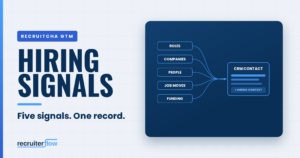
A funding round, an acquisition, a new CEO, a board change — these are the moments when leadership gaps open. Firms that reach out within days of a trigger event are positioned as informed advisors. Firms that reach out three months later are cold callers. AIRA’s Job Change Alert Agent monitors every contact in your CRM and surfaces these signals automatically — so your outreach is timed to the moment, not to whenever someone remembers to check.

Publish insight, not content.
Most executive search firm content is generic leadership commentary. The content that builds BD credibility is specific: compensation benchmarks for a particular sector, market maps showing leadership movement across a niche, insight into where talent is moving before clients see it themselves. That kind of output positions you as the advisor before the engagement.
Demonstrate search fluency early.
Most firms pitch credentials. The ones that win mandates demonstrate they understand the search process in detail — from kickoff through calibration, shortlisting, and client delivery. Partners who can speak specifically about how they run calibration meetings — presenting 5–10 candidate profiles to align on requirements before any outreach begins — signal a level of process discipline most clients haven’t experienced. That conversation, held before a mandate exists, is itself a BD move.
Use your network to build the network.
Placed candidates become hiring managers. Hiring managers become clients. Clients become referral sources. The firms that grow fastest in executive search are the ones that treat every successful placement as the start of a relationship, not the end of a transaction. Executive recruiting best practices consistently show that referral-driven mandates close faster, require less convincing, and convert at higher rates.
How to Use Your Existing Placements as a BD Engine
Your placement history is the most underused asset in executive search BD. Most firms treat it as a record of what happened. The firms that scale treat it as a pipeline signal.
Three ways placements generate mandates:
Placed executives create new client relationships.
A candidate placed as CFO at a portfolio company becomes a decision-maker three years later when that company needs a Chief Commercial Officer. If your CRM tracks the relationship — not just the placement — you’re already in position.
Clients who’ve placed with you will place again.
The Revenue Mix data from Recruiterflow’s Economics of Recruiting report shows that as firms scale, revenue from existing clients grows from 46% to 68% of total revenue. Retention is a BD strategy. How to get clients for your recruiting firm at scale is largely about deepening existing relationships, not constantly finding new ones.
Job changes in your database create warm outreach moments.
Mercury Hampton, an executive search firm specialising in engineering, aerospace, and manufacturing, processed 1,076 AIRA Job Change Alerts on their contact database. Two of those signals led directly to confirmed placements — candidates quietly hired by companies Mercury Hampton had been tracking. (Source: Mercury Hampton case study) The BD opportunity wasn’t visible without automated monitoring. With it, it was a notification.

Tools That Support Executive Search BD at Scale
The tools that move the needle for executive search BD are the ones that solve three specific problems: keeping your contact database current, staying present with target accounts over long cycles, and converting placement outcomes into future mandates.
CRM as relationship intelligence, not data storage.
A CRM that requires manual updates decays within months. Mercury Hampton’s previous system became so difficult to operate that consultants stopped using it — and the firm lost placements that weren’t logged, interviews that weren’t recorded, emails that were never sent through the system.
After switching to Recruiterflow, they documented a 164% increase in client submissions (client intros and shortlist deliveries) and a 65% reduction in time-to-fill. The change wasn’t just operational — it was BD. Clean, current data meant knowing exactly which contacts to reach and when. (Source: Mercury Hampton case study)
AIRA Job Change Alerts as a BD trigger engine.
Every leadership change in your target market is a potential mandate signal. Manually monitoring those changes across hundreds of contacts is impossible.
AIRA does it continuously — alerting you when a contact changes role, gets promoted, or moves to a new firm. For executive search software to actually support BD, it needs to turn a static database into a live signal layer.
Sequences 2.0 for consistent multi-channel presence.
The BD motion in executive search depends on 12–18 months of consistent, relevant contact. Multi Channel Sequences creates a structured cadence across email, LinkedIn, SMS, and phone — with branching logic that routes each contact to the channel they’re most likely to respond on.
Partners and associates still craft the message. The platform makes sure it gets sent, tracked, and followed up — so BD presence becomes a firm-wide process, not a habit that varies by individual.

Build the BD Engine Behind Your Next Mandates
Recruiterflow’s CRM, AIRA Job Change Alerts, and Sequences 2.0 are built for exactly this workflow — keeping your contact database current, triggering outreach at the right moment, and running multi-channel sequences that convert cold contacts into retained clients over time.
Book a personalised demo and see how Mercury Hampton used Recruiterflow to increase client intros and shortlist deliveries by 164%.
Frequently Asked Questions
What is executive search business development?
Executive search BD is the proactive process of identifying, building relationships with, and converting potential clients into retained mandates. Unlike transactional recruiting, it operates on 12–18 month relationship cycles — most mandates are won long before the brief is written.
How do executive search firms win new clients?
The most consistent path is through relationships built ahead of a mandate — staying visible to target accounts through relevant insight, monitoring leadership movement for trigger events, and converting placed candidates into long-term client relationships. Firms that wait for inbound briefs are competing for mandates others have already been shortlisted for.
What are the best business development strategies for executive search firms?
Build a named target account list rather than a broad sector focus. Monitor contacts for trigger events — funding rounds, leadership changes, acquisitions. Demonstrate search process fluency — including how you run calibration meetings — before a mandate exists. Use structured multi-channel contact cadences to stay present over 12–18 months without becoming noise. And treat every successful search as the start of a client relationship, not the conclusion of one.
What tools do executive search firms use for business development?
A CRM that stays current without manual maintenance, an outreach sequencing platform that runs multi-channel touchpoints consistently, and AI-powered job change monitoring that turns a contact database into a live signal engine. Recruiterflow combines all three — CRM, Sequences 2.0, and AIRA Job Change Alerts — in a single platform built for retained and contingent search firms.
Recruitment
Ayusmita is a B2B storyteller who spends her time translating recruiting workflows into clear stories at Recruiterflow.


Ayusmita