

Ultimate Guide to Candidate Relationship Management in 2026
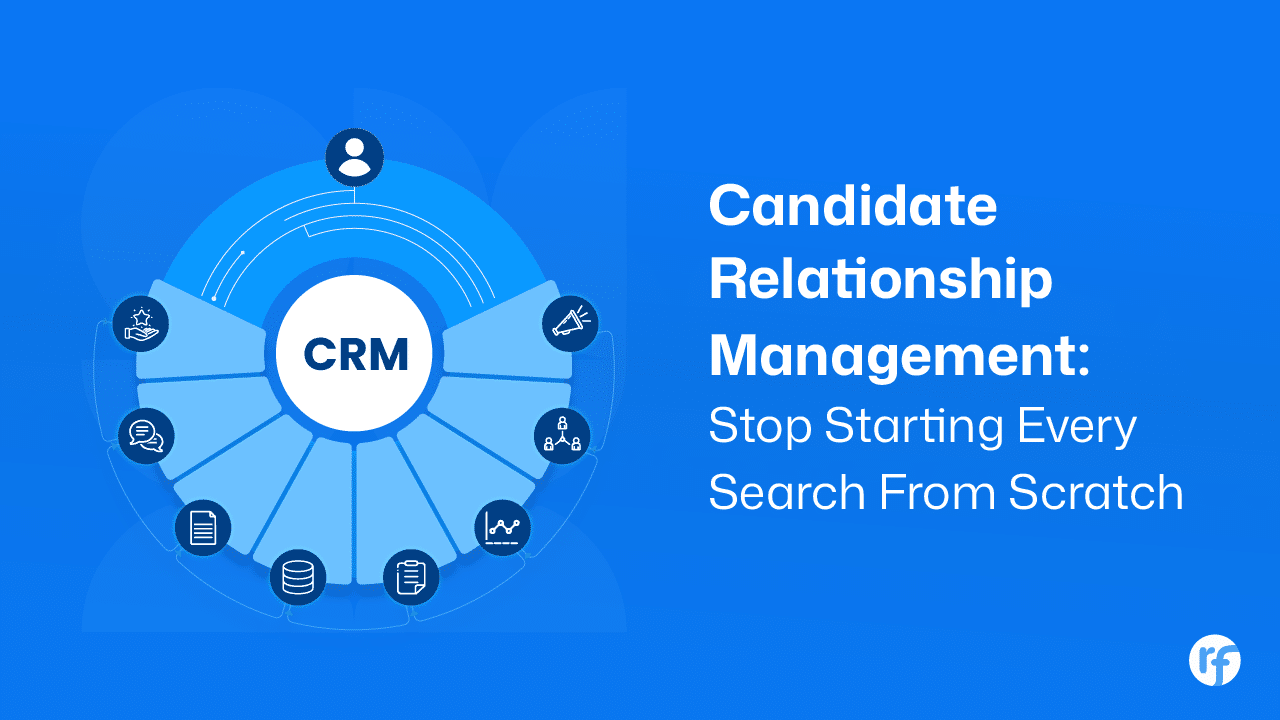
Your database is your most underleveraged asset. Most recruitment firms know this and do nothing about it.
Candidate relationship management — the discipline of building, maintaining, and activating relationships with candidates over time, not just when a job order is open — is what separates firms that consistently place from firms that start every search from scratch.
It’s the difference between a 200,000-record CRM that generates placements and a 200,000-record CRM that stores stale data nobody looks at.
This comprehensive 2026 guide explains candidate relationship management from the ground up what it is, why it matters more now than ever before, how to execute it successfully, and the top candidate relationship management tools worth investing in.
What Is Candidate Relationship Management?
Candidate relationship management (CRM) is the practice of proactively engaging and nurturing relationships with candidates — regardless of whether there’s an active role to fill. It treats your talent network as a long-term asset rather than a transactional database to query when a job order arrives.
In practice, it means staying in contact with candidates between placements, tracking relationship history and engagement signals, segmenting your network by sector and readiness, and reaching out with relevance rather than noise.
Why Candidate Relationship Management Matters More in 2026
Three forces have converged to make CRM more commercially critical than it’s ever been.
The passive candidate reality
The best candidates — the ones your clients actually want — are not on job boards. They’re employed, performing well, and not looking.
Reaching them requires a relationship that predates the job order.
Firms that operate primarily on inbound applications are fishing in the smallest pond. Firms with well-maintained CRM networks are fishing everywhere else.
Database decay is a real problem
The average recruitment database degrades at roughly 30% per year.
People change roles, get promoted, move cities, leave the workforce. A record that was accurate eighteen months ago is often wrong today. Firms that aren’t actively maintaining their databases are building long lists from bad data and wondering why outreach response rates are low.
Job change alerts, regular re-engagement sequences, and systematic enrichment aren’t nice-to-haves. They’re the operational baseline for a database that actually works.
Longer hiring cycles demand more relationship capital
Decision cycles are longer. Clients take more time to approve hires. Searches run for twelve to sixteen weeks.
In that environment, the candidates who stay engaged are the ones with whom you have an actual relationship — not just a profile in a system. Candidate dropout during long searches is almost always a relationship failure, not a process failure.
For a broader look at how CRM fits into the recruitment technology stack, see our guide to what is recruitment CRM and the benefits of CRM for recruitment.
ATS vs. CRM: The Distinction That Actually Matters
For senior recruiters, the practical implication is this: the ATS is where you work today’s requisitions. The CRM is how you make next quarter’s searches faster.
| ATS | CRM | |
| Primary purpose | Manage active job applications and hiring workflows | Build and nurture candidate relationships over time |
| Candidate status | Applied or in process for a specific role | In your network — active, passive, or future pipeline |
| Time horizon | Current open requisitions | Long-term talent pipeline |
| Key actions | Screen, shortlist, advance, reject | Engage, nurture, segment, re-engage |
| Communication | Role-specific, transactional | Ongoing, relationship-driven |
| Data focus | Application data, interview outcomes | Relationship history, preferences, engagement signals |
| Who owns it | Often TA operations or coordinators | Recruiters and business development |
For a detailed breakdown, see our full guide on ATS vs CRM in recruitment.
The Habits That Separate a Working CRM From an Expensive Contact List
The gap between firms with effective CRM and firms with expensive-but-unused CRM software is almost never the tool. It’s the habits around it.
Segment your database before you do anything else
A flat database where every candidate is treated the same is not a CRM — it’s a contact list.
Meaningful segmentation means you can reach the right people with the right message at the right moment. At minimum, segment by sector and function, seniority, engagement recency, and placement history.
The segmentation that matters most operationally: who is actively available now, who is passively open, and who is not looking but worth keeping warm.
Those three groups need different cadences, different messaging, and different levels of attention.
Make re-engagement systematic, not sporadic
Most firms re-engage candidates when they have a relevant role. That means the first contact in a year is a pitch — and pitches from people you haven’t heard from in twelve months don’t land well.
The firms with the best response rates are the ones whose candidates hear from them consistently, with something worth reading: a market update, a salary benchmark, an industry development that’s relevant to their function.
Not every touchpoint needs to be a job. In fact, the touchpoints that aren’t jobs are the ones that build the relationship that makes the job conversation easier.
|
Capture context from every interaction
A candidate record with a name, title, and phone number is nearly worthless.
A candidate record that includes what they told you about their motivations in 2023, what they were earning at their last role, what kind of move they said they’d consider, and what you discussed in your last call — that’s an asset.
The problem is that most recruiters don’t update records consistently. The context lives in their head, in email threads, in call notes that never made it to the CRM. When that recruiter leaves, the relationship walks out with them.
Platforms with automatic call transcription and CRM update agents solve this structurally — the context is captured whether or not the recruiter remembers to log it. That’s institutional memory rather than personal memory, and it survives staff turnover.

Use job change alerts as a re-engagement trigger
A candidate who just changed roles is in one of two states: they’ve landed somewhere they’re excited about, or they’ve made a lateral move that already feels wrong.
Either way, a well-timed congratulatory message — followed by a genuine check-in — opens a conversation at exactly the right moment.
Job change alerts automate the signal. The response still requires a human. But knowing within days rather than months that someone in your network has moved is a meaningful competitive advantage, particularly for executive search firms working passive markets.
Treat silver medalists as first-round picks for the next search
The candidate who came second in a competitive search — interviewed well, impressed the client, lost out on one criterion — is pre-qualified, reference-checked, and already familiar with your process. They’re often the fastest path to a successful placement on the next similar search.
Most firms note the outcome and move on. The firms with effective CRM tag silver medalists explicitly, track their availability, and reach out first when a relevant role opens. It’s one of the highest-ROI habits in recruitment and one of the most consistently overlooked.
Align CRM activity with business development
Candidate relationships and client relationships don’t exist in separate silos — or they shouldn’t. A candidate who moves into a hiring role becomes a client prospect. A client contact who gets made redundant becomes a candidate. The firms that manage both sides of the relationship in one system, with visibility across both, convert these transitions faster than firms that treat BD and recruiting as separate functions.
See our guide to candidate matching for how modern CRM systems surface the right candidate at the right moment rather than relying on manual search.
Best Candidate Relationship Management Software in 2026
The right CRM depends on whether you’re running a recruitment firm, a search business, or an in-house TA function — and whether you need CRM as a standalone tool or as part of a unified ATS+CRM platform. For most recruitment firms, the unified approach wins: context doesn’t fragment across systems, and your team isn’t manually transferring data between tools.
Here’s how the main options stack up.
| Tool | Best for | Key CRM strengths | Pricing |
| Recruiterflow | Recruitment firms, executive search, staffing | AIRA AI Twin, job change alerts, multi-channel sequencing, ATS+CRM unified | $119–165/user/month |
| Bullhorn | Large staffing firms | Deep ATS integration, enterprise-grade, wide ecosystem | Custom pricing |
| Vincere | Mid-size recruitment firms | Strong analytics, CRM + ATS combined, good reporting | Custom pricing |
| Loxo | Firms wanting AI sourcing | AI sourcing, talent intelligence, CRM built-in | From ~$600/user/month |
| Beamery | Enterprise in-house TA | Talent marketing, pipeline nurturing at scale | Enterprise pricing |
| Clinch (PageUp) | In-house TA teams | Candidate marketing, career site integration | Custom pricing |
1. Recruiterflow
Built for recruitment firms and search businesses — not adapted from a generic CRM. The ATS and CRM are unified, which means candidate relationship history is visible alongside active pipeline without switching systems.
AIRA handles the operational layer: call transcription, automatic CRM updates, job change alerts, and multi-channel outreach sequencing. The result is that relationship context gets captured consistently rather than depending on recruiter discipline.
Particularly strong for executive search and retained search firms where relationship depth matters more than application volume.
At $119–165/user/month, it’s significantly more affordable than enterprise alternatives with comparable AI capability.

2. Bullhorn
The dominant platform for large staffing firms. Deep ATS functionality, an extensive integration ecosystem, and enterprise-grade reliability. CRM capabilities exist but are not the strength — Bullhorn is fundamentally an ATS with relationship features layered in. The UI has improved but still carries legacy complexity. Pricing is custom and typically high. Worth considering at enterprise scale; harder to justify for smaller or mid-size firms.
3. Vincere
A strong mid-market option with solid analytics and combined ATS+CRM functionality. Good reporting on pipeline metrics and search performance. Less AI-native than Recruiterflow; more process-oriented. Works well for firms that want operational visibility across multiple practice areas. Pricing is custom.
4. Loxo
Positioned around AI sourcing and talent intelligence. The CRM is built-in and the AI surfacing of candidates is genuinely strong. Starting price of around $600/user/month makes it significantly more expensive than Recruiterflow for comparable functionality. Better suited to firms where sourcing speed is the primary constraint rather than relationship depth.
5. Beamery
Enterprise-grade talent relationship management built for large in-house TA teams. Strong at candidate marketing, pipeline nurturing at scale, and talent community management. Not designed for recruitment firms — this is an in-house tool. If you’re evaluating for a corporate TA function with significant headcount, it warrants consideration. For a recruitment or search business, it’s the wrong fit.
6. Clinch (PageUp)
In-house TA focused, with strong candidate marketing and career site integration. Similar positioning to Beamery — enterprise in-house rather than recruitment firm. The CRM functionality is oriented around employer brand and candidate experience rather than recruiter-led relationship management.
For a more detailed comparison, see our full guide to best candidate relationship management software.
Conclusion
Candidate relationship management is not a software problem. It’s a discipline — one that compounds over time. The firms that do it well have a structural advantage in every search: faster access to passive candidates, higher response rates, lower sourcing cost, and a database that gets more valuable with every interaction rather than decaying in the background.
The tool matters. The habits around the tool matter more.
FAQs
What does CRM mean in recruiting?
CRM stands for Candidate Relationship Management. In a recruiting context, it refers to the practice of proactively building and maintaining relationships with candidates over time — not just when an active role is available. It also refers to the software platforms that support this, combining contact management, engagement history, communication tools, and pipeline tracking in one system.
What is a candidate management system?
A candidate management system is a platform that helps recruiters track, engage, and manage candidate relationships across the full talent lifecycle — from first contact through placement and beyond. It typically includes a searchable candidate database, communication tools, engagement tracking, and pipeline management. In most modern platforms, candidate management functionality is combined with ATS and CRM capabilities rather than existing as a standalone tool.
What is the difference between an ATS and a CRM?
An ATS (Applicant Tracking System) manages active hiring workflows — applications, screening, interviews, offers. It’s built around specific open roles and the process of filling them. A CRM manages relationships over time, independent of any specific role — engagement history, re-engagement sequences, passive pipeline nurturing. The practical distinction: your ATS handles today’s searches; your CRM builds the talent network that makes future searches faster. Most modern recruitment platforms combine both.
What are the best CRM tools for recruitment?
For recruitment firms and search businesses, the leading options are Recruiterflow, Bullhorn, Vincere, and Loxo — each suited to different firm sizes and priorities. For in-house TA teams, Beamery and Clinch are more relevant. The right choice depends on whether you need a unified ATS+CRM, your firm size, and how central AI-driven relationship management is to your workflow.
Recruitment

Ayusmita is a B2B storyteller who spends her time translating messy, human recruiting workflows into clear stories that help teams work smarter, not harder. Big believer in human-first optimization, she writes for people who prefer clarity over complexity and conversations over checklists.

Ayusmita