
What Is an ATS? What It Actually Does, and What It Cannot
An ATS, or applicant tracking system, is the database and workflow layer that a hiring process runs on. It stores candidates and jobs, connects the two, and records every interaction and stage change along the way.
Candidates often describe an ATS as an invisible machine that automatically rejects applications. Recruiters know it as the system their working day runs inside. The reality is closer to the latter, although misconceptions about what an ATS can and cannot do remain widespread.
This guide explains what an ATS is, the five core functions every applicant tracking system performs, what it is often assumed to do but cannot, and what recruitment firms need from an ATS that in-house hiring teams do not.
What an ATS actually does
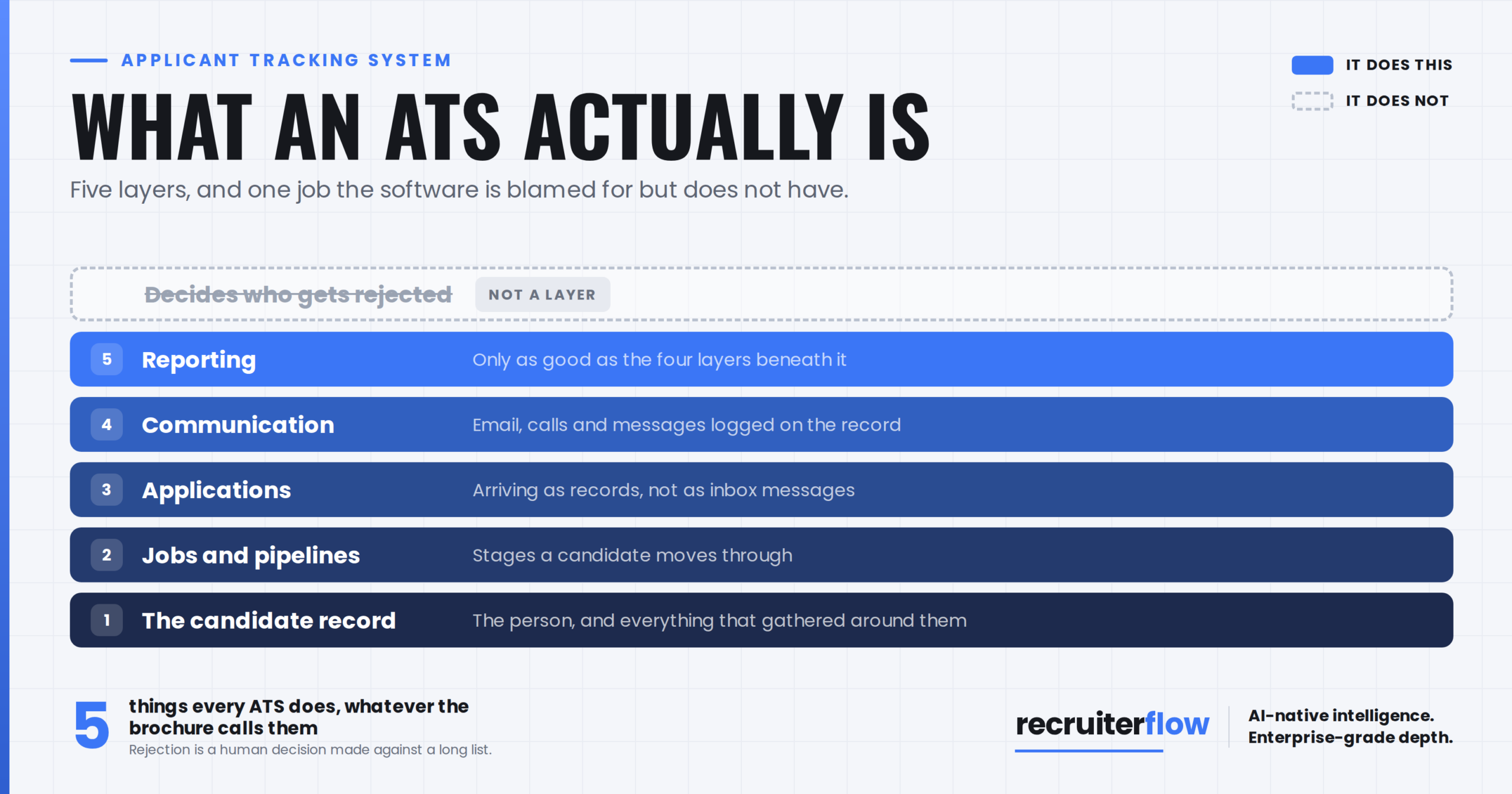
Strip away the marketing and every applicant tracking system does the same five things.
Holds the candidate record
One place where a person exists, with their history attached: applications, notes, calls, emails, attachments. The value of the record is not the contact details. It is everything that accumulated around them over the years.
Manages jobs and pipelines
A job has stages, and candidates move through them. Screening, submitted, interviewing, offer, placed. The stage names differ by firm. The structure does not.
Captures applications
Applications arrive from a careers page, a job board, an email address or a referral, and land as records rather than as messages in someone’s inbox.
Carries the communication
Email, and increasingly calls and messages, logged against the record so the next person to touch it can see what was said without asking.
Reports on all of it
Time to fill, source performance, pipeline volume, activity by consultant. The reporting is only as good as what the first four steps captured.
What the acronym hides
Applicant tracking system is a name from an era when the job was tracking applicants who applied to you. Most recruitment firms spend their time on people who did not apply, which is why the category has drifted well past its own name.
What an ATS does not do
This is where the public conversation and the working reality separate.
It does not decide who gets rejected
The belief that an applicant tracking system silently bins resumes is the most durable myth in hiring. Screening and knockout questions are features an employer switches on and configures. Many never do. When an application goes nowhere, the usual explanation is that a person looked at a long list and stopped reading, not that software intervened.
The distinction matters commercially too. A firm that believes its system is making decisions will stop checking the decisions.
It does not read a resume the way a person does
Parsing extracts structured fields from an unstructured document. It is good at names, dates, titles and skills, and it is imperfect on anything unusual: a two-column layout, a table, a career break described in prose. That is a reason to check parsed records rather than a reason to distrust the category.
It is not, by itself, a sourcing tool
An applicant tracking system organises the people you have. Finding people you do not have is a different job, and whether it happens inside the same platform varies enormously.
An ATS and a CRM are not the same thing
For recruitment firms this is the distinction that decides whether the software fits.
Two different questions
An ATS answers where a candidate is in a live search. A CRM answers who you know and who is worth calling now. Our longer piece on why search firms need both sets out the difference, and it reports that 71% of placements came from candidates already in the database before the search opened.
Why firms feel the gap before they name it
The symptom is familiar: the system is tidy while a search is open and useless the moment it closes. Candidates go quiet, clients are tracked in a spreadsheet, and business development lives in someone’s inbox. Nothing is broken. The software is simply doing the narrower of the two jobs.
Against a $168,000 annual revenue gap per recruiter between top-quartile firms and everyone else (Source: The Economics of Recruiting), a database that only works during live searches is an expensive way to store relationships.

What a recruitment firm needs that an in-house team does not
Most applicant tracking systems were built for companies hiring for themselves. Firms hiring for clients have three requirements those systems treat as edge cases.
Clients and deals as first-class objects
An in-house team has one employer. A firm has many, each with contacts, terms, fee agreements and a commercial history. If clients live in a notes field, the system was not built for you.
One candidate, many pipelines
The same person can be shortlisted for three clients at once. A system designed around a single employer’s requisitions tends to handle that awkwardly.
Business development in the same place as delivery
The work that wins the next mandate and the work that delivers the current one draw on the same relationships. Splitting them across two tools is how context gets lost.
Six signs yours is working
- A consultant can reconstruct a candidate relationship from the record alone, without asking a colleague.
- Notes and call logs survive, not just structured fields.
- Searching the database returns people you had forgotten, not only people you remember.
- Client and contact history sits in the same system as candidate history.
- Reports come out of the system rather than out of a spreadsheet rebuilt every month.
- New starters are productive on it in days rather than weeks.
If most of those are true, the system is doing its job. If most are not, the problem is usually configuration or adoption rather than the category.
The category is older than the problem
The name applicant tracking system describes a job most recruitment firms stopped doing years ago. What firms actually need is a record of every relationship they have built, searchable by meaning, with the commercial side of the business in the same place as the delivery side.
If you are evaluating one, our guide to evaluating an AI-native platform sets out the comparison, and what ATS pricing actually includes is worth reading before you talk to anyone.
Bring the six signs above to a demo and see how many the platform can show you rather than describe.
FAQs
What does ATS stand for?
Applicant tracking system. The name describes the original job of the software, which was tracking people who applied to a posted role.
What is an ATS in recruiting?
The system that holds candidate records, manages job pipelines, captures applications, logs communication and reports on activity. For a recruitment firm it usually needs to hold client and deal information as well.
Does an ATS automatically reject applications?
Not on its own. Screening and knockout questions are configurable features an employer chooses to switch on. Most rejections are human decisions made quickly against a long list.
What is the difference between an ATS and a CRM?
An ATS tracks candidates inside live searches. A CRM maintains relationships between them, including clients and prospects. Firms generally need both, in one system rather than two.
Do small recruitment firms need an ATS?
Once more than one person needs to see the same candidate history, a shared system replaces a spreadsheet. The threshold is shared context rather than headcount.
How is an AI-native ATS different?
In an AI-native platform the intelligence runs through the workflow rather than sitting beside it as a feature. Our guide to what AI-native actually means covers the distinction and how to test a vendor’s claim.
Recruitment
Ayusmita is a B2B storyteller who spends her time translating recruiting workflows into clear stories at Recruiterflow.
Ayusmita