

Recruiting Firm Owner’s Guide to Recruiter Onboarding & Ramp
Recruiter onboarding is more than getting a new hire familiar with the tools and team. It’s about getting recruiters productive faster, with a process that’s structured, repeatable, and measurable. This guide covers:
- Why ramp time is a hidden cost, not a soft metric
- What a real 30/60/90 program covers
- How to make onboarding repeatable, not person-dependent
- Which tools genuinely shorten the curve
- How to measure ramp time with data instead of a gut check
Why recruiter ramp time is a hidden cost, not a soft metric
Recruiting is a conversion-driven business, not a volume business. A recruiter can make 80 calls a day and still produce little if they haven’t yet learned how to move a candidate from screen to submission — the step every recruiter has to learn on the job, one way or another.
Industry-wide, screen-to-submission is the biggest funnel leak. Only 11.3% of screened candidates reach client submission on average (Source: The Economics of Recruiting). The gap between top performers and everyone else on this one metric is significant:
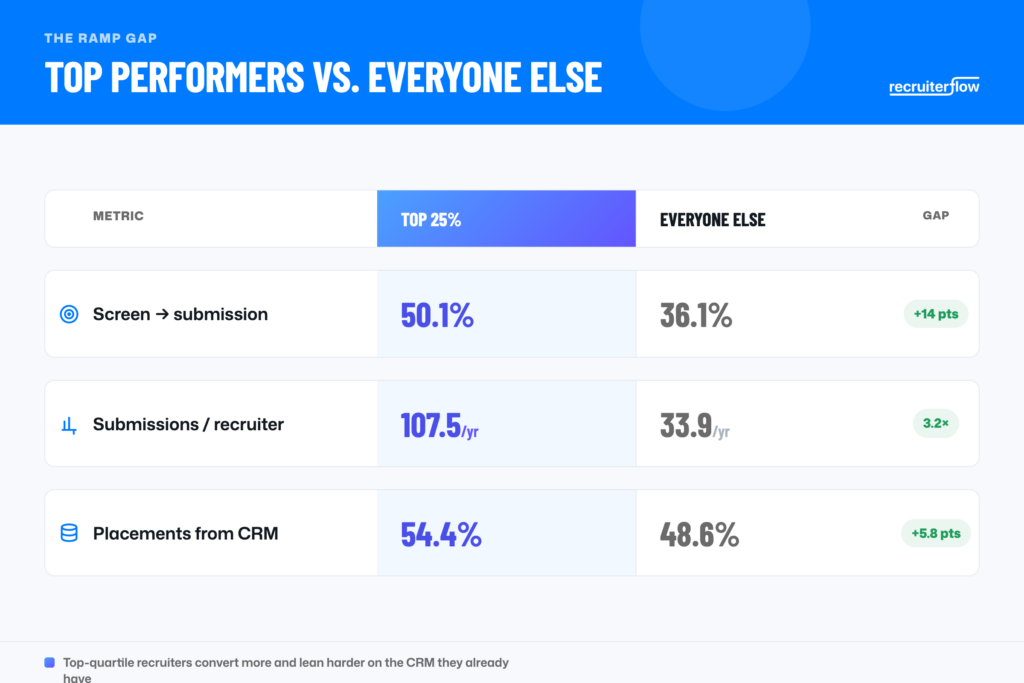
(Source: 25 Recruitment Metrics to Track in 2026)
The first 90 days matter more than most firms realize. Employ’s 2025–2026 benchmarks, cited in a recent staffing industry analysis, found 90-day retention fell to 84.6% in 2025, down from 93.9% the year before — even as time-to-fill improved. Hiring faster without onboarding better just moves the risk earlier.
Continuity Partners, an NYC firm, put a real number on fixing this. They cut new-recruiter training time from 7–10 days to 1–2, which contributed to 33% higher recruiter productivity and 25% revenue growth in six months (Source: Continuity Partners case study).
What a strong onboarding program covers (the first 30/60/90 days)
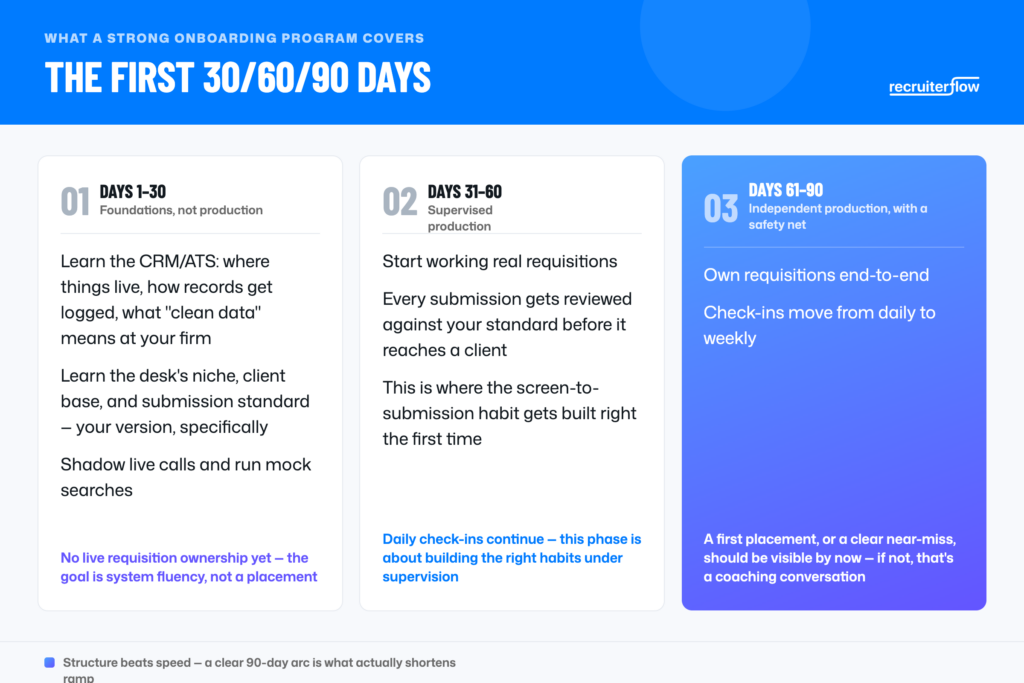
Days 1–30 — Foundations, not production
- Learn the CRM/ATS: where things live, how records get logged, what “clean data” means at your firm
- Learn the desk’s niche, client base, and submission standard — your version, specifically
- Shadow live calls and run mock searches
- No live requisition ownership yet — the goal is system fluency, not a placement
Days 31–60 — Supervised production
- Start working real requisitions
- Every submission gets reviewed against your standard before it reaches a client
- This is where the screen-to-submission habit gets built right the first time
Days 61–90 — Independent production, with a safety net
- Own requisitions end-to-end
- Check-ins move from daily to weekly
- A first placement, or a clear near-miss, should be visible by now — if not, that’s a coaching conversation
Give each phase one named owner — a team lead or senior recruiter, not whoever happens to be free. Recruiterflow’s guide to recruiter training breaks down the underlying skills — sourcing, interviewing, negotiation, business development — none of which belong on day one.
How to make onboarding repeatable, not person-dependent
A 30/60/90 framework only works if it runs the same way every time. In practice, that means three things:
- Written down — a checklist that exists outside any one person’s head, so onboarding doesn’t stall when your best trainer is out
- Owned — one named person accountable for each new hire’s ramp
- Checked — progress reviewed against the plan on a schedule, not only after something’s gone wrong
Many firms rely on their best recruiter training new hires informally. That works well — until that person is out, promoted, or leaves, and the training know-how leaves with them.
This is the same discipline behind firms that scale well. As Recruiterflow’s growth playbook notes, growth spending often goes to headcount before it goes to the system that headcount will run on. Onboarding is that system for new hires. Build it once, and every recruiter after the first one ramps faster.
Tools that shorten ramp time (CRM training, playbooks, shadowing)
Good tools don’t replace a structured program. They free up the time a structured program needs. An integrated ATS and CRM helps here specifically, because a new recruiter learns one system instead of stitching together several.
AI-assisted search on the hardest skill to teach: sourcing.
Boolean search takes months to master well. AIRA Matchmaker sidesteps that curve — a recruiter types qualification criteria in plain English and gets a shortlist in minutes, with a score explaining why each candidate qualifies.
Automated CRM hygiene from day one.
Inconsistent data entry early on is easy to pick up and hard to unlearn later. The AIRA Update Field Agent auto-fills missing or outdated profile data from calls, emails, and recruiting activity, keeping a new recruiter’s database clean without needing months of manual habit-building. Andiamo saw this play out at scale: AIRA agents joining calls and updating records automatically helped drive a 76% reduction in time-to-fill (Source: Andiamo case study).
Playbooks and shadowing, still.
Automation removes friction, not judgment. New recruiters still need to watch a senior recruiter handle a tough client call or a candidate objection. The fastest-ramping firms pair automation for mechanical work with real shadowing for what still needs a human read.
How to measure ramp time and know when a recruiter is up to speed
A gut feeling (“they seem to have it now”) isn’t a metric. The better approach: measure ramp against the same funnel benchmarks that measure everyone else. “Ramped” simply means performing like your established recruiters.
Track these four numbers per new hire, from day one:
- Screen-to-submission rate approaching the desk average. If established recruiters convert in the 40–50% range, a ramped recruiter should be closing in on that.
- Submissions per month hitting a defined floor. Top performers average 107.5 submissions a year against 33.9 for everyone else. Set a floor scaled to your desk and track weeks-to-floor as your firm’s real ramp-time number.
- First placement inside a defined window. Not a hard deadline — a flag. If 60 days pass with no placement and no near-miss in the pipeline, that’s worth a coaching conversation.
- Share of placements sourced from the existing database. Top firms place 54.4% of hires from candidates already in the CRM. A ramped recruiter should be trending toward that habit.
Track these consistently, and you get a real ramp-time figure for your firm — in weeks, based on your own numbers, not a borrowed industry rule of thumb.
FAQs
What should a recruitment onboarding software solution include?
Guided, self-paced CRM/ATS training, role-based checklists for the 30/60/90 timeline, automation that reduces manual data entry during the learning phase, and reporting that tracks a new hire’s funnel metrics against desk averages.
What’s the difference between recruiting and onboarding?
Recruiting is sourcing, screening, and placing candidates for open roles. Onboarding is the internal process of getting a new hire — here, a new recruiter — trained, equipped, and productive. A firm can be excellent at one with no formal process for the other.
What does a new recruiter onboarding checklist look like?
Three phases: CRM and process fluency in the first 30 days, supervised live requisitions from day 31–60, and independent ownership with declining check-ins from day 61–90 — each with specific, checkable milestones.
How long should recruiter onboarding take (ramp time benchmarks)?
There’s no universally agreed industry number, and it’s worth being skeptical of anyone citing one precisely. The more useful benchmark is internal: track how many weeks it takes a new recruiter’s screen-to-submission rate and submission volume to approach your desk’s own average.
How do you onboard a recruiter working remotely?
The same 30/60/90 structure applies, but shadowing needs to be scheduled deliberately — remote hires miss the incidental “overhear a great call” learning that happens in an office. Recorded call reviews and scheduled shadow sessions help close that gap.
What KPIs show a recruiter has fully ramped?
Screen-to-submission rate near the desk average, submissions per month at or above your internal floor, a first placement (or strong near-miss) inside your defined window, and a healthy share of placements sourced from the existing database.
Recruitment
Ayusmita is a B2B storyteller who spends her time translating recruiting workflows into clear stories at Recruiterflow.


Ayusmita