
What Is Agentic AI in Recruiting?
Generative AI writes the job description. Agentic AI posts it, sources against it, screens the applicants, books the interviews, and updates the record, then tells you what it did. One produces output on request; the other pursues a goal until it is finished.
This guide explains what agentic AI in recruiting means, how it works, what it does across the workflow, and how to tell the real thing from the marketing.
What is agentic AI in recruiting?
Agentic AI is artificial intelligence that behaves like an agent: you give it a goal, and it decides the steps, uses the tools available to it, and works toward the outcome without a prompt for each move. In recruiting, that means a system that can take a role, source candidates, screen them, reach out, and update your records as one connected sequence, checking its own progress along the way.
The word that matters is autonomy.
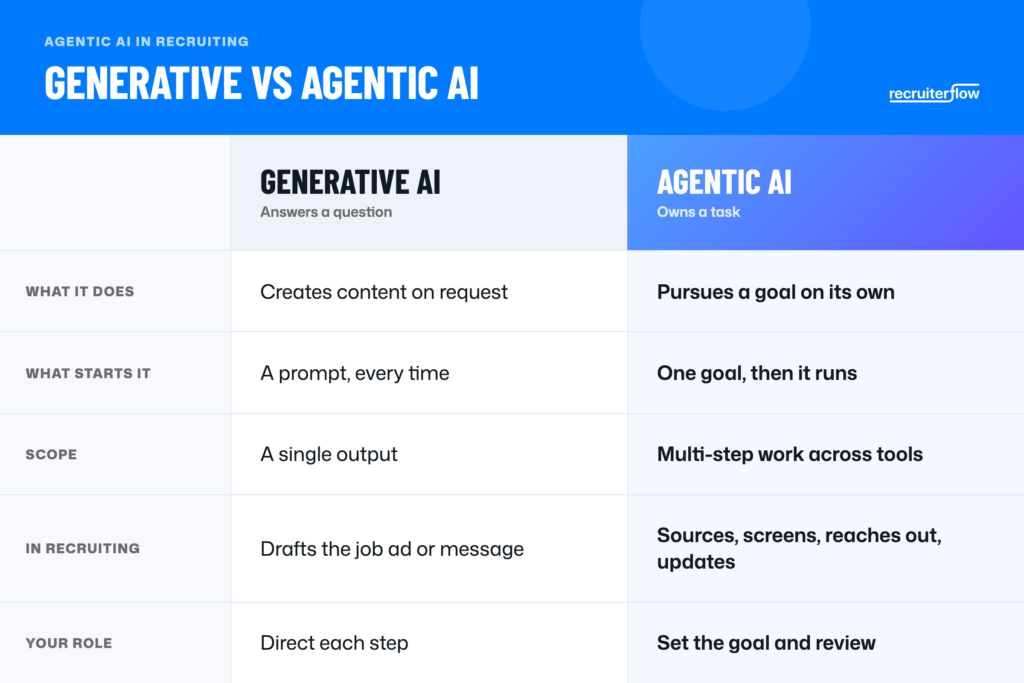
A generative model answers a question. An agent owns a task.
That distinction is the one buyers ask about most, so it is worth seeing side by side:
How agentic AI works: perceive, decide, act
Every agent runs a version of the same loop:
- Perceive. It reads the current state: the open role, the candidates in your database, the replies in the inbox, the signals in the market.
- Decide. It plans the next step toward the goal, choosing from the actions available to it.
- Act. It carries the step out using your tools, checks the result, and loops back.
Three things separate this from older automation. An agent works from a goal rather than a fixed script, so it adapts when reality does not match the plan. It chains multiple tools together rather than firing a single trigger. And it keeps context over time, so it sharpens as it learns your data. That combination, goal-driven, multi-step, and adaptive, is what earns the label agentic. The fuller line between agents and automation rules is where the distinction gets precise.
What agentic AI does across the recruiting workflow
In practice, agentic AI shows up as agents that each own a slice of the work:
- Sourcing. An agent searches for candidates against a live role and builds a shortlist instead of waiting for a recruiter to run each query. Recruiterflow’s AIRA Source does this across the web.
- Matching. AIRA Matchmaker ranks candidates by what a role means rather than the keywords it contains, and checks your existing database first, where most placements are hiding.
- Re-engagement. AIRA Job Change Alert watches your contacts and flags when someone changes roles, turning a stale record into a live opportunity.
- Record-keeping. AIRA Notetaker turn calls and emails into updated records and assigned tasks without anyone typing.
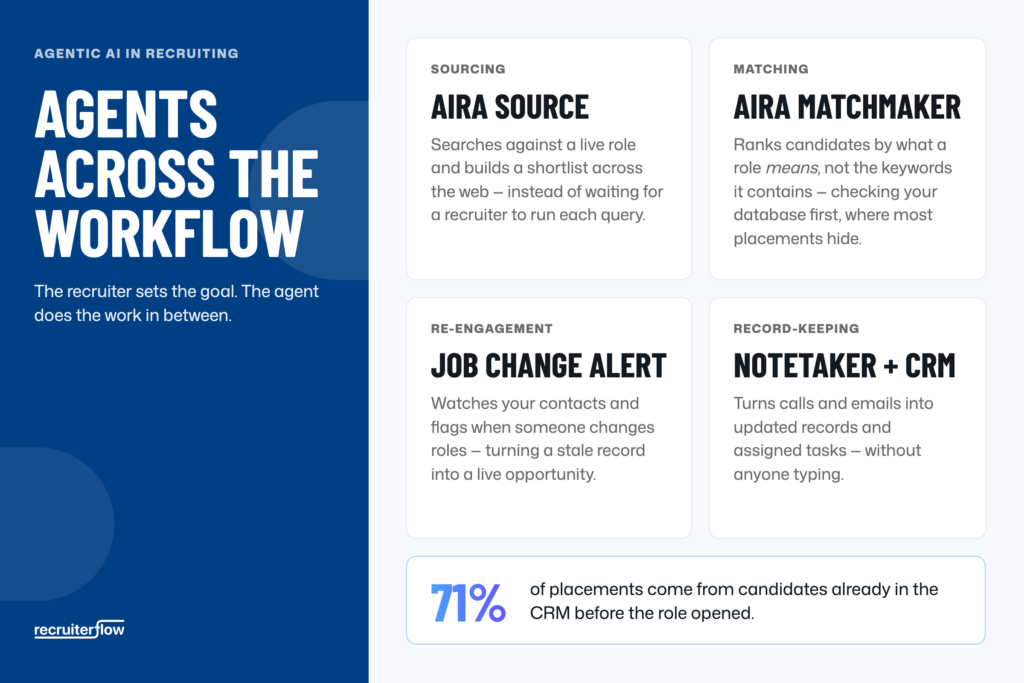
The pattern across all four is the same: the recruiter sets the goal, and the agent does the work in between.
Why agentic AI matters for a recruiting firm
The point of autonomy is time. Recruiters lose a large share of the week to admin, and it wears them down.
Recruiterflow’s research found that 61% of recruiters report burnout, with 45% tracing it to repetitive admin, the exact work agents absorb, giving back an estimated 10 to 15 hours per recruiter each week.
Source: How AI Agents Can Help Recruiters Reduce Burnout and Bill More
It shows up in results too. Most placements are already hiding in your data: 71% come from candidates in the CRM before the role opened, and firms acting on the change signals an agent surfaces cut time to first submittal by 34% while placing 12% more candidates.
Source: The Economics of Recruiting
The gain is not that agents replace recruiters. It is that they clear the busywork, so recruiters spend more time on the conversations only a human can have.
Agentic AI vs. automation vs. copilots
It helps to place agentic AI next to the two things it gets confused with.
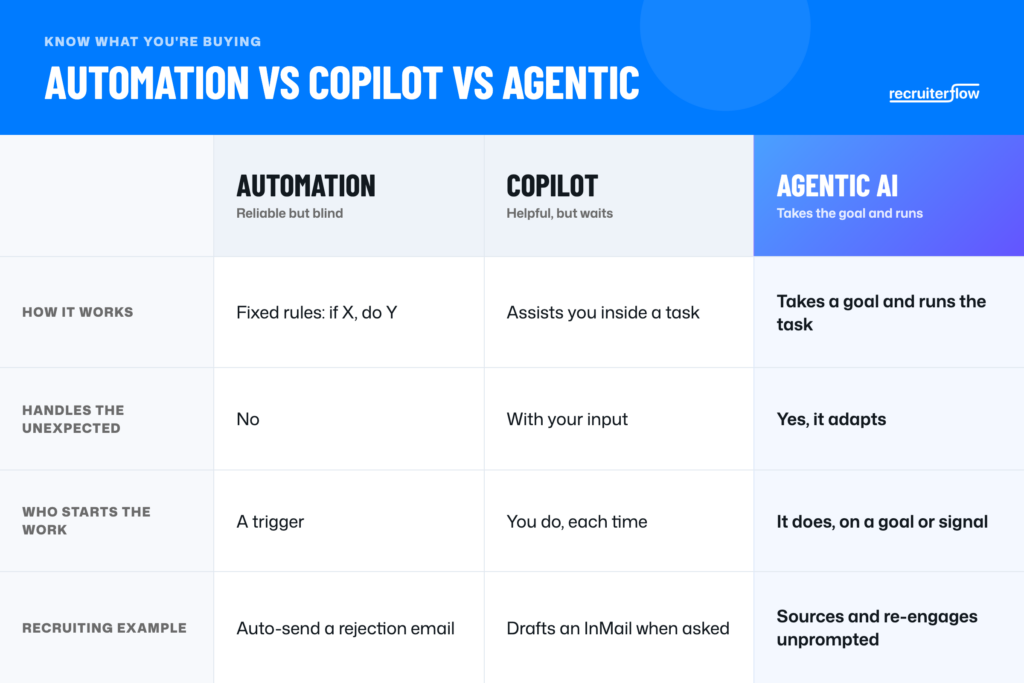
Automation is reliable but blind. A copilot is helpful but waits for you. Agentic AI sits beyond both: it takes the goal and runs the task itself. The distinctions are worth understanding in full, because vendors blur them, and how an agent differs from a copilot is its own read.
Real agentic AI vs. agent-washing
Because “agentic” sells, plenty of tools claim it without earning it. Analysts have been blunt about how much of the current wave is repackaging:
“Most HR tech vendors are ‘bolting on’ Generative AI tools.”
Josh Bersin, HRD Connect
Gartner named the pattern in a June 2025 forecast, predicting over 40% of agentic AI projects would be canceled by the end of 2027, and calling out “agent washing”: rebranding assistants, chatbots, and rule-based automation as agents. Gartner reckoned only about 130 of the thousands of self-described agentic vendors were the real thing.
Three questions cut through it:
- Does it act without a prompt, on a trigger you did not click?
- Does it complete multi-step work across tools rather than a single action?
- Does it have real architecture behind it? Agentic behavior depends on intelligence built into the core, which is why it tends to live in an AI-native platform rather than bolted onto a legacy one.
Answer yes to those and you are looking at agentic AI. Answer no and you are looking at a feature with a new name.
FAQs
What is the difference between agentic AI and generative AI?
Generative AI creates content in response to a prompt: a job description, a boolean string, an outreach message. Agentic AI pursues a goal, taking multi-step action across tools without a prompt at each step. In recruiting, generative AI drafts the message, while agentic AI decides who to contact, sends it, and follows up.
What is the difference between agentic AI and AI agents?
Agentic AI is the capability: a system able to act autonomously toward a goal. An AI agent is a single actor that does it, such as a sourcing agent or a re-engagement agent. Agentic AI is the paradigm; AI agents are the workers that carry it out.
How much does agentic AI recruiting software cost?
Pricing ranges from usage-based add-ons to platforms where agents are built into the core subscription rather than billed separately. The more useful question is cost per outcome, since an agent that runs a full workflow can cost less per placement than a tool you still have to drive. Ask vendors to price against results.
How do you start using agentic AI in recruiting?
Begin with one narrow, high-value job rather than automating everything at once. Re-engaging your existing database or keeping records updated automatically are common first steps. Give the agent a clear goal, keep a human reviewing outcomes, and expand once you trust it.
Do smaller recruiting firms benefit from agentic AI?
Often more than large ones, because small firms have the least time for admin and the fewest people to absorb it. An agent that sources, updates records, and flags opportunities adds capacity without adding headcount. The value depends less on firm size than on how much of the week goes to work software could handle.
Recruitment
Ayusmita is a B2B storyteller who spends her time translating recruiting workflows into clear stories at Recruiterflow.


Ayusmita