
7 Best Recruit CRM Alternatives for Search Firms in 2026
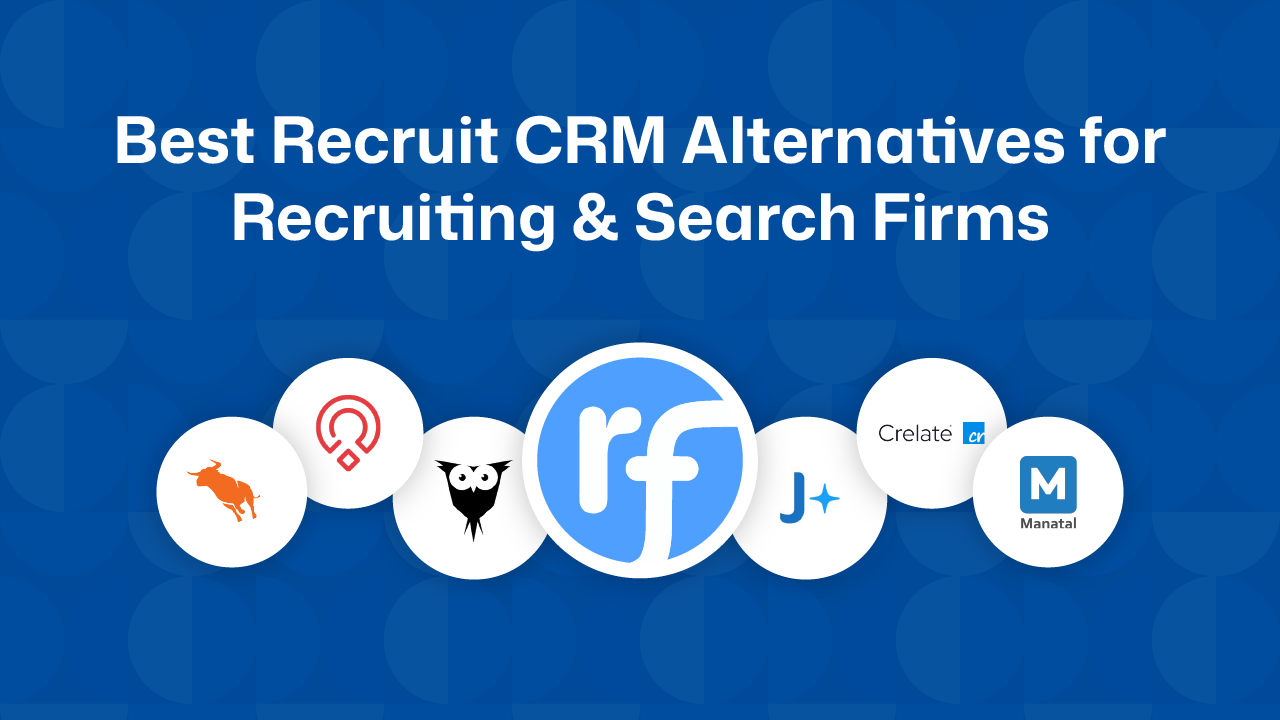
Looking for the best Recruit CRM alternatives for recruiting and search firms in 2026? We’ve listed the top alternatives to Recruit CRM in this blog, along with their G2 and Capterra ratings, pricing, ideal use cases, pros and cons, and the real-world tradeoffs of each.
If you want AI built into the core of your recruitment platform, Recruiterflow is one of the closest AI-native alternatives. If sourcing is your biggest priority, Loxo stands out. For large staffing firms that need back-office and VMS functionality, Bullhorn remains a strong option.
The 7 Best Recruit CRM Alternatives in 2026
Here are the seven platforms covered in this guide:
- Recruiterflow – Best for AI-native recruiting and search
- Loxo – Best for built-in candidate sourcing
- Bullhorn – Best for enterprise staffing
- Crelate – Best for workflow customization
- JobAdder – Best for job-board-driven recruiting
- Zoho Recruit – Best for teams already using Zoho
- Manatal – Best low-cost ATS with AI features
Recruit CRM Alternatives at a Glance
| Platform | Best For | G2 | Capterra | Trial | Starting Price |
|---|---|---|---|---|---|
| Recruiterflow | AI-native recruiting and search | 4.6 | 4.7 | Yes | From $119/user/month |
| Loxo | Built-in sourcing database | 4.6 | 4.6 | Free tier | Basic from $109/month |
| Bullhorn | Enterprise staffing scale | 4.2 | 4.1 | Demo-led | Pricing not publicly listed |
| Crelate | Workflow customization | 4.4 | 4.5 | Demo-led | From $119/user/month |
| JobAdder | ANZ and UK job-board hiring | 4.4 | 4.5 | Demo-led | Pricing not publicly listed |
| Zoho Recruit | Teams using the Zoho ecosystem | 4.4 | 4.5 | Free plan | From $25/user/month |
| Manatal | Low-cost AI-assisted ATS | 4.3 | 4.6 | 14 days | From $15/user/month |
Ratings and pricing were accurate at the time of writing. Check each vendor’s current pricing and review pages before making a purchase decision.
Why Recruiting Firms Look for Recruit CRM Alternatives
Recruit CRM is a good fit for plenty of smaller recruitment firms, so switching platforms only makes sense when the software starts limiting how your firm wants to operate.
Here are some of the most common reasons recruiting and search firms begin evaluating Recruit CRM competitors.
AI Usage Limits
Recruit CRM includes AI functionality, but usage is tied to monthly token allowances, while some advanced capabilities such as full candidate matching are reserved for higher pricing tiers.
For firms that expect recruiters to use AI continuously for matching, research, database updates, sourcing, and business development, usage limits can become an important consideration.
Reporting and Customization
Smaller teams may be comfortable with standard reports.
As a firm grows, however, leadership often wants to analyze recruiter productivity, pipeline conversion, search performance, business development activity, placements, and other metrics in more specific ways.
That creates a greater need for flexible reporting and customization.
Scalability
What works smoothly for a three-person recruitment firm does not necessarily work the same way for a 30-, 50-, or 100-person organization.
Larger firms typically need:
- More sophisticated permissions
- Better data governance
- Advanced automations
- Custom workflows
- More flexible reporting
- Larger integration ecosystems
- AI that can work across bigger databases
Native AI Rather Than Add-ons
Recruitment technology is increasingly moving from individual AI features toward AI that works across the entire recruiting workflow.
Instead of using separate tools for candidate matching, sourcing, research, meeting notes, database maintenance, and business development, firms increasingly want intelligence built into their ATS and CRM.
If none of these limitations affect you, Recruit CRM may still be the right fit.
If they do, the seven platforms below are worth evaluating.
1. Recruiterflow
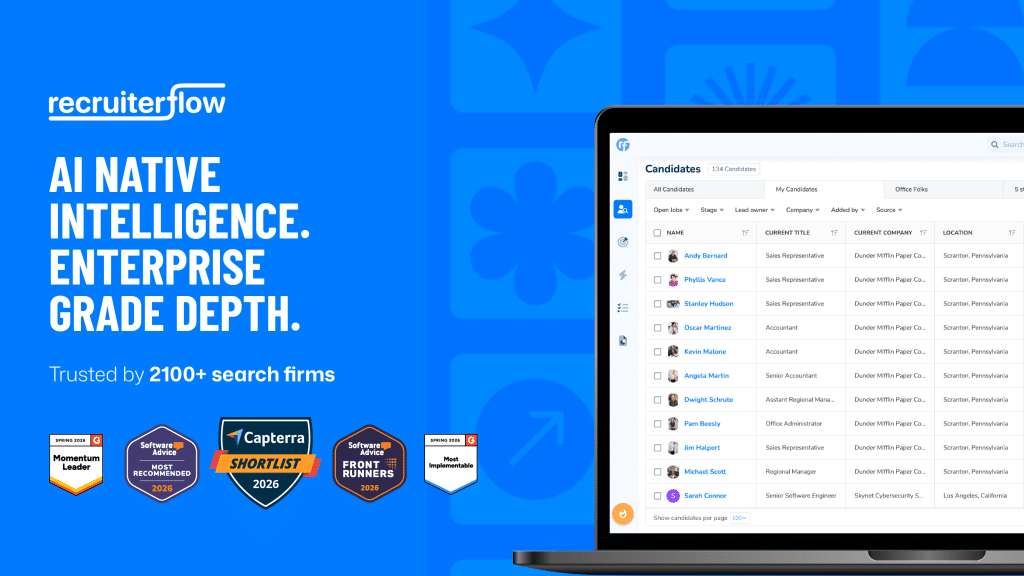
Best for: Retained, contingent, and executive search firms that want AI built into their ATS and CRM rather than added as a separate layer.
- G2 Rating: 4.6/5
- Capterra Rating: 4.7/5
- Free Trial: Available
- Pricing: From $119/user/month
Recruiterflow is an ATS and CRM built specifically for recruitment and search firms.
Its biggest differentiator is the way AI operates inside the platform.
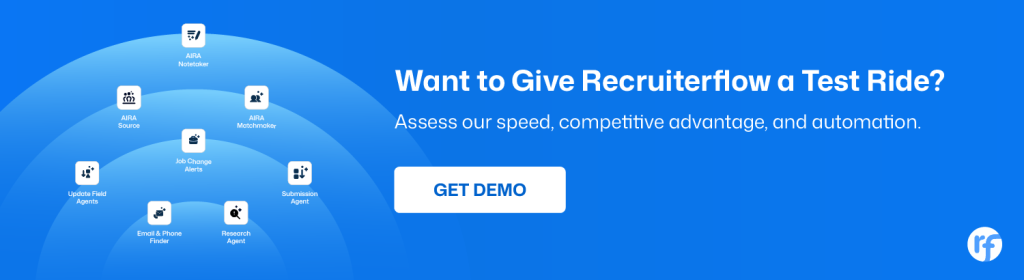
Rather than offering AI as a standalone assistant, Recruiterflow’s AIRA works as an intelligence layer across recruiting workflows including candidate matching, meeting capture, research, database updates, sourcing, and job-change monitoring.
You can read more about the approach in this guide to an AI-native ATS and CRM.
Recruiterflow AI Capabilities
AIRA includes agents designed to support workflows such as:
- Candidate matching
- Meeting note-taking
- Candidate and company research
- Database updates
- Job-change alerts
- Candidate sourcing
- Search and database intelligence
AIRA Matchmaker, for example, helps recruiters surface matching candidates already sitting inside their database.
That matters because Recruiterflow’s Economics of Recruiting research found that a significant share of placements comes from candidates already known to the agency.
Recruiterflow Pros
- AI works across the ATS and CRM rather than operating as a separate tool
- Strong candidate and client CRM capabilities
- Built specifically for recruitment agencies
- AIRA agents automate repetitive recruiter workflows
- Advanced automation and reporting
- Job-change monitoring can turn existing database records into business-development signals
- Strong fit for retained search, executive search, and contingent recruiting firms
Recruiterflow Cons
- Back-office pay-and-bill workflows for large temporary staffing firms rely more heavily on integrations
- Smaller integration ecosystem than long-established enterprise platforms such as Bullhorn
Recruiterflow vs. Recruit CRM
Recruit CRM is attractive for smaller firms that want a broad recruiting platform at a relatively accessible price.
Recruiterflow becomes more compelling when a firm needs AI operating throughout the recruitment workflow, deeper automation, database intelligence, and infrastructure designed to support a growing search business.
Choose Recruiterflow if: Your priority is moving toward an AI-native recruitment operating model rather than simply adding individual AI features to your ATS.
2. Loxo
Best for: Sourcing-heavy firms that want a candidate database built directly into the platform.
- G2 Rating: 4.6/5
- Capterra Rating: 4.6/5
- Free Trial: Free tier for one user
- Pricing: Basic from $109/month; Professional and Enterprise custom quoted
Loxo combines an ATS and CRM with a large built-in sourcing database and natural-language search.
For firms that spend heavily on sourcing technology, this can make Loxo particularly attractive because recruiters can search external candidate profiles without constantly switching between systems.
Loxo Pros
- Large sourcing database built into the platform
- Natural-language candidate search
- ATS, CRM, sourcing, and outreach in one system
- Can reduce reliance on separate sourcing tools
- Strong fit for sourcing-intensive recruitment firms
Loxo Cons
- More advanced AI and sourcing capabilities sit behind higher pricing tiers
- Contact-data quality can vary depending on role and market
- Firms with a strong proprietary database may get less value from the sourcing-first approach
Loxo vs. Recruit CRM
Choose Loxo over Recruit CRM when external candidate discovery is one of your recruiters’ biggest day-to-day challenges.
Recruit CRM is more focused on providing a broad recruitment CRM, while Loxo differentiates itself through integrated sourcing.
Choose Loxo if: You want your ATS, CRM, and external sourcing database in one platform.
3. Bullhorn
Best for: Large staffing businesses that need VMS integrations, back-office workflows, and a mature enterprise ecosystem.
- G2 Rating: 4.2/5
- Capterra Rating: 4.1/5
- Free Trial: Not available
- Pricing: Custom pricing
Bullhorn is one of the longest-established platforms in recruitment technology.
Its ATS and CRM are particularly well suited to larger staffing organizations that need functionality extending beyond candidate and client management into areas such as VMS integrations, timesheets, invoicing, and pay-and-bill.
For a deeper comparison of the category, see our guide to the best Bullhorn alternatives and competitors.
Bullhorn Pros
- Mature staffing ATS and CRM
- Strong VMS integration capabilities
- Extensive back-office functionality
- Large partner and integration ecosystem
- Designed for larger staffing organizations
Bullhorn Cons
- Pricing is not publicly transparent
- Total cost can increase as firms add products and integrations
- More complex implementation than lighter recruitment platforms
- AI configuration may require additional setup depending on the workflow
Bullhorn vs. Recruit CRM
Recruit CRM is easier to approach for smaller recruitment firms.
Bullhorn becomes more suitable when staffing operations become complex enough to require enterprise integrations, back-office infrastructure, and large-scale operational controls.
Choose Bullhorn if: You run a large temporary or contract staffing operation where back-office and VMS capabilities are essential.
4. Crelate
Best for: Recruitment firms that prioritize deep workflow customization.
- G2 Rating: 4.4/5
- Capterra Rating: 4.5/5
- Free Trial: Demo-led
- Pricing: Business from $119/user/month; Business Plus and Enterprise custom quoted
Crelate is known for giving recruiters significant control over fields, workflows, pipelines, and automations.
It serves executive search, direct placement, staffing, and internal recruiting teams.
Crelate Pros
- Highly configurable pipelines
- Extensive custom fields
- Workflow automation
- Support for multiple recruiting models
- AI-assisted matching and workflow capabilities in higher tiers
Crelate Cons
- AI Co-Pilot functionality requires higher pricing tiers
- Contact-data enrichment is a separate paid capability
- Greater configurability can create more administrative work
Crelate vs. Recruit CRM
Recruit CRM may be simpler for smaller firms that want a more opinionated recruitment workflow.
Crelate is more attractive when your agency has unusual processes and needs the system to adapt around them.
Choose Crelate if: Workflow customization matters more to your business than simplicity out of the box.
5. JobAdder
Best for: Recruitment firms in Australia, New Zealand, and the UK that depend heavily on job-board distribution.
- G2 Rating: 4.4/5
- Capterra Rating: 4.5/5
- Free Trial: Not available
- Pricing: Not publicly listed
JobAdder has built a strong presence in Australia, New Zealand, and the UK.
Its combination of ATS functionality, candidate management, job advertising, and broad job-board connectivity makes it particularly useful for agencies whose recruitment model relies heavily on advertising open roles.
JobAdder Pros
- Broad job-board integration ecosystem
- Straightforward recruiter interface
- Strong presence in ANZ and the UK
- AI-assisted candidate relevance and workflow recommendations
- Good candidate and job management capabilities
JobAdder Cons
- AI functionality is not available across every pricing tier
- Reporting depth may be limiting for firms with more complex analytics needs
- Less compelling for search firms that rely primarily on proactive sourcing
JobAdder vs. Recruit CRM
Both platforms serve recruitment agencies well.
JobAdder stands out when job-board distribution is central to your workflow, while Recruit CRM can be better suited to smaller agencies looking for a broader CRM-centric approach.
Choose JobAdder if: Job advertising and job-board distribution are core parts of your recruitment engine.
6. Zoho Recruit
Best for: Recruitment firms already operating within the Zoho ecosystem.
- G2 Rating: 4.4/5
- Capterra Rating: 4.5/5
- Free Trial: Free plan available
- Pricing: Paid tiers from approximately $25–$75/user/month when billed annually
Zoho Recruit combines applicant tracking and recruiting CRM functionality with the wider Zoho software ecosystem.
For organizations already using Zoho CRM, Zoho People, Zoho Books, or other Zoho applications, that integration can be its strongest selling point.
Zoho’s Zia AI also supports capabilities such as candidate matching, screening, and profile summaries.
Zoho Recruit Pros
- Competitive pricing
- Strong integration with other Zoho products
- Large existing software ecosystem
- AI-assisted matching and candidate management
- Good option for budget-conscious teams
Zoho Recruit Cons
- More advanced AI functionality requires higher plans
- Recruitment is only one part of the broader Zoho ecosystem
- Performance and usability can become more challenging with complex configurations or larger databases
Zoho Recruit vs. Recruit CRM
Recruit CRM is more purpose-built around agency recruitment.
Zoho Recruit makes more sense when your business already depends heavily on other Zoho products and you want recruitment to sit inside that ecosystem.
Choose Zoho Recruit if: Zoho is already the technology backbone of your business.
7. Manatal
Best for: Solo recruiters or very small recruitment teams looking for an inexpensive ATS with AI-assisted matching.
- G2 Rating: 4.3/5
- Capterra Rating: 4.6/5
- Free Trial: 14 days
- Pricing: $15–$59/user/month depending on plan
Manatal is the lowest-cost platform on this list.
It combines a simple applicant tracking interface with AI-based candidate recommendations, drag-and-drop pipelines, and other core recruiting functionality.
Its low price and quick setup make it particularly attractive to solo recruiters and smaller firms that do not yet need enterprise-level CRM capabilities.
Manatal Pros
- Lowest starting price among the platforms compared here
- AI-based candidate recommendations
- Fast implementation
- Straightforward user interface
- Low barrier to entry for small teams
Manatal Cons
- Better suited to smaller recruitment operations
- Less depth for complex staffing or executive search workflows
- AI recommendations are more dependent on structured resume information
Manatal vs. Recruit CRM
Recruit CRM offers greater recruitment CRM depth and is generally better suited to agencies planning to scale.
Manatal is a compelling option when affordability and ease of implementation outweigh the need for sophisticated workflows.
Choose Manatal if: You are a solo recruiter or small team looking for a low-cost entry into AI-assisted recruiting software.
How to Choose the Right Recruit CRM Alternative
The right platform depends less on how many features it offers and more on the limitation you are trying to solve.
Choose Recruiterflow if You Want AI Across Your Recruiting Workflow
If your priority is moving beyond isolated AI features toward AI that supports matching, sourcing, meeting capture, database updates, research, and business development, Recruiterflow is the strongest fit on this list.
Choose Loxo if Sourcing Is Your Biggest Expense
If your recruiters spend significant time and money searching for candidates outside your ATS, Loxo’s built-in candidate database can consolidate more of the sourcing workflow.
Choose Bullhorn if You Run a Large Staffing Operation
If you require VMS integrations, pay-and-bill, timesheets, and enterprise back-office infrastructure, Bullhorn is better aligned with that operating model.
For other options in this category, see our comparison of Vincere alternatives.
Choose Crelate if Customization Matters Most
Crelate makes sense for firms with processes that require extensive custom fields, pipeline configurations, and workflow flexibility.
Choose JobAdder if Job Boards Drive Your Recruiting
For firms in ANZ and the UK with a job-advertising-heavy strategy, JobAdder deserves a closer look.
Choose Zoho Recruit if You Already Use Zoho
Zoho Recruit’s biggest advantage comes from how naturally it fits alongside the rest of the Zoho product suite.
Choose Manatal if Budget Is the Deciding Factor
Very small teams that need a simple ATS and basic AI-assisted matching can get started at a substantially lower price point.
Recruit CRM Alternatives: Which One Is Best?
There is no single Recruit CRM competitor that will be right for every recruiting business.
For small teams focused on cost, Manatal and Zoho Recruit are worth considering.
For sourcing-heavy recruiters, Loxo provides a compelling integrated database.
For large staffing firms with complex back-office requirements, Bullhorn remains a strong enterprise option.
For firms that need extensive workflow customization, Crelate deserves consideration.
For job-board-heavy recruitment firms, particularly in ANZ and the UK, JobAdder is a strong option.
And for recruitment and search firms looking for an AI-native ATS and CRM, Recruiterflow is one of the closest fits.
The most important thing is to evaluate and price the version of each platform your recruiters will actually use.
A low entry-level price can be misleading if candidate matching, AI, enrichment, reporting, automation, or sourcing requires moving several tiers higher.
Frequently Asked Questions About Recruit CRM Alternatives
What Is the Best Recruit CRM Alternative?
The best Recruit CRM alternative depends on why you are considering switching.
Recruiterflow is a strong option for recruitment and search firms that want AI embedded across their ATS and CRM. Loxo is particularly strong for sourcing-heavy teams, while Bullhorn is better suited to larger staffing organizations that need VMS and back-office functionality.
Who Are Recruit CRM’s Main Competitors?
Common Recruit CRM competitors include Recruiterflow, Loxo, Bullhorn, Crelate, JobAdder, Zoho Recruit, and Manatal.
The right option depends on your firm’s size, recruitment model, AI requirements, sourcing strategy, integrations, reporting needs, and budget.
Is Recruiterflow Better Than Recruit CRM?
Recruiterflow and Recruit CRM serve many of the same recruitment-agency workflows but take different approaches.
Recruit CRM can be a good choice for smaller agencies looking for an accessible ATS and CRM.
Recruiterflow is better suited to firms that prioritize AI-native workflows, database intelligence, automation, and scalability across sourcing, matching, recruitment, and business development.
Recruit CRM vs. Zoho Recruit: Which Is Better?
Recruit CRM is purpose-built for recruitment agencies and provides recruitment-specific CRM functionality out of the box.
Zoho Recruit is usually more attractive to organizations already using the wider Zoho ecosystem or those prioritizing a lower starting price.
Choose Recruit CRM for recruitment-specific workflows and Zoho Recruit for ecosystem integration and affordability.
How Much Does Recruit CRM Cost?
Recruit CRM pricing varies by plan, with higher tiers unlocking more AI usage and advanced candidate-matching functionality.
When comparing costs, evaluate the plan containing the features your recruiters actually need rather than comparing entry-level prices alone.
Is Recruit CRM Good for Executive Search Firms?
Recruit CRM can work well for smaller executive search firms.
Larger or fast-growing executive search firms may eventually require deeper reporting, database intelligence, automation, permission controls, relationship management, and AI capabilities that operate across more of the search workflow.
What Is the Best ATS and CRM for Executive Search Firms?
Executive search firms should prioritize relationship intelligence, candidate and company search, research capabilities, long-term database management, business development workflows, reporting, and automation.
Recruiterflow is particularly well suited to this model because its ATS, CRM, and AIRA intelligence layer are designed around agency recruiting and search workflows.
How Difficult Is It to Migrate Away From Recruit CRM?
Most modern recruitment software providers offer assisted data migration.
The most important parts of a migration are usually:
- Mapping candidate, contact, company, and job fields
- Recreating pipeline stages
- Preserving historical activities and notes
- Cleaning duplicate records
- Rebuilding automations
- Training recruiters on the new workflow
Ask every shortlisted vendor exactly what data they migrate, how historical records are handled, and what implementation support is included before signing a contract.
Ready to Compare Recruit CRM With an AI-Native Alternative?
If your reason for looking beyond Recruit CRM is that you want AI to do more than generate content or recommend candidates, take a closer look at Recruiterflow.
AIRA works across sourcing, candidate matching, meeting capture, research, database maintenance, and business development inside the same ATS and CRM your recruiters use every day.
Recruitment
Ayusmita is a B2B storyteller who spends her time translating recruiting workflows into clear stories at Recruiterflow.

Ayusmita