

Will AI Kill Executive Search Firms? Sequoia says NO.

Every time a new AI model drops, the same question comes: Is this the end of the search firm?
In a recently published thesis by Sequoia Capital, Julien Bek provides the most definitive answer yet.
For the uninitiated, Sequoia Capital is considered the most successful venture capital firm in history. They were early backers of Apple, Google, Airbnb, WhatsApp, and Zoom. When Sequoia publishes a thesis, the business world treats it as a roadmap for the next decade of global commerce.
In his essay, “Services: The New Software,” Sequoia partner Julien Bek argues that we are entering a new era of AI.
- The Old Era: We built “Copilots”—AI tools that help a human work faster.
- The New Era: We are building “Autopilots”—AI companies that actually do the work and sell the final outcome directly to the customer.
Bek’s core argument is that the next $1 trillion company won’t just sell you a piece of software; it will sell you the finished service.
Naturally, this has led to a panicked question in our industry: Will AI just kill search firms?
The short answer? No.
The long answer? AI won’t kill search firms, but it will fundamentally change what you are selling.
If you are running a search business, you need to understand the “Sequoia Playbook” for the AI era. It’s the difference between being a firm that gets replaced by a tool and a firm that becomes a category-defining powerhouse.
The core split: Intelligence vs. Judgement
Sequoia argues that every profession is divided into two parts: Intelligence and Judgement.
- Intelligence is the ability to follow rules, parse data, and execute a spec. In search, this is sourcing, screening resumes, mapping a market, and scheduling interviews.
- Judgement is different. It’s built on years of practice, taste, and instinct. It’s knowing which candidate has the “grit” to lead a turnaround, sensing a culture misfit that isn’t on paper, and knowing exactly when to push—and when to pull back—during a delicate C-suite negotiation.
The Sequoia Thesis: AI has crossed the threshold where it can do the Intelligence work autonomously. Software engineering was the first to feel this; Search is next.
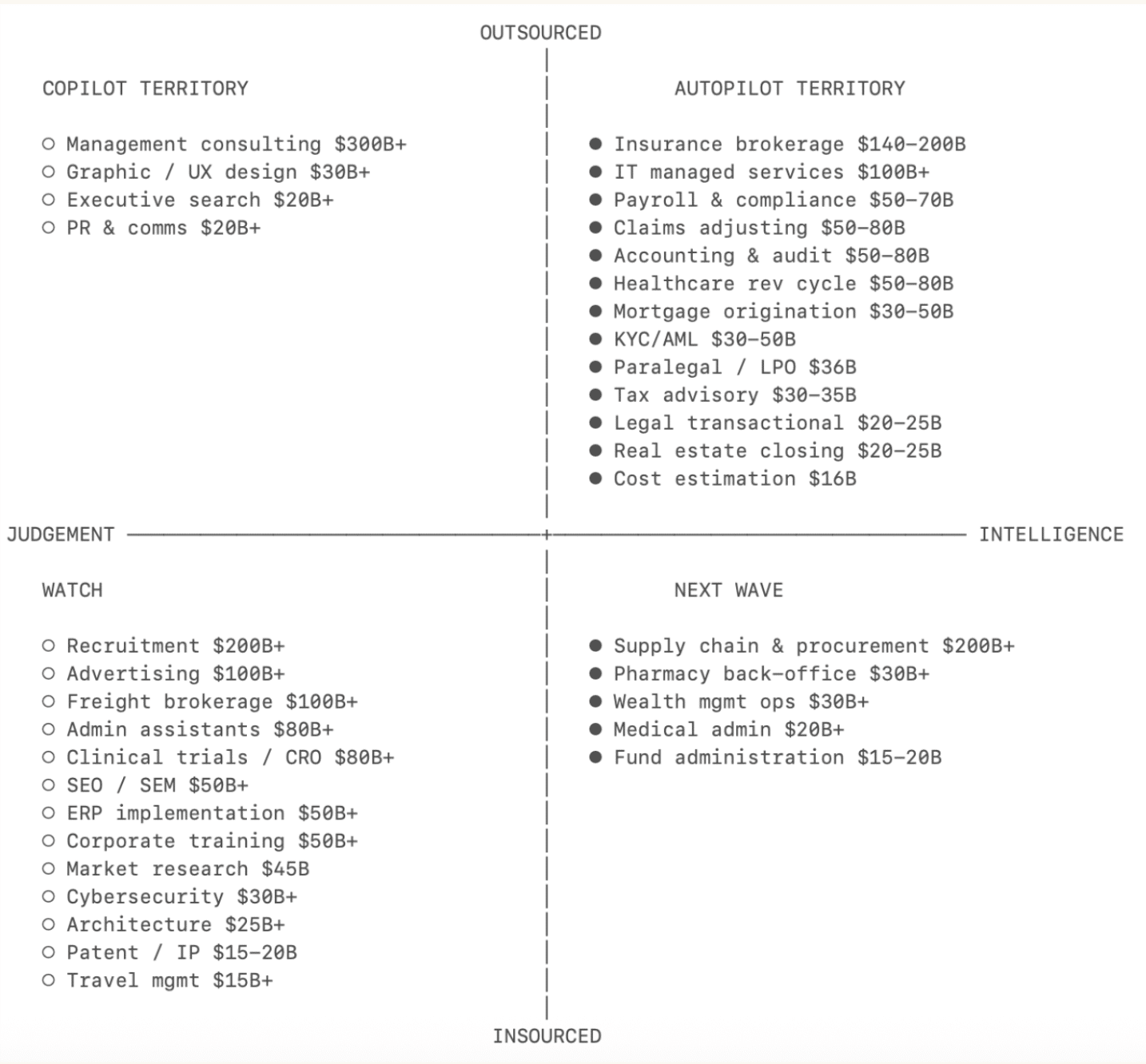
Source: Sequoia
What this means for executive search firms
If your search firm’s value-add is just “finding the names,” you are in a race against the model. But if your value is the Judgement of who to hire, AI is the best thing that ever happened to your margins.
According to Julien, executive search is one of the most difficult businesses to disrupt with AI since it is heavily dependent on judgement, no intelligence.
One of the most jarring statistics in the Sequoia report is the spend ratio: For every $1 spent on software, companies spend $6 on services.
- A company might pay LinkedIn or an ATS $10,000 a year for search intelligence. This is the “Software Budget.”
- The Work: That same company will pay a search firm $60,000 for one hire. This is the “Judgement or Services Budget.”
The “Judgement or Services” bucket is 6x larger than the “Software” bucket in this scenario.
The goal isn’t just to use AI to work faster. It’s to leverage AI to gather context & intelligence allowing consultants to do what they do best: building relationships and making placements.
Redefining the MOAT for your search business
Sequoia’s “Opportunity Map” highlights where AI “Autopilots” will win first. They look for tasks that are:
- Intelligence-heavy (Sourcing/Mapping).
- Already outsourced (Search firms).
- Standardized (High-volume/Mid-level roles).
The Moat: Executive Search is “Judgement-heavy” and “Insourced” in terms of the final decision. This is your protection. As AI accumulates data on what “good judgement” looks like, the frontier will shift, but the human-to-human closing of a candidate remains the ultimate moat.
If you operate in the high-volume, low-judgement “contingency” space, the “Autopilots” are coming for your budget line today.
The 2026 Playbook to scale your search business
If you run a search business, here’s the clear 2026 framework:
- Move up the “Judgement” curve
If your team is spending 80% of their time on “Intelligence” (sourcing/outreach), you are a software company that hasn’t realized it yet. You need to flip that ratio to 80% “Judgement” (advising/closing). - Stop selling “process” and start selling “outcome”
AI makes the process, data and intelligence cheap. Your value is in the judgement that you bring, sell results not the data. - Adopt the “Copilot” today to avoid the “Autopilot” tomorrow
Use AI Native software like Recruiterflow to automate the autopilot and intelligence layer. If you don’t use AI to close the “Intelligence gap,” a pure-play AI firm will eventually underbid you on fees.
Will AI kill search firms? Definitely not.
In fact, we believe there hasn’t been a better time in the history of search firms to shine.
AI will kill the admin and amplify the value your consultants provide.
The next legendary search firms won’t be the ones with the biggest databases, as it is already commodotised—they’ll be the ones who use AI to handle the intelligence, leaving the consultants to do what they do best: building relationships, and making placements.
Recruitment
Akshad is a marketer with 8 years of experience who firmly believes in the power of storytelling to build brand awareness and drive revenue. He is also a watch enthusiast and a podcaster in the making.
Akshad