

7 Best Loxo Alternatives for Recruiting & Executive Search Firms (2026)
Are you looking for Loxo alternatives? You may have outgrown Loxo’s sourcing-first approach and need more from your recruiting tech stack whether that means a true all-in-one workflow, purpose-built executive search tools, or more reliable contact data for senior roles.
The good news: there are several strong Loxo alternatives to consider. We compared the seven best Loxo alternatives for recruiting and executive search firms in 2026, looking at verified G2 and Capterra ratings, pricing, core features, and the real-world tradeoffs of each platform.
So, which Loxo alternative is right for you? Recruiterflow is a strong option for firms looking for an AI-native, all-in-one recruiting platform. Thrive TRM stands out for retained executive search, while hireEZ is a strong fit for teams that primarily need a powerful sourcing engine.
Read on to compare the best Loxo alternatives and find the platform that makes the most sense for your firm, workflow, and recruiting goals.
Why recruiting and search firms look for Loxo alternatives
Loxo’s strengths are real: a large built-in sourcing database, a free tier, and AI woven through the workflow. The reasons firms still shop around are specific:
- It is sourcing-first. If your bottleneck is workflow, client management, or executive-search structure rather than finding candidates, Loxo can feel weighted toward the wrong end.
- Contact-data accuracy on senior roles. Reviewers note that emails and numbers for niche or recently moved candidates are not always current.
- The best AI and sourcing credits sit behind higher tiers. The free and Basic plans do not include the capabilities most firms want.
- Fit. Small teams and single-recruiter search firms sometimes find it more platform than they need.
None of that makes Loxo a poor tool. It means the right alternative depends on which of those pushed you to look. The list below is grouped that way: all-in-one platforms, an executive-search specialist, and a sourcing-first swap.
The 7 best Loxo alternatives at a glance
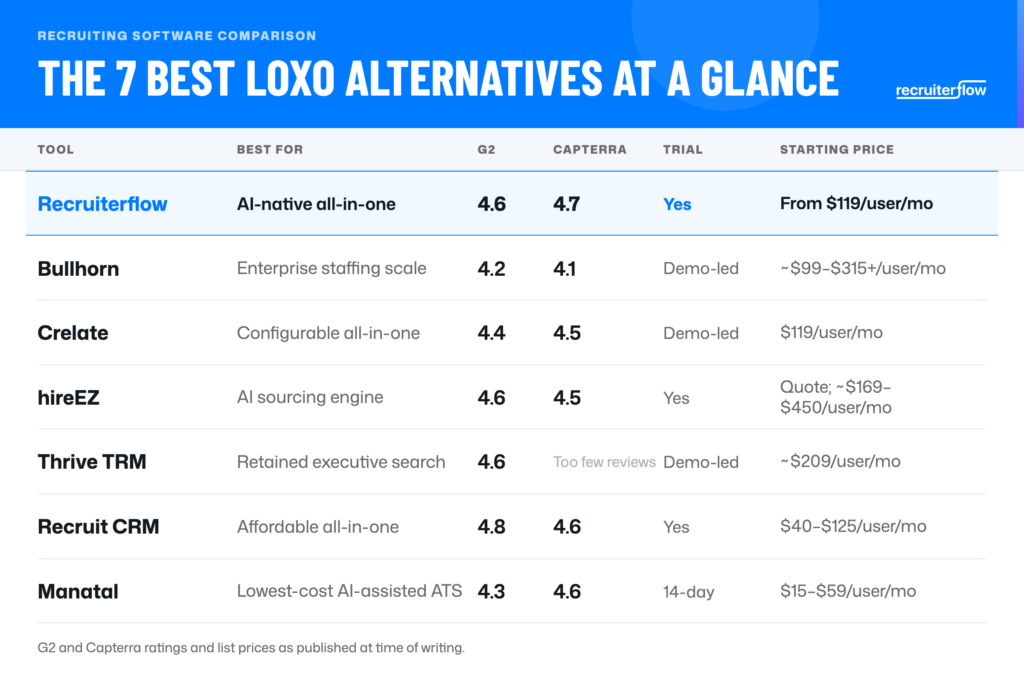
Ratings and pricing verified at the time of writing; re-check the live review pages before you buy, since both move.
1. Recruiterflow
Best for: Search and staffing firms that want an AI-native all-in-one rather than a sourcing-first tool.
- G2 Rating: 4.6/5
- Capterra Rating: 4.7/5
- Free Trial: Available
- Pricing: From $119/user/mo
Recruiterflow is an AI-native ATS and CRM where AIRA runs as the intelligence layer across sourcing, matching, outreach, and record-keeping. Where Loxo leads with its sourcing database, Recruiterflow leads with the full workflow, which is the core of the Loxo head-to-head. One G2 reviewer, founder Billy M., says: “The workflow feels seamless from start to finish.”
Pros:
- AIRA agents handle matching, call notes, research, and job-change alerts natively.
- Purpose-built for both recruiting-firm and executive-search workflows.
- Enterprise depth (SOC 2, permissions, reporting) included rather than gated.
Cons:
- Its own sourcing database is smaller than Loxo’s dedicated engine.
- Temp and contract pay-and-bill leans on integrations rather than native modules.
2. Bullhorn
Best for: Large staffing operations needing VMS integration and back-office depth.
- G2 Rating: 4.2/5
- Capterra Rating: 4.1/5
- Free Trial: Not available (demo-led)
- Pricing: Not published; reported ~$99–$315+/user/mo
Bullhorn is the enterprise incumbent, with dual ATS and CRM architecture and the deepest back-office toolset on this list. One G2 reviewer says: “It’s my go-to tool and I rely on it every day.” If you are cross-shopping it, the Bullhorn alternatives breakdown goes deeper.

Pros:
- Unmatched back-office and VMS depth for enterprise-client staffing.
- A mature integration and partner ecosystem.
Cons:
- The AI Assistant is a bring-your-own-model setup rather than native agents.
- No public pricing, with reviewers reporting add-on costs and renewal increases.
3. Crelate
Best for: Firms that want deep workflow customization in an all-in-one.
- G2 Rating: 4.4/5
- Capterra Rating: 4.5/5
- Free Trial: Demo-led
- Pricing: Business $119/user/mo; higher tiers custom
Crelate is highly configurable across fields, pipelines, and automations, and serves executive search, direct placement, and in-house teams. President Hilary T. writes on G2: “The product itself is great, smart, intuitive, lots of functionality.”
Pros:
- Deep customization for firms with particular workflows.
- AI Co-Pilot and agentic features on higher tiers.
Cons:
- The AI Co-Pilot is gated above the entry plan.
- Contact-data enrichment is a separate paid add-on.
4. hireEZ
Best for: Teams whose main use of Loxo was large-scale sourcing.
- G2 Rating: 4.6/5
- Capterra Rating: 4.5/5
- Free Trial: Available
- Pricing: Quote-based; reported ~$169–$450/user/mo
hireEZ (formerly Hiretual) is a dedicated AI sourcing platform that indexes candidates across the open web rather than only LinkedIn, with strong ATS rediscovery. It is the closest like-for-like if sourcing was the reason you were on Loxo. One G2 reviewer notes “the AI ranking of candidates help us focus on the most qualified ones.”
Pros:
- Deep open-web sourcing across 800M+ profiles.
- EEO-compliant diversity sourcing filters and a strong Chrome extension.
Cons:
- Opaque quote-based pricing, with reviewers reporting steep renewal increases.
- Outreach is limited to email and InMail rather than true multichannel, and contact-data accuracy on movers can lag.
5. Thrive TRM
Best for: Retained and board-level executive search built on relationships rather than sourcing.
- G2 Rating: 4.6/5
- Capterra Rating: too few public reviews to rate
- Free Trial: Not available (demo-led)
- Pricing: Demo-led; starts around $209/user/mo
Thrive TRM is a relationship-intelligence platform for long-cycle, senior searches, with network mapping, collaborative candidate evaluation, and compensation benchmarking. It is the opposite end of the spectrum from Loxo: its intelligence sits in relationship data rather than generative sourcing, so you bring your own pipeline.
Pros:
- Purpose-built for retained, senior-level executive search.
- Collaborative longlist-to-shortlist workflow and compensation benchmarking that most CRMs lack.
Cons:
- Premium pricing puts it out of reach for smaller firms.
- No native sourcing database, and it can feel overbuilt for single-recruiter workflows.
6. Recruit CRM
Best for: Small and international firms wanting an affordable all-in-one.
- G2 Rating: 4.8/5
- Capterra Rating: 4.6/5
- Free Trial: Available
- Pricing: $40–$125/user/mo, billed annually
Recruit CRM is a well-liked all-in-one ATS and CRM with recruiting-specific AI and an easy learning curve. CEO Mohamed E. calls it, on G2, “a reliable and affordable recruitment solution.”
Pros:
- Strong value for small and mid-sized firms, with fast onboarding.
- Recruiting-specific workflows out of the box.
Cons:
- AI usage is capped by tokens, and full matching sits on higher tiers.
- Reporting and large-database performance can strain as firms scale.
7. Manatal
Best for: Solo recruiters and very small teams wanting AI at the lowest cost.
- G2 Rating: 4.3/5
- Capterra Rating: 4.6/5
- Free Trial: 14-day free trial
- Pricing: $15–$59/user/mo
Manatal is the most affordable AI-assisted ATS here, with drag-and-drop pipelines and setup measured in hours. One G2 reviewer, Samsoor K., says: “The AI-generated application summaries are a standout feature.”
Pros:
- The lowest entry price on this list, with AI candidate recommendations included.
- Fast setup and a simple interface.
Cons:
- AI recommendations work best with English-language resumes.
- Built for smaller operations, so it does not scale to large staffing teams.
How to choose the right Loxo alternative
Match the alternative to the reason you are leaving:
- You want a deeper all-in-one workflow. Recruiterflow, Bullhorn, Crelate, and Recruit CRM run the full desk rather than only sourcing. Recruiterflow is the closest AI-native match to Loxo’s philosophy.
- You do retained executive search. Thrive TRM is built for relationship-led, board-level work where sourcing volume matters less than network depth.
- You mainly wanted Loxo’s sourcing engine. hireEZ is the most direct swap, with open-web sourcing and ATS rediscovery.
- You need the lowest cost. Manatal for a lean AI ATS, or Recruit CRM for an affordable all-in-one.
One consistent note: the most useful AI features usually sit a tier or two above the entry price, so cost the plan you will run, not the sticker.
FAQs
What is the best Loxo alternative?
It depends on what you used Loxo for. For an AI-native all-in-one that runs the full workflow, Recruiterflow is the closest fit; for retained executive search, Thrive TRM; and if sourcing was your main use, hireEZ is the most direct swap.
How much does Loxo cost?
Loxo offers a free tier for a single user, with Basic starting around $109 per month and Professional and Enterprise tiers custom-quoted. The most useful AI and sourcing credits sit on the higher plans, so price the tier that includes what you need.
Is Loxo a good fit for executive search firms?
It can be, especially where sourcing volume matters. Firms doing retained, relationship-led search sometimes prefer a platform built around network mapping and collaborative evaluation, such as Thrive TRM, over a sourcing-first tool.
Loxo vs. Recruiterflow: which should a firm choose?
Loxo leads with a large sourcing database; Recruiterflow leads with an AI-native, all-in-one workflow and agents that act across sourcing, matching, and record-keeping. Choose Loxo if sourcing volume is the priority, and Recruiterflow if you want the whole desk run on native AI. The full comparison breaks it down.
What should you look for in a Loxo alternative?
Start with the gap that pushed you to look: workflow depth, executive-search structure, sourcing accuracy, or price. Then check that the AI you want is included rather than gated, that pricing is transparent, and that the platform fits your recruiting model rather than forcing you into a sourcing-first one.
Templates
Ayusmita is a B2B storyteller who spends her time translating recruiting workflows into clear stories at Recruiterflow.

Ayusmita