

Best Executive Search Software with Built-in Talent Intelligence
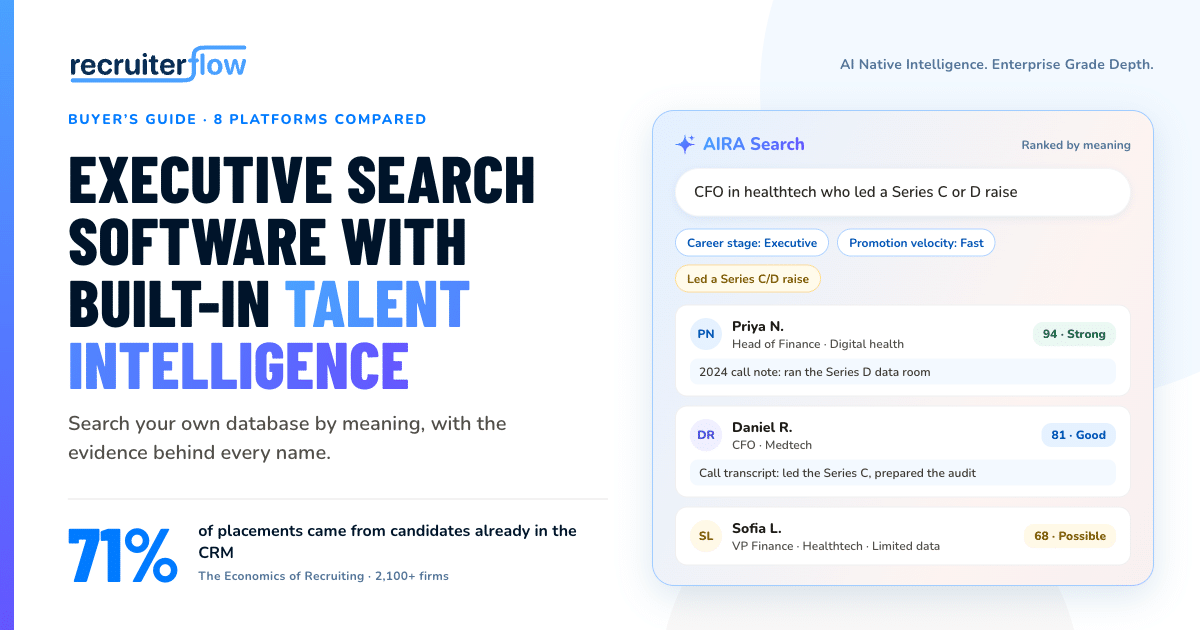
A client calls with a CFO brief on Monday morning. Somewhere in your database is the finance leader your team met in 2024, the one who ran a Series D data room and said she would move for the right founder. Whether she makes the longlist depends on someone remembering her name.
That dependency is expensive. Executive search software with talent intelligence makes that history searchable by meaning, so what your consultants learn on every call keeps working for the firm.
This guide explains what talent intelligence means in executive search software, how it differs from a standard search CRM, what to test in a demo, and how eight platforms compare on the intelligence they offer today.
What is executive search software with talent intelligence?
Executive search software with talent intelligence is an ATS and CRM built for retained and boutique search firms that also understands the people inside it: career stage, promotion pace, sector depth, tenure, and company context. A consultant can ask for “a CFO who has led a Series C or D raise in healthtech” and get a ranked shortlist, with the evidence behind every name.
Here is the same search brief written two ways.
Boolean, the way most databases still need it:
(CFO OR “Chief Financial Officer” OR “VP Finance”) AND (healthtech OR medtech OR “digital health”) AND (“Series C” OR “Series D”)
Natural language, the way a consultant describes it to a colleague:
A CFO with 12 to 18 years in healthtech or medtech who has led a Series C or D fundraise and prepared a company for a regulatory audit. Ideally from a founder-led business.
The Boolean string finds profiles where those words appear. It misses the finance leader whose CV says “Head of Finance” while a 2024 call note records that she ran the Series D data room. Talent intelligence reads the call note.
For the wider picture of how AI is changing the search process itself, see our guide to AI for executive search.
How is talent intelligence different from a standard executive search CRM?
A standard executive search CRM stores records; talent intelligence reads them and tells you what they mean for the mandate in front of you.
The difference shows up in four places:
- Search reaches unstructured data. Notes, call transcripts and CV narratives become searchable alongside structured fields like title, company and location.
- Signals are derived. Career stage, promotion pace, months in a function or sector and median tenure are calculated from career history, so you can filter on them.
- Results carry evidence. Each shortlisted name comes with the note, transcript line or role that earned its place.
- Records stay current. The system notices when a candidate or client contact changes jobs and flags it.
A disciplined talent mapping process still does the groundwork on a new market. Talent intelligence makes the maps your firm has already built searchable, years after the search that produced them closed.
Eight capabilities to look for in executive search software with talent intelligence
- Can it search notes and call transcripts?
Ask the vendor to find a candidate whose relevant experience appears only in an interview note or call transcript. This tests whether search can retrieve your firm’s knowledge beyond structured fields such as title, company and location.
- Does every recommendation show supporting evidence?
Look for the specific note, transcript excerpt or career detail behind each recommendation, with its source and date. The system should flag missing information so consultants can distinguish a promising research lead from a candidate ready for calibration.
- Can it search by career signals and company context?
Test criteria such as promotion pace, sector tenure, P&L responsibility and experience at a particular business stage. Check whether the platform distinguishes documented achievements from inferred signals—and a company’s circumstances during an executive’s tenure from its position today.
- Does it clarify ambiguous requirements?
“Senior” could describe an experienced individual contributor or someone who leads several management layers. Check whether the system asks a clarifying question or shows its interpretation before running the search, allowing consultants to correct assumptions.
- Does it detect relevant career moves?
Ask whether the platform monitors job changes among existing contacts and connects those updates to relationship history. Test how consultants receive alerts, verify the change and decide whether it creates a reason to reconnect or a potential client opportunity.
- Can it research beyond your database in the same workflow?
Some mandates require executives your firm has never contacted. Check whether consultants can research external profiles, compare them with existing records and preserve source information without repeatedly copying data between tools. Confirm any additional subscriptions, credits or usage limits.
- Will your search history survive migration?
Validate how notes, call logs, transcripts, attachments and past mandates move across—and when they become searchable. Use a sample migration to check that relationships, dates and permissions remain intact. Successfully importing a file does not establish that its contents are available to contextual search.
- Is intelligence connected to mandates, clients and commercial activity?
Check whether candidate context, client relationships, search progress and engagement fees remain connected across the ATS and CRM. Consultants should be able to move from research to delivery without rebuilding context. Test permissions across those workflows, and assess security assurance and data-protection requirements separately.
What is the best executive search software with built-in talent intelligence?
Recruiterflow is the strongest fit for search firms that want ATS, CRM, and talent intelligence in one system, on their own database, at boutique scale today and enterprise scale tomorrow. The other seven each lead on something specific, listed below. For a wider catalogue of 30+ tools, see our executive search software guide.
| Platform | Best for | Pricing model (Oct 2026) |
| Recruiterflow | Firms of every size, from boutiques to enterprise practices, that want their own database searchable by meaning | Platform plan $149/user/month; AIRA Plan custom |
| Clockwork Recruiting | Retained firms that win on client transparency | One published per-user plan |
| Invenias by Bullhorn | Established firms that work inside Microsoft Outlook | Not Disclosed |
| Talentis | Boutiques taking mandates in sectors they have not mapped | From $119/month |
| Stardex | Small firms that want a young, AI-centred system of record | Published per-user tiers |
| Ezekia | UK and European firms that want a configurable search CRM | From £120/user/month |
| Thrive TRM | PE and VC talent partners, in-house executive teams | Not Disclosed |
| Loxo | Firms running mixed models with heavy outbound research | From $109/user/month |
Each profile below covers talent intelligence only: what the platform understands about the people in your database and in the wider market, and how it shows you why someone fits.
1. Recruiterflow
G2 Rating: 4.6/5 (207 reviews)
Capterra Rating: 4.7/5 (332 reviews)
Pricing: Platform plan $149/user/month; AIRA Search is included in the AIRA Plan, which is custom-priced.
Best for: search firms at every stage of growth, from five-person boutiques to multi-office enterprise practices, that want one intelligence layer to scale with them.
Recruiterflow is built to grow with the firm. A boutique running its first retained mandates and an enterprise search practice operating across offices and brands work on the same AI-native foundation, with enterprise-grade depth beneath it: role-based permissions, multi-brand configuration, a client portal with field-level visibility controls, and SOC 2 and GDPR compliance. The intelligence compounds as the firm expands. Every call, note, and placement enriches the AIRA Talent Graph, so a larger team and a longer history make each search sharper. Guy Last Recruitment grew its team tenfold on the platform (Guy Last Recruitment case study).
AIRA is the intelligence layer running through Recruiterflow, and AIRA Search is where it meets the search brief. It reads structured fields plus the AIRA Talent Graph, a profile built from notes, AIRA Notetaker call transcripts, CVs, Crunchbase funding data, LinkedIn data and other enrichment (AIRA Search FAQ). A consultant describes the person in plain English and receives a ranked list with the evidence behind every name. Mercury Hampton generated around £25,000 in fees from job change alerts on its existing database (Mercury Hampton case study).
Pros
- One intelligence layer from boutique to enterprise: the Talent Graph deepens with every call, note and placement, so search quality rises as the firm scales. Searches notes, call transcripts and CV narratives by meaning, so experience that never reached a title field still counts.
- Derives career stage (Early to Executive), promotion velocity (Slow to Exceptional), months in a function or industry, skill strength and median tenure (how AIRA reads a query).
- Every result carries an AIRA Insight with the note or transcript line that earned its rank, scored 0 to 100 against qualitative signals such as “led a Series C raise”.
- Asks a clarifying question when a query is ambiguous and labels thin profiles as limited data.
- The AIRA Job Change Alert Agent keeps career data current, and AIRA Source extends research to 850M+ external profiles in the same workflow.
Cons
- AIRA Search sits on the AIRA Plan only.
- It currently searches candidates; contacts and companies are listed as a future release.
- Saved queries and export of results are not available yet.
- Ranking depth depends on captured data: a candidate with no notes, calls, or CV ranks on structured fields alone.
2. Clockwork Recruiting
G2 Rating: 3.6/5 (6 reviews)
Capterra Rating: 4.4/5 (51 reviews)
Pricing: One published per-user plan on the vendor’s site.
Best for: retained firms that want AI to turn past search data into research criteria for the next mandate.
Clockwork’s AI works on the search brief. It draws on a firm’s past search data to generate research criteria and an ideal candidate profile, then runs preliminary assessments of candidates against those criteria. External market data comes through partner integrations, and an MCP server lets outside AI agents query Clockwork records.
Pros
- AI-generated research criteria and benchmark profiles built from the firm’s previous searches.
- Preliminary candidate assessments against those criteria.
- An MCP server that exposes search data to AI agents the firm already uses.
Cons
- Meaning-based search across notes and transcripts, with evidence per result, is not documented in its public materials.
- External profile intelligence depends on third-party partners.
- Some Capterra reviewers, mostly on earlier versions, ask for stronger people search and org-chart views of client companies.
3. Invenias by Bullhorn
G2 Rating: 1.3/5 (6 reviews)
Capterra Rating: 4.2/5 (15 reviews)
Pricing: Quote-based.
Best for: established firms in Outlook that want relationship mapping across a long client history.
Bullhorn’s June 2026 product update describes a three-stage AI plan for Invenias. Stage one is available now: natural language search, AI candidate matching that returns ranked and contextualised profiles, document search across CVs, proposals and assessments, and relationship intelligence that maps warm introductions across the firm’s network. Transcript-driven record updates and background agents come in later stages.
Pros
- Natural language search and ranked, contextualised candidate matching.
- Document search that reaches keywords inside CVs, proposals and assessments.
- Relationship mapping that surfaces existing warm paths into a target.
Cons
- AI that reads call transcripts and updates records is still on the roadmap.
- A sector agent that pre-ranks a draft longlist is a later-stage plan.
- No external profile data is documented, and G2 reviewers cite slow processing.
4. Talentis
G2 Rating: 4.9/5 (6 reviews)
Capterra Rating: No reviews yet
Pricing: From $119/month, with a free trial.
Best for: boutiques that keep taking mandates in markets they have never mapped.
Talentis is built on market intelligence. Its TalentGraph indexes 800 million public profiles (Capterra listing) and refreshes them continuously, with search filters designed for executive search such as company description and board-level experience. An AI search button builds a starting search from the assignment’s client and title.
Pros
- A large public-profile graph built into the CRM.
- Executive-specific filters, including board experience.
- Profiles that refresh from the graph without manual updates.
Cons
- Intelligence centres on public web data; ranking by what consultants captured in calls and notes gets little attention in its materials.
- No evidence-per-result view is documented.
- Few independent reviews to judge it by.
5. Stardex
G2 Rating: Not listed
Capterra Rating: Not listed
Pricing: Published per-user tiers on the vendor’s site.
Best for: small firms that want semantic search over their own history from a young vendor.
Stardex is an AI-native ATS and CRM from a Y Combinator-backed team built around semantic search across candidate records, notes, emails and call transcripts. Background agents capture calls and tag records, which keeps that searchable history growing without manual entry.
Pros
- Semantic search across notes, emails and transcripts.
- Agents that capture calls and tag records automatically.
- MCP access, so general AI assistants can query the database.
Cons
- No external profile database.
- Derived career signals such as promotion pace or tenure are not documented.
- No public reviews on G2 or Capterra to verify the claims.
6. Ezekia
G2 Rating: No reviews yet
Capterra Rating: 4.8/5 (4 reviews)
Pricing: From £120/user/month, with a free trial.
Best for: UK and European firms that want AI help reading and summarising candidate records.
Ezekia’s built-in assistant, Sidekick, summarises activity, parses CVs, matches candidates against job specs and drafts candidate summaries from the record. External research comes through partnerships, including one with HelloSky for AI-led candidate research.
Pros
- Job-spec matching against candidates already in the database.
- AI summaries of candidate records and activity.
- External research through partner tools.
Cons
- Meaning-based ranking across notes and transcripts, with evidence per result, is not documented.
- Derived career signals are not documented.
- Its Capterra rating rests on four vendor-referred reviews from 2020.
7. Thrive TRM
G2 Rating: 5.0/5 (1 review)
Capterra Rating: No reviews yet
Pricing: Quote-based.
Best for: PE and VC talent partners whose intelligence lives in years of relationship history.
Thrive describes itself on G2 as a system of intelligence for executive talent work. It connects a firm’s own conversations, assessments, introductions and search activity with secure AI to find the right people faster and remember every relationship. Relationship mapping across candidates, clients and opportunities sits at its core.
Pros
- Positioned around the firm’s proprietary relationship knowledge.
- Relationship mapping across candidates, clients and opportunities.
- Succession planning data for in-house executive teams.
Cons
- Public detail on how its AI search ranks and explains results is thin.
- No external profile data is documented.
- One G2 review and none on Capterra.
8. Loxo
G2 Rating: 4.6/5 (187 reviews)
Capterra Rating: 4.6/5 (134 reviews)
Pricing: Free tier; paid plans from $109/user/month.
Best for: mixed-model firms that want a large external talent graph alongside their database.
Loxo calls itself a talent intelligence platform. Its Capterra listing describes a people and company search engine of more than 1.2 billion people, with AI ranking and matching. Natural language search, AI recommendations that rank semantic matches, and a self-updating CRM agent work across both its own graph and the firm’s database.
Pros
- A proprietary external talent graph inside the same system.
- Natural language search with semantic ranking.
- A self-updating CRM agent that keeps records current.
Cons
- Its intelligence is built mainly around the external graph; ranking from the firm’s own notes and transcripts is less documented.
- No evidence-per-result view is documented.
- Some Capterra reviewers report outdated profile and contact data in its sourcing graph.
How do these platforms compare on talent intelligence?
Only Recruiterflow documents all six capabilities below on one record. “Not documented” means we could not find the capability in the vendor’s public materials as of October 2026, so ask for it in a demo.
| Platform | Searches notes and transcripts by meaning | Evidence shown per result | Derived career signals | Job change detection | External profile data | Unified ATS + CRM |
| Recruiterflow | Yes (AIRA Search) | Yes (AIRA Insight) | Yes (career stage, promotion velocity, tenure) | Yes | Yes (AIRA Source) | Yes |
| Clockwork Recruiting | Not documented | AI assessments against research criteria | Not documented | Not documented | Via partners | Yes |
| Invenias by Bullhorn | Natural language and document search | Ranked, contextualised matches | Not documented | Not documented | Not documented | Yes |
| Talentis | Public-profile search | Not documented | Board-experience filters | TalentGraph profile refresh | Yes (TalentGraph) | Yes |
| Stardex | Yes (semantic search) | Vendor-described | Not documented | Not documented | No | Yes |
| Ezekia | AI-driven search (vendor-described) | Not documented | Not documented | Not documented | Via extensions and partners | Yes |
| Thrive TRM | Vendor-described (own relationship knowledge) | Not documented | Not documented | Not documented | Not documented | Yes |
| Loxo | Natural language search and semantic recommendations | Not documented | Not documented | Self-updating CRM agent | Yes (own talent graph) | Yes |
Which option fits a boutique vs. a mid-size search firm?
If you are a 5- to 20-person boutique, choose the platform that makes your own history searchable by meaning and keeps it current, because your edge is relationships your consultants already hold. If you run 50 or more concurrent searches, prioritise one system of record with permissions, reporting and a migration that carries every note, then check that the intelligence layer reads those same records.
Boutique firms (5 to 20 people). The partner doing research is usually the partner whose judgment the client is paying for, so every hour spent rebuilding context is an hour of billable thinking lost.
Recruiterflow and Stardex are built around searching your own history; Clockwork suits boutiques whose differentiator is the client portal.
Our piece on boutique search firm software shows what Andiamo changed to get its results.
Mid-size firms (50+ concurrent searches). Volume exposes weak foundations: duplicate records, notes trapped in one consultant’s inbox, reporting rebuilt in spreadsheets. Look hardest at migration, role-based permissions, multi-office setup and reporting.
Recruiterflow and Invenias are the most established choices here; Invenias suits firms committed to Outlook.
PE and VC talent partners. Long relationship cycles across a portfolio favour Thrive TRM or Ezekia, and Recruiterflow where the team also wants AI search over its call history.
Firms that keep entering new sectors. Pair relationship intelligence with market data. Talentis and Loxo bring their own public-profile graphs; inside Recruiterflow, AIRA Source does the same job in the same workflow.
Search your own database by meaning
The next shortlist your client approves is probably already in your notes. Bring a live search brief to a Recruiterflow demo and watch AIRA Search rank the people your firm already knows, with the evidence for every name.
The only software to future-proof your search business.
FAQs
How much does executive search software cost?
Executive search software typically costs about $100 to $160 per user per month, billed annually. Plans that include advanced AI or talent intelligence, and enterprise contracts with multi-office or multi-brand requirements, are usually quoted individually and sit above that range. Budget separately for data migration and onboarding, which vary with the size and age of your database.
What is the difference between executive search software and an ATS?
An ATS tracks applicants through a hiring pipeline. Executive search software runs a mandate end to end: research, longlist, calibration, shortlist, client reporting and the relationships that outlast any single search. Talent intelligence adds a layer that understands the people in that history.
What is the best CRM for executive search firms?
The best CRM for an executive search firm keeps candidates and client contacts on one record, because the same person moves between both over a career. Recruiterflow pairs that unified ATS and CRM with AIRA Search across your own notes and transcripts; Clockwork leads on the client portal and Invenias on Outlook integration.
Do boutique search firms need talent intelligence?
Boutiques arguably need it most. Across 2,100+ firms, 71% of placements came from candidates already in the CRM (The Economics of Recruiting), and a small team cannot afford to research people it already knows.
Can talent intelligence work on our existing database after migration?
Yes, if the migration carries notes, call logs and attachments along with structured fields. AIRA Search builds its Talent Graph from exactly that material, and labels candidates with limited profile data as exactly that.
Is AI search accurate enough for C-suite searches?
Treat it as research acceleration with evidence you can check. The consultant still makes the call, and a ranked list that shows why each person appears gives the calibration meeting something concrete to challenge. Test any platform on a closed search where you already know the right answer.
Clockwork vs Invenias vs Recruiterflow: which is better for executive search?
Clockwork is strongest on client-facing transparency, Invenias on working inside Outlook, and Recruiterflow on searching your own database by meaning with evidence for every result. Pick the one that matches where your firm currently loses the most time.
Software and Tools
Abhishek holds 7+ years of experience in helping companies rank for over 1,000 commercial keywords with a data-driven approach. As the SEO lead at Recruiterflow, he drives strategies that boost organic visibility and ensure competitive growth. Outside of work, Abhishek is a dedicated father of two, finding balance between his passion for SEO and family life.
13 min read
Abhishek Sharma