
Will AI Replace Executive Search? Hype vs Reality
n August 2026 the AESC launched a training programme for search firms. It is called AI 101.
The association has represented this industry since 1959 and speaks for more than 16,000 professionals across 80 countries. A day after the course, it launched a second service: an audit of the AI tools firms have already bought.
Its stated reason is worth sitting with. Most AI training aimed at this industry is either too elementary or assumes everyone is already an expert, and much of what is on offer asks firms to rebuild proven workflows around a new tool (Source: AESC).
Meanwhile the trade press describes an industry standing at the edge of a cliff.
Both descriptions are accurate. The distance between them is where the useful conversation lives.
That gap is also where the headline question answers itself: no, AI is not replacing executive search. What it is doing is narrower, more specific, and more useful than either camp is arguing — which is exactly why “hype vs reality” is the wrong frame for firms still deciding what to do about it.
TL;DR
- 67% of executive search firms report using AI tools. The industry body is simultaneously teaching AI 101 and auditing tools firms bought without a use case. Adoption is wide and shallow.
- Three common claims do not survive a retained engagement: scanning millions of profiles, halving time-to-fill, and assessing executive fit.
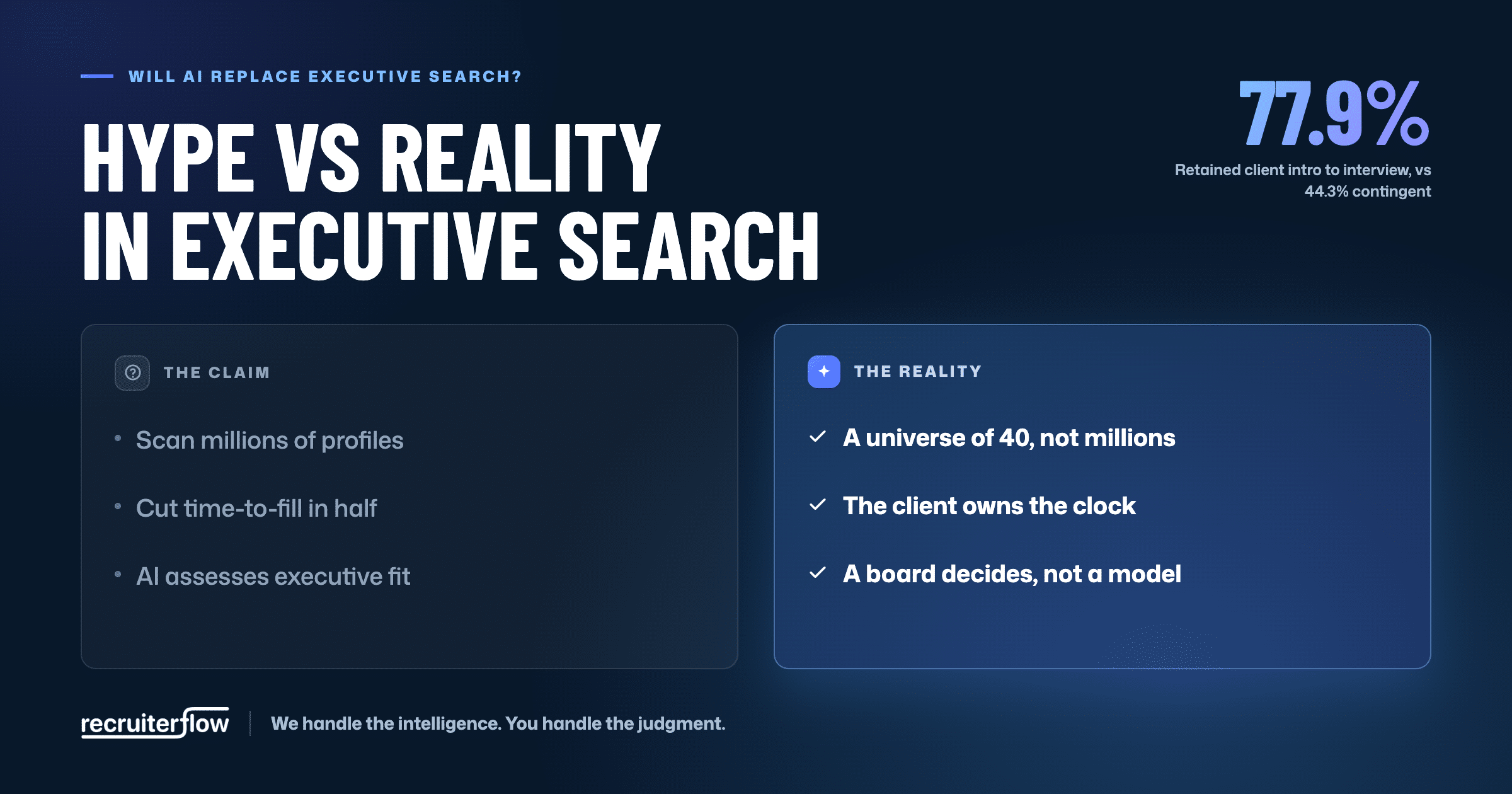
- Retained work converts at 77.9% from client intro to interview against 44.3% for contingent. That gap exists because judgment is applied before the client sees anyone.
- AI that pushes more volume into the shortlist attacks the exact number that justifies the engagement fee.
- The right frame for this segment is augmentation, and our own capability matrix has said so since before it was fashionable.
What the adoption numbers actually say
67% of executive search firms were using AI-powered tools in their workflows in early 2026 (Source: Hunt Scanlon Media).
Read next to what firms are doing with those tools, that figure describes breadth rather than depth.
Our own analysis of the wider market found the same shape a year earlier. In 2024, 88% of recruiting professionals expressed interest in AI while fewer than 60% actually used it, and the barrier was neither cost nor scepticism. It was the absence of well-defined use cases.
The AESC’s two August launches confirm the picture from the inside. You do not build an audit service for an industry that has integrated something well.
So the fair read on adoption is this. Most firms have bought something. Fewer have decided what it is for.

Three claims that do not survive a retained engagement
Vendor language borrowed from high-volume recruiting does not transfer to VP-and-above work. Three claims in particular.
“Scan millions of profiles in seconds”
A retained search has a candidate universe measured in tens, occasionally in low hundreds. For a divisional CFO in a defined sector and geography, the list of credible people is a list a good associate can build and defend.
Scale was never the constraint here.
The constraint is discriminating between four people who all look qualified on paper, one of whom will survive the board. Screening a million profiles faster does not help with that. It produces a longer longlist, which is not the same as a better one. Written material is the other half of that problem, because a CV or cover letter that reads cleanly now says less about the person who sent it than it used to. Running a candidate’s written submission through a free ai detector returns a percentage likelihood rather than a yes-or-no verdict and colour-codes the passages that read machine-written, which gives an associate something specific to probe on the first call instead of a reason to drop anyone.
“A 40 to 50% reduction in time-to-fill”
This figure circulates widely, including in the coverage cited above. It is worth taking apart.
Timelines in retained search are gated by the client. Calibration scheduling, board availability, stakeholder alignment, and the fortnight that passes while a chair is travelling.
The market is also moving against the claim rather than with it. Our reading of earnings from Page Group, Randstad, Robert Half and others found decision cycles lengthening, with processes that once took two weeks now running past a month.
Compressing research from three weeks to one is real value. It is not a halving of the engagement, because most of the elapsed time sits on the other side of the table.
“AI assessment of executive fit”
Assessment at this level is a judgment about one organisation at one moment. What this board will tolerate. What the outgoing incumbent left behind. Whether this person’s third year will go better than their first.
There is also a structural problem that no model solves.
A sitting chief executive exploring a move does not disclose their situation to a platform. They disclose it to a partner they have known for nine years, on a call that never appears in a calendar invite. Off-limits obligations and client confidentiality further restrict what can be processed, by whom, and where.
Tools can prepare the ground for that conversation. They do not have it.
Where AI actually earns its place
None of the above is an argument for standing still. It is an argument about placement.
The AESC’s own curriculum points at the right three areas: search execution, market intelligence, and client delivery with reporting and compliance. That maps closely onto the work that is repetitive rather than judgment-led.
Market mapping and research. Building a defensible view of who exists in a market, where they sit and how they have moved. This is the part of research that rewards breadth, and where AIRA earns its keep.
Context capture. AIRA Notetaker joins the call, transcribes it, summarises it and updates the record from what was said. In a business where the same person is a candidate this year and a client three years from now, the conversation is the asset. A partner reconstructing a call from memory at 9pm is losing most of it.
Client deliverables. Search progress reports, market documents, the written view a client is paying for. Larger firms staff knowledge management teams for exactly this. AI does the assembly so the consultant does the thinking, which is the correct division of labour.
Search health. Whether the first shortlist will land within three weeks of kickoff, and which engagements have quietly stopped moving. Signals, not judgments.
Our published capability matrix has always drawn this line by hiring complexity. High-volume staffing is a candidate for near-total automation. Mid-level hiring is AI-assisted. Executive search is AI-augmented, where the value the consultant adds is relationship, insight and positioning.
That framing has not changed, because it was never a marketing position.
The retained numbers that explain why judgment is the product
Here is the part of the argument with data behind it.
Across 2,100+ firms, our benchmark study broke conversion down by engagement type. Retained work behaves differently at one step in particular.
| Stage | Retained | Contingent |
|---|---|---|
| Added to screening | 46.0% | 41.3% |
| Screening to client intro | 16.5% | 11.6% |
| Client intro to interview | 77.9% | 44.3% |
| Interview to hire | 17.4% | 26.8% |
(Source: The Economics of Recruiting. The study labels these stages screening to submission and submission to interview.)
Look at the third row.
Nearly four in five people a retained consultant introduces reach interview. In contingent work it is fewer than half.
That gap is the product. It exists because judgment is applied before the client sees anyone, and because the client trusts that it was.
Which is why volume-oriented AI is a risk in this segment rather than an upgrade. Any tool that makes it cheaper to put more names in front of a client is attacking the 77.9%.
A high-volume firm can absorb a looser shortlist, because its economics reward throughput. A retained firm charging a third of salary across three tranches cannot, because the second tranche is paid on the strength of that shortlist.
The neighbouring finding is more encouraging. 71% of placements came from candidates already in the CRM before the search opened.
For a firm whose asset is a decade of relationships, the highest-return use of AI is not finding new people. It is remembering the ones you already know, and noticing when their situation changes.
What good adoption looks like
The firms doing this well are unremarkable about it.
Oxyn Partners run their outreach cadences inside Recruiterflow with every touchpoint written by hand. They use the system for coverage and visibility, so nobody is contacted twice and nothing goes cold. Not one message is generated for them.
That is the pattern worth copying. Put the tooling where the admin is, not where the judgment is.
The AESC’s criticism of the market is the second half of the lesson. Be sceptical of anything that requires you to rebuild a process that already works. A firm with a proven calibration routine and a client deliverable format its clients like should be fitting software to that, not the reverse.
If a platform change is on the table, the migration should be the disruption. Not a permanent renovation of how you run searches.
Questions worth asking any vendor
Four questions separate tools built for this segment from tools adapted to it.
How does off-limits work? If the answer is a tag, it was not designed for retained work. This is a contractual obligation, not a preference.
Does it work on a universe of 40? Most AI matching is tuned for large pools. Ask what it does with a shortlist of nine.
Where is candidate data processed and stored, and who are your sub-processors? Client confidentiality in this segment is not a compliance formality.
What did you ship three years ago? Architecture is a starting point. Shipping history tells you whether it goes anywhere.
For a fuller version of that conversation, our guide to evaluating an AI-native recruiting platform works through the same questions in more detail. If you are earlier than that and still mapping the category, our roundup of executive search software and the executive search firm tech stack cover the wider picture.
Frequently asked questions
Will AI replace executive search consultants?
No. The stages carrying the value at VP level and above are not automatable: calibration with a client, assessment of a specific leader against a specific board, and the relationship in which a sitting executive first admits they are open to a move. AI is displacing the admin around those stages, which is a different claim from replacing the consultant.
How many executive search firms use AI?
67% reported using AI-powered tools in their workflows in early 2026, according to Hunt Scanlon Media. Depth of use is a separate question. The AESC launched both introductory AI training and an audit service for firms’ existing AI tools in August 2026.
What can AI not do in executive search?
Assess fit against a specific organisation and board, hold a confidential conversation with a sitting executive, take responsibility for a shortlist, or shorten the part of the timeline the client controls.
Does AI shorten time-to-fill in retained search?
It shortens research. Total elapsed time is largely governed by client-side scheduling and decision-making, which has been lengthening across the market, so claims of halving the timeline deserve scrutiny.
Is AI useful in retained search at all?
Yes, in four places: market mapping, capturing conversations into the record, assembling client deliverables, and flagging search health. All four augment the consultant rather than substitute for one.
Should a boutique search firm adopt AI now?
Yes, starting with the admin load rather than the judgment. The firms getting value defined a use case first. That 67% adoption figure includes a large number who bought a tool and are still looking for the problem.
Judgment is still the product
The uncomfortable version of this argument cuts both ways.
Firms dismissing AI because it cannot assess a chief executive are right about the assessment and wrong about the conclusion. Most of their week is not assessment. It is notes, records, documents and follow-up.
Firms buying AI to produce longer longlists faster have misread what their clients pay for.
The work worth protecting is the judgment. Everything wrapped around it is overhead, and overhead is what this technology is actually good at removing.
We handle the intelligence. You handle the judgment. If you want to see what that looks like against a search you are running right now, book a demo and bring it with you.

Ayusmita is a B2B storyteller who spends her time translating recruiting workflows into clear stories at Recruiterflow.


Ayusmita