13 min read

TL;DR
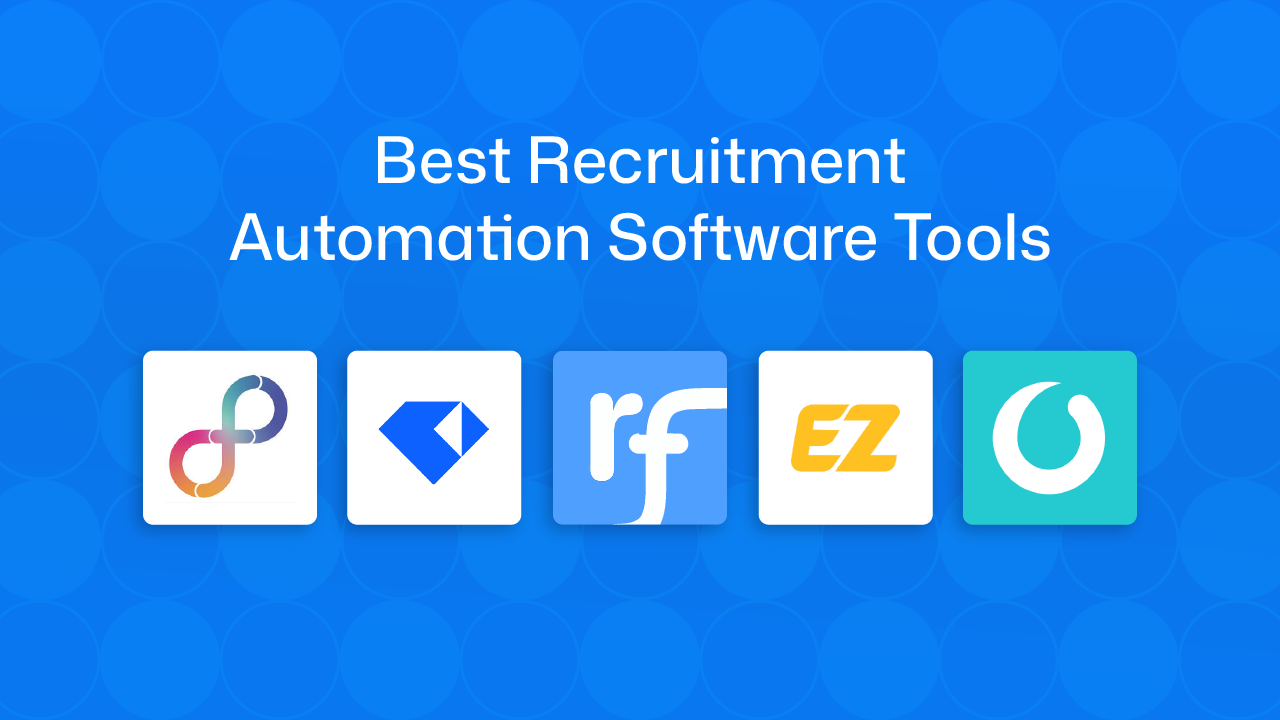
Recruiterflow: Best for search firms that want workflow-embedded automation via ATS + CRM plus AI agents (AIRA) that execute real recruiter tasks.
Eightfold AI: Enterprise talent intelligence platform focused on skills-based matching and workforce insights at scale.
hireEZ: AI sourcing and engagement layer designed to boost top-of-funnel pipeline generation.
SmartRecruiters: ATS built for global hiring infrastructure and compliance.
Workable: SMB-friendly all-in-one hiring platform with practical AI assistance.
Phenom: Enterprise talent experience platform applying AI across the full candidate and employee lifecycle.
Bottom line: pick the tool that automates the work your recruiters actually do — not the one with the loudest AI label.
Everyone in recruitment is talking about AI. Far fewer teams actually know what to expect from it, or what to do with it.
That gap is starting to show in the numbers.
According to the GRID Industry Trends Report, agencies using AI strategically are 3–5× more likely to grow revenue, yet only 12% of agencies have AI embedded across their workflow.
In other words, adoption is widespread. Operational impact is not.
That’s because not all recruitment automation tools are built the same. Some add AI on the surface. Others embed automation directly into the recruiting workflow, where search, outreach, and submissions actually happen.
In this guide, we break down the best recruitment automation tools for 2026 and where each one truly fits.
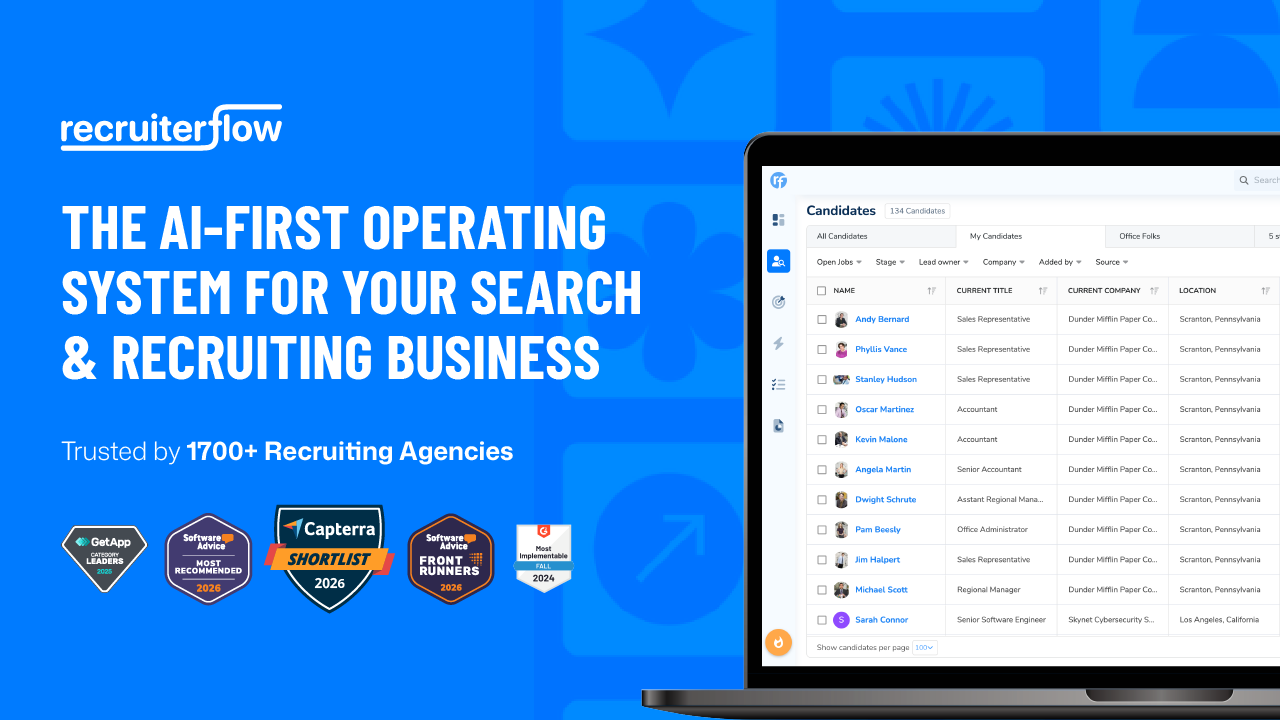
Recruiterflow is the AI operating system built for agencies that want automation to live inside the recruiting workflow. The platform combines a native ATS and CRM with multichannel sequencing, pipeline automation, and reporting, giving teams one system to manage candidates, clients, and outreach.
Recruiterflow’s edge comes from AIRA (“Your AI Twin”), a suite of AI agents that execute real recruiter work. Instead of just generating text, AIRA handles call summaries, automatic field updates, and job-change alerts that keep databases fresh — exactly where most teams lose time.

Gem positions itself as an all-in-one recruiting platform focused on consolidating ATS, CRM, sourcing, scheduling, and analytics into a single environment. Its automation strengths show up most clearly in sequencing, outreach coordination, and pipeline visibility — making it a popular choice for in-house TA teams standardising their stack.
The platform emphasises AI built into every workflow, with recommendations powered by recruiting data context, though most of its automation value sits at the coordination and intelligence layer rather than deep desk execution.
Recruit CRM offers a broad agency-style ATS and CRM with built-in automation across sourcing, email sequencing, and pipeline management. The platform is designed to cover both recruiting and business development workflows in one place, which makes it attractive for teams looking for wide feature coverage without heavy implementation.
Its AI capabilities currently centre on GPT-assisted workflows like resume parsing, content generation, and candidate matching. While helpful for productivity, the automation model is more assistive than agent-driven, making it best suited for teams prioritising usability and coverage over deeper workflow automation.
CloudTalk is an AI-powered business calling platform built for teams that rely on high-volume phone outreach, giving recruiters a dedicated communication layer that sits cleanly alongside their ATS and CRM rather than inside it. Its automation strengths show up most clearly in power dialing, call routing, and AI-generated call summaries, making it a natural fit for agency recruiters and TA teams that conduct a heavy volume of candidate and client calls each day.
Where CloudTalk stands apart is in turning every call into structured, searchable data: transcripts, sentiment signals, and activity logs sync automatically into connected tools like HubSpot, Salesforce, or Pipedrive. Its automation model is execution-focused rather than workflow-wide. It won’t replace your ATS, but for teams where the phone is a primary recruitment channel, it removes the manual overhead that typically surrounds every conversation.
Ringover is a cloud-based business phone system designed to support sales and support teams with integrated calling, messaging, and contact center capabilities. It combines VoIP software with features like call campaigns, power dialer, CRM integrations, and real-time analytics, enabling teams to manage high-volume outreach while maintaining visibility into performance and customer interactions.
Beyond core telephony, Ringover offers AI-powered tools such as call transcription, conversation analysis, and omnichannel communication (voice, SMS, messaging apps), helping teams streamline workflows and improve engagement across channels. The platform is particularly well-suited for organizations looking to centralize communication and scale their outreach without adding operational complexity.
G2 rating: 4.6/5
Pricing: Starts at $21/user/month (tiered plans)
hireEZ is built primarily as an AI sourcing and engagement layer for teams that want to strengthen top-of-funnel pipeline generation. The platform functions as a recruitment CRM that plugs into existing ATS stacks, with automation focused on candidate discovery, outreach campaigns, and screening workflows.
Its positioning around agentic AI shows up most clearly in contact discovery and AI-ranked candidate lists for hard-to-fill roles. For teams prioritising outbound sourcing efficiency, this is useful — though organisations looking for a single end-to-end system will typically pair it with a core ATS.
Paradox is best known for Olivia, its conversational AI assistant designed to automate high-volume candidate interactions. The platform focuses heavily on front-of-funnel workflows like screening conversations, interview scheduling, and candidate Q&A, helping teams reduce coordination overhead at scale.
Its automation strength sits squarely in conversational orchestration rather than full recruiting system coverage. For high-volume hiring environments, that focus can deliver fast efficiency gains — though most teams still rely on a primary ATS alongside it.
SmartRecruiters positions itself as an enterprise-grade hiring platform with a broad ATS ecosystem and partner marketplace. The platform covers core recruiting workflows end to end, with strength in global hiring infrastructure, collaboration, and integration flexibility.
Its AI capabilities are framed at the platform optimisation level rather than task-specific automation. For large organisations prioritising compliance, scalability, and ecosystem depth, this approach fits well — though smaller or agency teams may find the footprint more than they need.
Pinpoint is a modern ATS designed for in-house teams that want structured hiring workflows with configurable automation. The platform focuses on making complex, multi-role hiring easier to manage across regions, with clean pipeline controls and built-in workflow rules.
Its AI features centre on AI Candidate Filters, Match Scores, and AI Fields, all built with explicit human-in-the-loop oversight, though the platform remains primarily ATS-led rather than deeply automation-first.
Workable has built strong traction in the SMB and mid-market segment by offering a broad, easy-to-deploy hiring platform. It combines job distribution, candidate tracking, automation, and reporting into a single system, making it a practical choice for teams that want fast time-to-value.
The platform includes a built-in AI assistant for job description drafting and screening support. While useful for day-to-day productivity, the automation layer is largely assistive, making Workable best suited for teams prioritising simplicity and coverage over deeper workflow orchestration.
Phenom operates as a broad talent experience platform aimed at large enterprises managing the full candidate and employee lifecycle. Its scope extends beyond traditional ATS functionality into CRM, chatbots, campaigns, and internal mobility — supported by a wide API surface.
AI is applied across multiple touchpoints to improve automation and personalisation at scale. For organisations investing in end-to-end talent experience strategy, this breadth is compelling — though teams focused narrowly on recruiter desk automation may find the platform more expansive than necessary.
Eightfold operates in a different category, positioning itself as a talent intelligence platform that layers AI on top of existing HR systems like Workday or SuccessFactors. Its strength lies in skills-based matching and large-scale workforce intelligence rather than day-to-day recruiter workflow management.
The platform’s AI is geared toward enterprise transformation use cases — internal mobility, talent insights, and lifecycle intelligence. For organisations pursuing skills-first hiring strategies, this depth is valuable, though teams focused primarily on desk-level automation may find the platform heavier than required.
Also, check our blog on 10 AI Recruitment Management Software in 2026
When Guy Last Recruitment started evaluating recruitment automation tools, the team needed “a system of productivity & work instead of just a system of record.” Their legacy ATS was storing information — but not helping recruiters move faster.
After moving to Recruiterflow and standardising automation across workflows, the impact showed up quickly.
Read the detailed case study here.
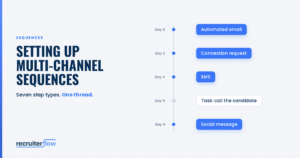
Multi-channel sequences expanded client reach, advanced filters improved shortlist speed, and automated updates reduced daily admin drag.
The result: 142% increase in job orders, 40% more submittals per recruiter, and a 34% reduction in time to placement.
The lesson for buyers: the right recruitment automation platform shouldn’t just add features — it should remove friction from the desk.
Book a 15-minute call — we’ll show you exactly where your current ATS is leaking time and money.
The best recruitment automation tools are the ones that remove real manual work from your team. Agency users often prioritise ATS + CRM automation and sequencing, while enterprise teams look for scale, integrations, and compliance. In 2026, platforms with workflow-embedded automation consistently deliver the strongest ROI.
Yes — when the AI actually executes tasks. Tools that automate follow-ups, screening, scheduling, and data updates typically drive measurable efficiency gains. Surface-level AI (like basic text generation) delivers far less impact.
Most agency-focused tools range from ~$100 to $165 per user/month, while enterprise platforms are usually quote-based. Advanced AI modules are often priced separately. The real benchmark is ROI, not license cost alone.
Yes. Small teams often benefit the most because automation expands recruiter capacity without adding headcount. Many platforms offer scalable pricing to start small and grow.
They can help — especially through structured workflows, skills-based matching, and consistent evaluation criteria. But automation alone doesn’t remove bias; outcomes still depend on how the system is configured and used.
Software and Tools

Ayusmita is a B2B storyteller who spends her time translating recruiting workflows into clear stories at Recruiterflow.
Ayusmita