
How to Build a Winning Recruitment Team Structure That Scales

TL;DR

- A high-performing recruitment team is built around candidate flow and ownership, not job titles or hierarchy.

 - As a recruitment team scales, separating core functions—sourcing, candidate conversion, coordination, client ownership, and recruitment operations—prevents delays, burnout, and candidate drop-offs.

- A strong recruitment team structure defines clear handoffs, accountability at every stage, and escalation paths when work stalls.

- Growing recruitment teams should use flow-based metrics such as time between stages, feedback lag, and drop-off rates to continuously redesign their recruitment team structure and scale without slowing down.
Recruitment teams rarely break overnight. They decay slowly.
Recruiters begin relying on memory. Because writing things down feels slower. (It isn’t.)
These are early warning signs. They usually appear once the team grows beyond a few roles.
Without deliberate coordination, leadership defaults to whoever moves fastest — not always the most experienced or accountable person.
That’s where structure matters.
A strong recruitment team structure acts like a control system. It governs how work moves, where it gets stuck, and who fixes things when they quietly break.
In this blog we will discuss how to scale your recruitment team without slowing down, burning out, or losing candidate trust.
What is a Recruitment Team Structure?
Every hire moves through a pipeline: role intake – sourcing – screening – shortlisting – interviews – feedback – offer – close.
When teams are small, each transition point in this sequence is smooth.
But as the work expands, you start seeing delays, confusion, and drop-offs happen. You can no longer Slack each other or remember key facts.
A recruitment team structure exists to streamline the pipeline, independent of memory, goodwill, or heroics.
It is NOT a hierarchy of who reports to whom, which roles exist, and how many of each you need.
Rather, it is a framework that determines:
- Who owns the candidate relationship at each stage
- Who is responsible for speed vs. quality
- Where decisions are made
- How handoffs work
- What happens when something stalls
Recruitment Team vs. Hiring Team vs. Talent Acquisition Team
| Team Type | Primary responsibility | What it optimizes for | Common mistake |
| Recruitment Team | Sourcing, outreach, screening, coordination, follow-ups, offer management, closing | Movement (speed, throughput, conversion) | Being structured like a committee instead of an engine |
| Hiring Team | Interviewing, feedback, decision-making, role fit validation | Judgment quality (fit, performance, risk reduction) | Being mistaken for the recruitment team |
| Talent Acquisition Team | Workforce planning, employer branding, pipeline strategy, future skills mapping | Sustainability (future hiring readiness) | Being treated as a short-term fulfillment function |
P.S.: In case you want some deeper reading, try this: 360 Recruitment: A Complete Guide
Why Recruitment Team Structure Matters
1. Replaces memory-based coordination with reliable systems
In very small teams, coordination can happen informally.
But as soon as the number of roles, candidates, and stakeholders increases, then follow-ups slip, handoffs become ambiguous, and work gets delayed.
This is due to no system in place to manage the flow of tasks.
A defined recruiting agency team structure replaces memory-based coordination with intentional ownership and repeatable processes.
2. Prevents small delays from magnifying into systemic slowdowns
A day’s delay in feedback becomes a week. A missed follow-up becomes a lost candidate. A vague ownership boundary becomes recurring confusion.
If these events keep occurring, eventually the time-to-hire stretches, candidate trust erodes, and clients start asking why you’re slowing down.
A recruitment department structure controls micro-delays and prevents them from accumulating.
3. Makes ownership visible and enforceable
Without structure, people assume someone else will handle a follow-up.
Or, two people send the same update to one client…familiar scenarios in candidate communication, client updates, and interview coordination.
A well-designed recruitment team structure defines responsibility and gets rid of ambiguities.
It answers: Who owns the candidate relationship at this stage? Who is accountable if this stalls? Who is responsible for pushing the next step?
The result is reduced duplication, gaps, and confusion.
4. Reduces dependency on individual excellence
Every poorly structured team keeps running because of a few exceptional people.
They notice when something breaks, fix it, chase feedback, calm frustrated candidates, and manually track what should be automated.
While the system appears to work, it is fundamentally unstable.
When the few good people burn out, go on leave, or quit, everything collapses at once.
Structure distributes responsibility so that success does not depend on a few individuals compensating for everyone else.
5. Standardizes candidate and client experience
In unstructured teams, some candidates get fast responses, clear timelines, and proactive communication. Others wait days between updates and are out of the loop.
This inconsistency comes from different personal working styles.
A strong recruiting agency team structure helps deliver a consistent experience, regardless of who is handling the role.
This builds trust with both candidates and clients.
6. Allows teams to scale without slowing down
Growth introduces complexity with more roles, clients, stakeholders, and coordination.
If structure doesn’t evolve, every new hire adds friction. Recruiters spend more time coordinating than recruiting. Managers spend more time fixing than doing their job.
Recruitment department structure defines how work expands without becoming chaotic. It ensures that adding people results in higher outcomes instead of adding noise.
Key Roles in a Recruitment Agency Team
Recruitment roles are not static job titles. In practice, these roles evolve to solve problems that appear as agencies scale.
1. The Sourcer
The sourcer seeks out talent in the market.
A strong sourcer understands where talent actually comes from and what is needed to attract them: which companies, what titles, what keywords, what comp packages, and what messaging.
Poor sourcing creates downstream problems such as low-quality inbound, weak shortlists, high drop-offs after first calls and longer time-to-fill.
2. The Recruiter
Recruiters are conversion specialists.
They translate role requirements for candidates. They manage uncertainty, hesitation, counteroffers, competing opportunities, and timing mismatches.
Strong recruiters actively diagnose risk while interacting with candidates. They ask:
- Is this candidate serious?
- Is the compensation expectation real?
- Will this client move fast enough?
- Is this interview process going to kill momentum?
Ideally, recruiters should not get dragged into sourcing, scheduling, reporting, and client updates. Their actual value is closing.
3. The Account Manager
Unclear client ownership causes enormous damage to recruitment agencies.
When multiple people talk to a client, the client gets confused by multiple versions and narratives. When nobody clearly owns the client relationship, feedback comes intermittently, priorities shift, and service quality falters.
The role of the account manager is primarily to control the client’s expectations. They clarify what the market can realistically deliver. They push back on unrealistic timelines. They clarify feedback and protect recruiters from being roped into more work.
4. The Recruitment Coordinator: The Velocity Keeper
This role stands as a guardrail between a fast pipeline and a stalled one. Responsibilities include interview scheduling, calendar conflicts, feedback collection, document sharing, and status updates.
Every extra day between stages increases the chance of candidate dropout.
Coordinators prevent this as schedulers, chasers, and human notification systems. They keep the pipeline from drifting and losing good candidates because of preventable delays.
5. Recruitment Operations
Most recruiting teams add this role too late.
Recruitment operations basically design how recruiting work should move, day to day.
They define pipelines, standardize handoffs, build dashboards and look for chokepoints where candidates stall and why. They also build in automated processes to relieve humans of grunt work.
6. Leadership
Good recruitment leaders remove friction.
They look for patterns: which roles are always delayed, where handoffs fail, which recruiters carry invisible load, which clients distort priorities.
Once they see the patterns, they design operational flows for minimal bottlenecks.
How to Structure Your Recruitment Team Based on Agency Size
There is no single “correct” recruitment team structure. What works for a three-person team will actively hurt a thirty-person team.
Most agencies tend to copy structures they admire instead of tailoring them to problems they actually have. Any change in team size fundamentally changes how people communicate, how bottlenecks show up, who owns processes, and what outcomes emerge.
Early-Stage Agencies (1–5 people)
At this stage, most recruiting teams can get by with generalist recruiters. Everyone does a bit of everything: sourcing, screening, client calls, scheduling, closing.
Since volume is low and context is shared among a few people, this can work. Memory works fine where there isn’t too much to remember.
However, important functions are not properly distinguished and owned. No one is explicitly responsible for candidate follow-ups, setting client expectations, and establishing data hygiene.
Soon enough, you’ll start to feel the cracks.
At this point, it’s best to start by labeling the functions that already exist. Even if one person handles sourcing, closing, and coordination, name them as distinct responsibilities. This helps simplify the process of specialization when the team grows.
Growing Agencies (6–15 people)
This is where the need for structure becomes clear.
As you hire more people, you’ll notice that:
- Some recruiters are great closers but weak sourcers.
- Some people are always chasing feedback.
- Some clients are constantly confused.
- The same two people seem to know most about what’s going on at each stage.
To deal with this, agencies start to set up their first layer of specialization:
- A dedicated sourcer (or two)
- A coordinator or delivery-focused role
- Clear ownership of client communication
- A set of team communication tools to improve collaboration in the recruitment process
Agencies also begin to understand that sourcing and closing require different mental modes. Using a team dynamics assessment can help agencies understand how sourcers, recruiters, and coordinators naturally operate, reducing friction as specialization increases. If your recruiters are constantly switching between prospecting, selling, scheduling, and reporting, you’re losing on quality output.
Scaling Agencies (15–40 people)
At this stage, all memory-based systems become useless.
People no longer know what everyone else is doing. Slack comes into play. Meetings multiply. “Just checking in” messages are everywhere.
Work feels slower even though the team has more people.
Teams now start implementing:
- Smaller pod-based teams comprising one sourcer, two recruiters, and one coordinator per pod, for eg.
- Vertical or industry-aligned groups.
- A formal recruitment operations role.
- Clear escalation paths.
Metrics also become important, especially the flow-based ones, like:
- Time between stages.
- Drop-off points.
- Feedback lag.
- Offer velocity.
Large Agencies (40+ people)
At this scale, recruitment becomes an organizational problem. Without a proper recruitment department structure:
- Different teams develop different norms.
- Clients get different experiences.
- The quality of the outcome varies. No one can tell whether delays are local or systemic.
If agencies do not implement structure at this point, they will plateau. That structure looks like:
- Layered leadership (team leads, regional leads, vertical heads).
- Dedicated recruitment operations.
- Enablement and training functions.
- Employer branding or recruitment marketing.
- Centralized analytics.
This structure prevents the agency from feeling like multiple small agencies sharing a logo.
Pro-Tip:
Many agencies try to achieve “startup speed” by avoiding structure. What they end up with is chaos. A tailored, targeted talent acquisition team structure can offer predictability without being bogged down by bureaucracy.
Best Practices for Building a Recruitment Team Structure
Most recruitment team structures look good on paper but fail in practice.
This happens because team structure is designed around roles, rather than how work actually moves. Cardinal mistake.
A good recruitment team structure works as a living system that must adapt as your business, client types, and hiring volume change. These principles help you get to that team structure without bankrupting budgets and effort.
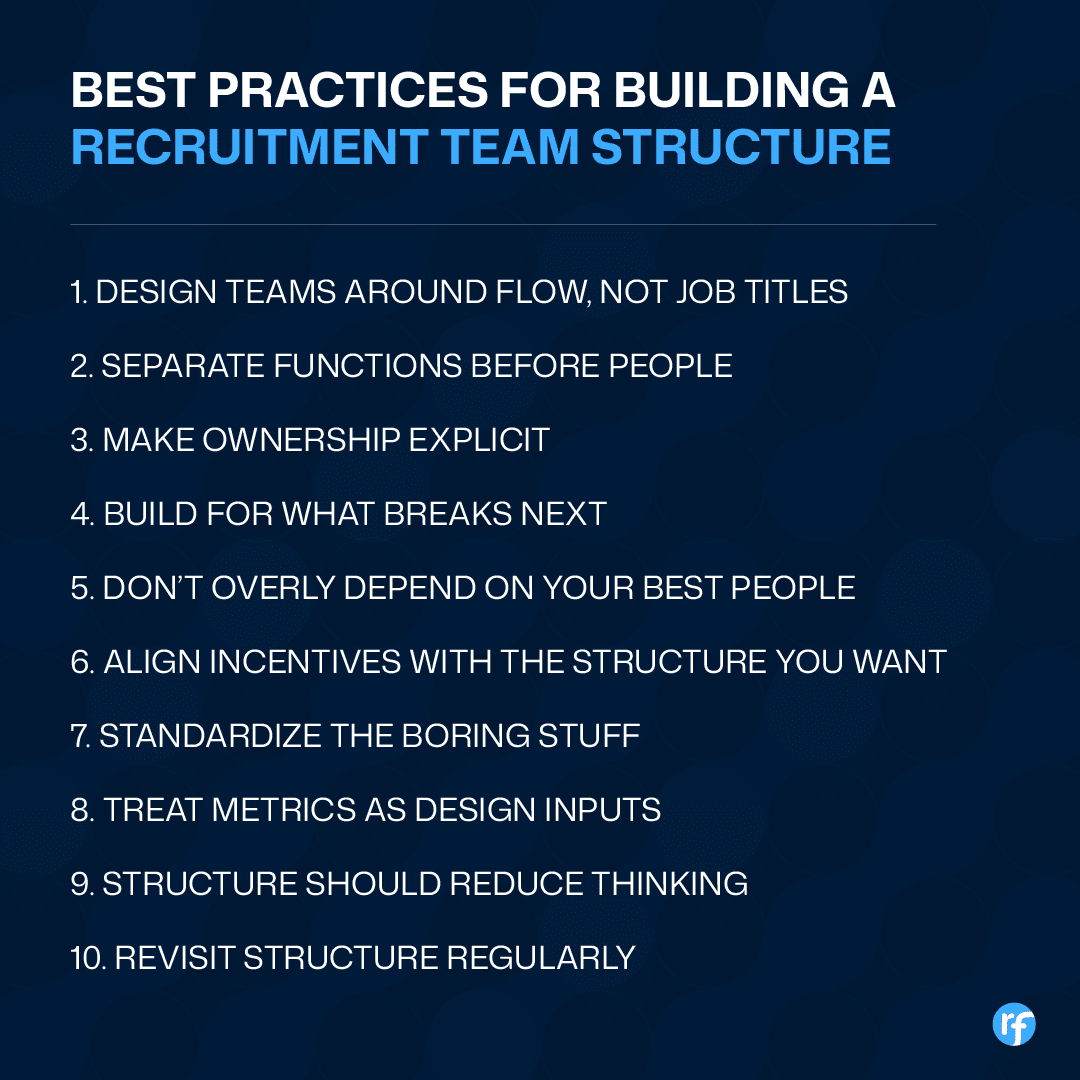
1. Design Teams Around Flow, Not Job Titles
Forget job titles. Start with how work flows.
Analyze the actual journey of a candidate and a client. When a role comes in for you to fill, what actually happens?
Who touches it? Who makes decisions? Where does it pause? What bottlenecks keep showing up?
Most inefficiencies in recruiting come from work bouncing between people with unclear ownership. If three people run candidate follow-ups at different times, no one really owns the function. If everyone can talk to the client, the client almost always gets confused.
Your structure should let everyone know exactly what they are doing at all times.
2. Separate Functions Before People
Don’t start hiring new people before separating specific functions in your team. What generally happens is that recruiters do multiple kinds of work:
- Market prospecting (sourcing).
- Candidate selling (closing).
- Logistics (scheduling, feedback chasing).
- Client communication.
- Reporting and tracking.
Those are different cognitive tasks, and need to be separated conceptually and structurally.
So before you go gung-ho into hiring new recruiters, ask:
- Which function is currently slowing us down?
- Which function is eating up the most time from our best performers?
- Which function is being done inconsistently?
Then hire for this role.
3. Make Ownership Explicit
DO NOT prioritize collaboration at the cost of clarity. Ambiguous ownership will kill your outcomes. You need to have specific people responsible for:
- Candidate follow-ups.
- Client updates.
- Interview scheduling.
- Feedback loops.
- Offer progression.
In some teams, clear ownership might initially feel uncomfortable. People will worry about stepping on toes, and be unclear about what their job really is.
Stay on track. The discomfort of recruiting teams will subside, and the clarity will drive real results.
4. Build for What Breaks Next
Don’t restructure your team only after recruiters are overwhelmed, clients are unhappy, and drop-offs are high.
Anticipate the next breaking point, and get to hiring team members to prevent the collapse.
At small scale, memory breaks.
At the medium scale, communication breaks.
At a large scale, alignment breaks.
Establish a talent acquisition team structure to address these breaks before they become visible.
If your team is 8 people, design a team structure for 15. Otherwise, you will always be playing catch-up with your problems.
5. Don’t Overly Depend on Your Best People
Every team has a few people who do more than others. They notice gaps, fix things quietly, and compensate for broken handoffs.
But they cannot be the structural glue for your whole operation.
Over time, these folks will burn out, grow resentful, and leave. When they do, everything collapses, and you don’t know how to start fixing it.
Focus on establishing a talent acquisition team structure where the average performance is reliable and exceptional performance is not required.
6. Align Incentives With the Structure You Want
If you want better collaboration, do not reward individual placements.
If you want quality, do not reward speed.
If you want long-term relationships, do not reward short-term wins.
Your recruitment marketing ideas, compensation, KPIs, and recognition systems should reward actions that produce desired outcomes in terms of team structure.
If you want a split-desk model, reward both sides. If you want pods, you must measure team outcomes, not just individual ones.
7. Standardize the Boring Stuff
Recruitment involves a lot of repetition:
- Follow-ups
- Interview scheduling
- Status updates
- Feedback reminders
- Data entry
If these are not standardized, they will drift and create clutter.
Standardize and automate whatever grunt work you can, so recruiters can focus on tasks that necessitate human intelligence.
Every minute they spend remembering what to do next is a minute they do not spend closing.
8. Treat Metrics as Design Inputs
A strong recruiting agency will use recruitment metrics to design the workflow.
If you see long delays between stages, it’s a handoff problem. Don’t blame the recruiters.
If candidates consistently drop after the second interview, it’s a selling or process issue. Sourcing is not the problem here.
Use data to ask:
“Where is our structure leaking?” rather than “Who is underperforming?”
9. Structure Should Reduce Thinking
A good structure makes decisions obvious, removes ambiguity, and tells people in a recruiting team what “normal” looks like.
If your team constantly asks:
“Should I do this or that?”
“Who should handle this?”
“Is this my job?”
Then your structure is not optimally designed.
10. Revisit Structure Regularly
Don’t stick to one talent acquisition team structure because it worked in the past.
Every new client type, new volume band, new geography, and even hiring team members can change workflows. If your structure doesn’t adapt, people will work around it, and that’s how shadow processes form.
Set a cadence to review:
- Where delays are happening.
- Where confusion is occurring.
- Where people are compensating.
- Where decisions are unclear.
How To Put This Structure To Action?
A well-designed recruitment team structure allows you to handle both routine processes and unexpected disruptions without relying on heroic effort.
It removes dependency on a few exceptional individuals holding everything together.
Structure creates momentum — and momentum is what enables sustainable growth.
If you’re ready to move beyond running recruitment smoothly and start scaling your agency deliberately, this ebook explains how $10M+ firms think about retention, revenue mix, and long-term growth.
Recruitment
Ayusmita is a B2B storyteller who spends her time translating recruiting workflows into clear stories at Recruiterflow.
Ayusmita