

Intake Meeting Checklist for Recruiters (Free Downloadable Template)
Intake meetings often fall somewhere between “this could’ve been an email” and “a week of back-and-forth clarifications.”
You leave with a job title, a few must-haves, and a vague idea of what the hiring manager really wants and the search still drifts off-course.
A great questions checklist won’t solve your entire life as a recruiter, but it can absolutely anchor the conversation and reduce misalignment.
But before we get to the good stuff, let’s take a minute to make sure we’re on the same page.
In this blog, we will cover the definition of intake meeting, its importance, and how to conduct one in the most effective way.
What Is an Intake Meeting?
An intake meeting is a structured conversation between a recruiter and the hiring manager where both sides align on the role, success criteria, candidate profile, hiring process, and market expectations before the search begins. It’s the foundation of any effective recruiting plan.
If you want the simplest intake meeting definition:
In recruiting, this is sometimes called a job intake, recruitment meeting, or recruiting kickoff, but the goal is always the same: establish clarity.
Not just about job titles or keywords, but the actual outcomes, competencies, and constraints that will drive a successful hire.
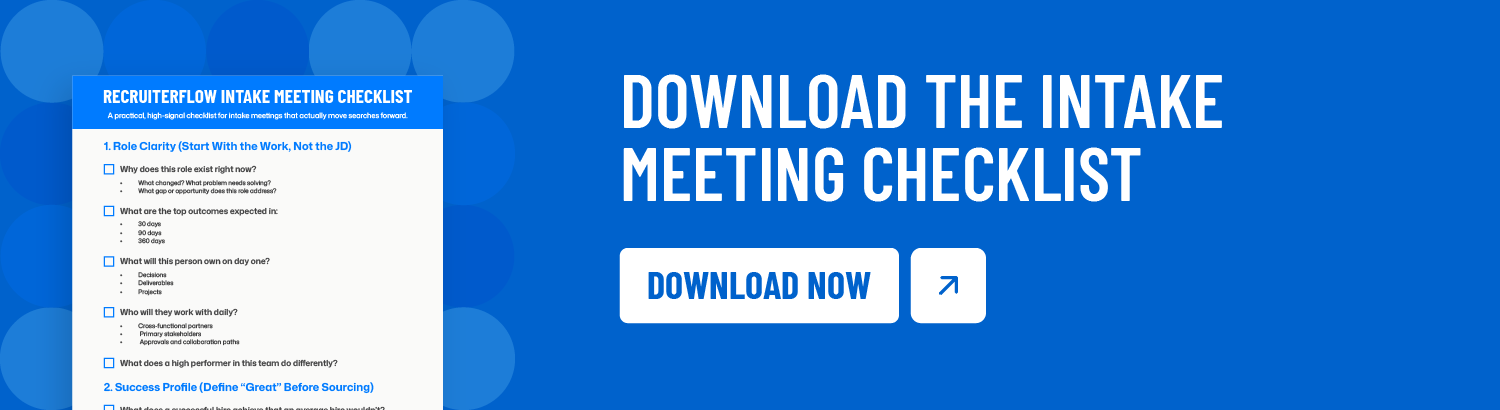
Intake Meeting Checklist (Free Download)
A structured intake equals a smoother search. Use this checklist to ask better questions, align faster, and prevent avoidable rework.
Why Intake Meetings Are Important (and Why a Questionnaire Isn’t Enough)
A fair question: do you really need to spend time on an intake meeting, or can you just send a well-designed questionnaire and get on with your search?
On paper, a questionnaire sounds efficient: fewer meetings, faster turnaround, cleaner data.
And it absolutely has its place. A questionnaire can support your workflow, but it can’t replace an intake meeting.
For straightforward or repetitive roles, a form may be enough but for more complex roles, especially in executive search, an intake meeting becomes non-negotiable.
Here’s why.
1. Questionnaires capture information; intake meetings dig context
A form can tell you the what:
- Required skills
- Responsibilities
- Experience range
But only a conversation reveals the why:
- Why this role exists
- Where the team is struggling
- What prompted the hire
- What success looks like beyond the job description
That context is what shapes your sourcing strategy. Without it, you’re running the search in low resolution.
2. Questionnaires can’t surface unspoken expectations (managers always have them)
Every hiring manager carries assumptions they won’t write down:
- “Someone who can push back on the product.”
- “I can’t manage juniors right now.”
- “We’d prefer someone from X-type companies.”
- “We’ve had challenges with Y profiles in the past.”
These insights rarely show up unless you tease them out.
3. Trade-offs require real-time negotiation
The intake meeting is where you challenge constraints and negotiate trade-offs:
- “If we reduce X requirement, the talent pool opens by 40%.”
- “If the comp range stays here, here’s what the market actually looks like.”
- “If you want speed, this is the screening model we should follow.”
Trade-offs are dynamic. They need back-and-forth, not tick boxes.
4. It’s your best opportunity to calibrate expectations before sourcing
Most misalignment happens because expectations weren’t surfaced early.
The intake meeting lets you say:
- “Here’s what’s feasible.”
- “Here’s what the market data suggests.”
- “Here’s the timeline we can realistically commit to.”
A questionnaire can’t course-correct unrealistic expectations. An intake meeting can.
5. Relationships are built over conversations, not in forms
Recruiters are advisors, not order processors. Your authority, trust, and influence are built in live conversations where you:
- Ask smart questions,
- Interpret the role better than the JD,
- Bring market insight,
- Gain visibility into how the hiring manager thinks.
You don’t build that kind of partnership through a Google Form.
If aligning early helps reduce back-and-forth, tightening the rest of your pipeline matters too.
Also Read: How to Reduce Time-to-Fill in Recruitment
Pre-Intake Prep: Come Armed With Market Reality (Not Optimism)
Before you walk into the intake meeting, do the groundwork that actually shapes the conversation. Top recruiters don’t show up with generic questions; they show up with data.
Research ahead of time:
- Talent availability in the market
- Competitive demand for similar roles
- Compensation alignment with the current market
- Likely trade-offs the hiring manager may need to accept
(speed vs. seniority, budget vs. experience, flexibility vs. pipeline size)
This prep transforms the conversation.
Instead of being an order-taker, you walk in as an advisor who can say:
- “This is realistic.”
- “This may be a stretch.”
- “Here’s where we’ll need to compromise.”
- “Here’s what the current market supports.”
This way, the intake meeting starts from clarity, not assumptions, and you avoid spending the next four weeks recalibrating expectations.
How to Run an Effective Intake Meeting (What to Cover + How to Cover It)
A high-quality intake meeting has two goals:
- Understand the role at a deep, functional level, and
- Align with the hiring manager on expectations, process, and constraints.
Here’s a clear, comprehensive framework you can follow, whether the role is engineering, sales, product, or anything in between.
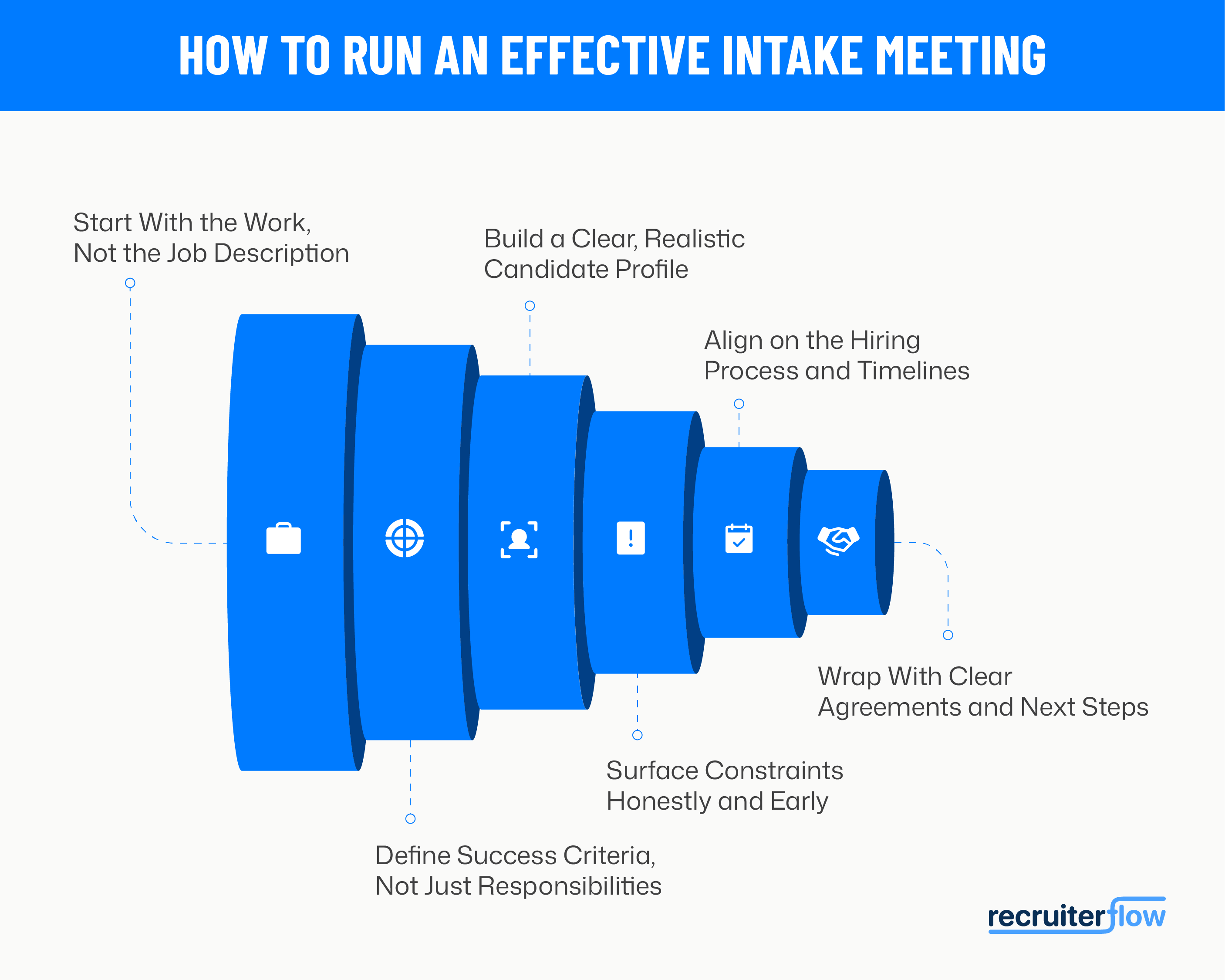
1. Start With the Work, Not the Job Description
Go beyond just titles, keywords, and years of experience.
Begin with the actual work the person will own.
Ask the hiring manager:
- What problems is this person being hired to solve?
- What will they be doing in their first 30, 90, and 360 days?
- What outcomes define success in this role?
2. Define Success Criteria, Not Just Responsibilities
Most job descriptions list tasks. Few explain what success looks like.
Clarify:
- How performance will be measured
- What separates an “okay hire” from a “great hire”
- Competencies and behaviors that predict success
3. Build a Clear, Realistic Candidate Profile
Instead of keyword-matching, map what a strong candidate has actually done.
Cover:
- Must-have vs. nice-to-have experience
- Types of companies or environments that produce relevant talent
- Backgrounds that typically do not work well
- Deal-breakers (explicit and implicit)
This step stops misalignment before it happens.
Once you know who you’re hiring, the next step is making sure the right candidates actually find you.
Also Read: A Recruiter’s Guide to Inbound Recruiting
4. Surface Constraints Honestly and Early
Before you start sourcing, you need clarity on the limits of the search.
Align on:
- Compensation range and flexibility
- Work model (onsite, remote, hybrid)
- Sponsorship, compliance, or clearance requirements
These are the “hidden blockers” that create bottlenecks if left vague.
5. Align on the Hiring Process and Timelines
Document the process from the first screen to offer.
Clarify:
- Who is involved in each interview stage
- Required assessments
- Expected feedback turnaround
- The timeline you’re collectively committing to
This prevents the classic mid-search chaos: “Can we change the process?” “Why is this taking so long?”
6. Wrap With Clear Agreements and Next Steps
Before ending the meeting, lock in:
- The agreed candidate profile
- The defined success criteria
- The final hiring process
- Feedback expectations
- Timelines
- The hiring manager’s weekly time commitment
This alignment is what keeps the search from drifting.
If you prefer a more tactical breakdown: exact questions, examples, and pro-level intake moves, we’ve already documented the full playbook.
Read our blog on how to conduct intake meetings.
The Step After the Intake Meeting That Most Recruiters Forget
You know what happens right after a great intake meeting?
Everyone nods, everyone feels aligned… and then someone says,
“Can you send me the notes?”
And that’s the part most recruiters quietly dread: turning a fast, layered, 30-minute conversation into a clean, structured brief you can actually use.
That’s where details slip, assumptions sneak in, and alignment starts to drift.
So we built our own process around one principle:
Stay fully present in the conversation, and let the system handle the structure.
Here’s the workflow:
Before the meeting:
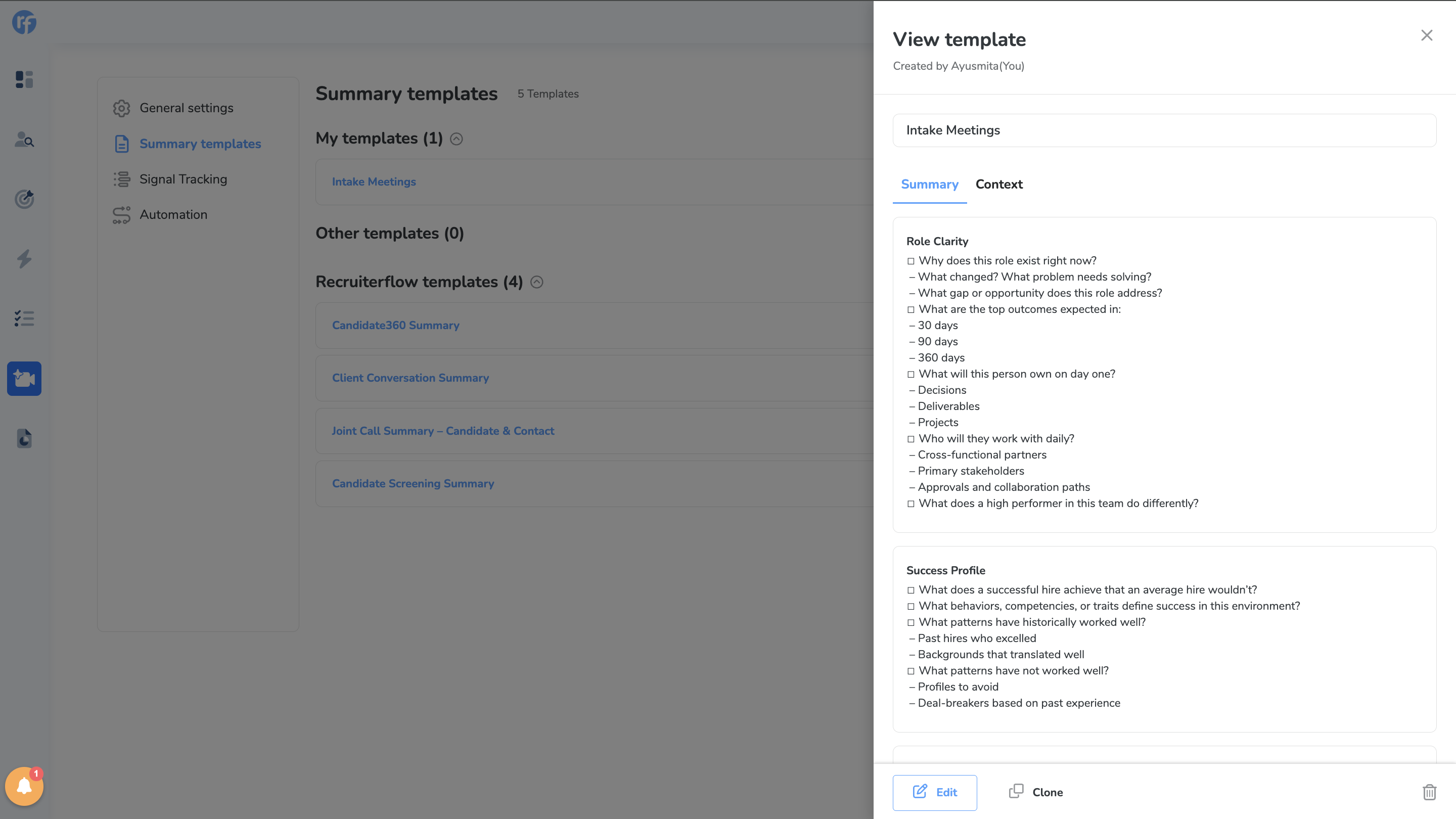
Create a customized summary template inside Recruiterflow’s AIRA Notetaker, modeled directly on the checklist you’re about to download.
During the meeting:
Focus entirely on the human parts: the nuance, the probing, the expectation-setting.
AIRA quietly captures the full conversation in the background.
Right after the meeting:
Select your template. AIRA instantly organizes everything into clean sections:
- role clarity
- success outcomes
- must-haves and deal-breakers
- constraints
- timelines
No scrubbing through recordings.
No messy half-notes to “fix later.”
Just a ready-to-share intake summary you can drop straight into your ATS.
Want to replicate this workflow?
Get a live demo of how AIRA handled the intake notes, highlighted gaps, and accelerated the search — and explore the rest of Recruiterflow’s AI capabilities.
Frequently Asked Questions
1. What is the purpose of the intake discussion?
The purpose of an intake meeting (sometimes called a recruitment meeting, recruiting meeting, or job intake) is to align the recruiter and hiring manager on the role, the success outcomes, the candidate profile, and the hiring process. The goal is to remove ambiguity early and ensure the search starts with a clear direction and shared expectations.
2. How long is an intake meeting?
A well-run intake meeting typically lasts 30–45 minutes. Longer sessions usually indicate the conversation isn’t structured, while overly short meetings often miss important details. The ideal duration is long enough to cover outcomes, constraints, and process — but short enough to stay focused and actionable.
3. How do you prepare for an intake call?
Preparation begins with understanding the intake meeting meaning: it’s not just a formality, but the foundation of the search. Before the intake call, review the job description, look for gaps, analyze compensation benchmarks, gather market insights, and prepare questions around role outcomes, candidate signals, constraints, and timelines. Preparation ensures the job intake conversation stays strategic rather than reactive.
4. What happens during an intake session?
During an intake meeting, the recruiter and hiring manager clarify:
- Why the role exists
- What success looks like (30/90/360 days)
- Must-have and nice-to-have candidate traits
- Compensation and constraints
- Interview stages and timelines
This is where the real intake meeting definition comes to life — it’s a collaborative discussion designed to remove blind spots and align on a hiring strategy.
5. What are the 5 stages of the recruitment process?
While models vary, most teams follow a version of these five stages:
- Intake meeting / role alignment
- Sourcing and outreach
- Screening and assessments
- Interviews and evaluation
- Offer, close, and onboarding
The intake meeting is the first and arguably most important stage because it sets the direction for everything that follows.
Recruitment
Ayusmita is a B2B storyteller who spends her time translating messy, human recruiting workflows into clear stories that help teams work smarter, not harder. Big believer in human-first optimization, she writes for people who prefer clarity over complexity and conversations over checklists.
Ayusmita