
How to Build a Talent Pipeline From the Candidates You Already Know
A talent pipeline is a group of candidate relationships you keep current and ready for future searches. For a recruitment firm, building one rarely means starting from zero. It means making the people you have already met, screened and placed easy to find and worth contacting again.
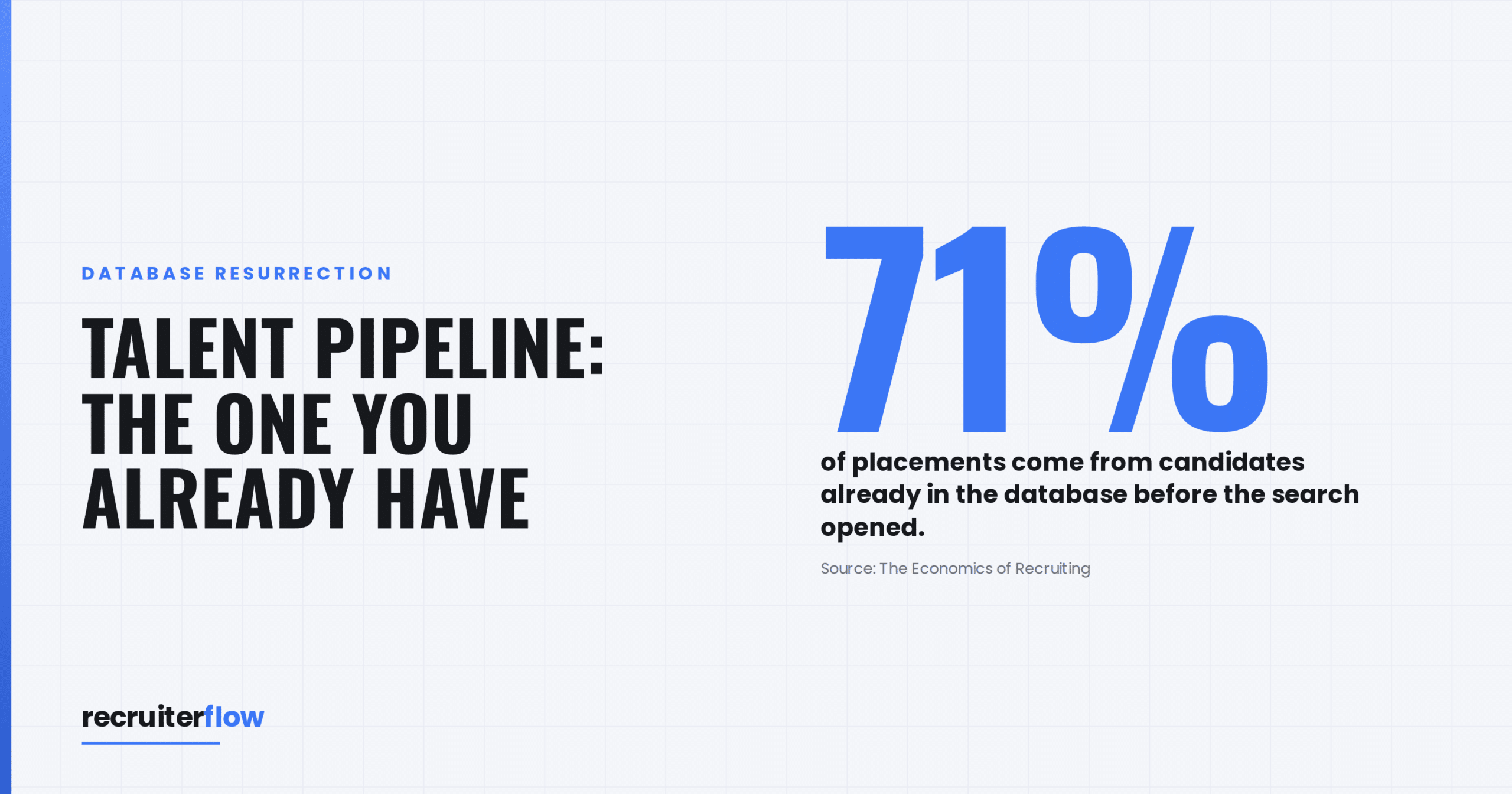
That matters because 71% of placements in Recruiterflow’s benchmark came from candidates who were already in the database before the search opened (The Economics of Recruiting). The opportunity is to turn that existing history into a pipeline consultants can use deliberately, instead of relying on memory each time a mandate arrives.
Here is what makes a talent pipeline different from a large database, why existing relationships go unused, and how to build a process that gets stronger with every search.
What a talent pipeline actually is
A pipeline is not a list
A list is a set of names. A pipeline is a set of relationships you can act on, with enough context attached that someone other than you can pick one up and make a call.
The distinction matters commercially. A list degrades quietly and you find out when you need it. A pipeline is maintained on purpose.
Not the same as a talent pool
A talent pool is everyone you hold. A pipeline is the subset you are actively keeping warm for work you expect to win. Treating the whole database as a pipeline is how firms end up with neither.
The difference is maintenance
Every pipeline decays. People move, titles change, motivations shift. A pipeline is defined less by who is in it than by how recently anyone checked.
The pipeline you already have
Around 71% of placements come from candidates already in the database before the search opened (The Economics of Recruiting). That is a strong reason to search your database first when a new mandate comes in.

Why it goes unused
Three reasons, in roughly this order.
The records are not findable. If the only way to surface someone is to remember the exact job title you filed them under, the database is a filing cabinet rather than a pipeline.
The records are not trusted. Once consultants believe the data is stale, they stop looking, which makes it staler. That loop is hard to reverse and easy to avoid.
Nobody owns it. Sourcing new people is somebody’s job this week. Maintaining what you have is nobody’s job any week.
What it looks like when it works
Mercury Hampton generated £25,000 from Job Change Alerts alone, and cut time-to-fill from 106 days to 37. The example shows the value of noticing movement among people the firm already knew.
What makes a pipeline usable
Findable by meaning, not by keyword
Most databases are searchable only by the words someone typed at the time. The useful question is not “who has this job title” but “who has done this kind of work in this kind of environment,” which is a different retrieval problem.
If your search only returns people you could already name, the pipeline is not doing any work.
Current, not just large
A hundred thousand records that have not been touched in four years is not an asset. Size is the vanity metric of recruiting databases. Recency and completeness are the useful measures, which is why a recruiting database audit is usually the first honest step.
Attached to a person
Every pipeline that survives has a named owner and a review rhythm. Not a project. A recurring hour.
Building one that compounds
In-house teams build pipelines for roles they will hire repeatedly. Firms build them for markets they intend to keep selling into, which changes the method.
Map the market once, not per search
Every search teaches you something about a market. Most firms throw that away when the search closes. Recording the market rather than the shortlist helps the next search begin with more context. This is the working idea behind talent mapping for recruiters.
Capture context, not contacts
A phone number ages badly. A note saying why someone turned down a move last year, and what would change their mind, ages well. Context is the part competitors cannot buy.
Give it a cadence
A pipeline with no scheduled contact becomes a list again. Decide what the touch is, how often, and who does it, then track whether it happened. Adoption of the rhythm matters more than the elegance of the rhythm.
Six checks on your pipeline this quarter
- Search your own database for a live search before you source externally. Count what comes back.
- Pick ten records from three years ago. Check how many have a current employer.
- Ask whether a colleague could pick up any of your relationships from the record alone.
- Find out who owns maintenance, by name. If the answer is a shrug, that is the finding.
- Check whether you are alerted when someone in the database changes job, or whether you find out on LinkedIn.
- Look at your last ten placements and count how many were already known to the firm.
The last check helps show where to spend the next hour.
FAQs
What is a talent pipeline?
A maintained group of candidate relationships, held with enough context to act on and kept warm for work you expect to win. It differs from a list because someone is responsible for keeping it current.
What is the difference between a talent pipeline and a talent pool?
The pool is everyone in your database. The pipeline is the subset you are deliberately keeping warm. A firm can have a large pool and still lack a usable pipeline.
How do you build a talent pipeline?
Start with the database you have. Audit it, make relevant candidates easier to find, record market knowledge from every search, and set a contact cadence with a named owner.
How often should a talent pipeline be refreshed?
Often enough that consultants trust it. Use a recurring review to check records and relationships, and act on relevant changes as they occur.
What metrics show a talent pipeline is working?
Track the proportion of placements that came from existing records, time to first shortlist, and the share of priority records with a verified current employer.
Do small firms need a talent pipeline?
Yes. A maintained pipeline helps a small team reuse the relationships and market knowledge it has already earned.
The pipeline is a maintenance habit
Firms tend to treat the pipeline as something to build, which makes it a project with an end date. It is closer to a standard of care: a rule about what gets recorded, how often it is checked, and who notices when someone moves.
Run the six checks above. If many of your recent placements came from people the firm already knew, focus on making those relationships findable, current and owned.
Bring a live search to a demo and we will search your own database against it.


Abhishek holds 7+ years of experience in helping companies rank for over 1,000 commercial keywords with a data-driven approach. As the SEO lead at Recruiterflow, he drives strategies that boost organic visibility and ensure competitive growth. Outside of work, Abhishek is a dedicated father of two, finding balance between his passion for SEO and family life.

Abhishek Sharma