
The Six-Figure Leak: 3 Places Your Recruitment Firm Is Losing Revenue

Ask a recruitment firm owner what they billed last year. You’ll get a number, to the dollar.
Ask what they lost. The room goes quiet.
Not the deals they didn’t win. The revenue already sitting inside the business: fees owed, candidates on file, hours spent typing. None of it shows up on a P&L. Your invoicing and CRM were built to record what happened, not what didn’t.
This post covers the three recruitment firm revenue leaks we priced live in our webinar with Recruiterflow CEO Manan Shah: backdoor hires, external-first searching, and admin time. Each one gets a number. Every assumption is on the page, including the ones you’ll want to argue with.
Leak 1: Backdoor hires
You submit a candidate. The client passes. Eight months later, that candidate works there. No call. No invoice.
Most firms find out by accident: a LinkedIn update, a chance conversation. Most never find out at all.
How often does it happen? According to HIRABL, a detection vendor that analysed 80 million submissions, 1 in 484 submissions ends in a backdoor hire. In the UK, it’s 1 in 388.
Run that against your own desk. A firm making 1,500 submissions a year should expect about three. At a $25,000 average fee, that’s $75,000 walking out the back door.
Close it in two places. First, your terms of business: an introduction period covering every candidate you present, and fees that still apply if the client hires through an affiliate. Second, detection. Off-platform hire tracking in Recruiterflow monitors every candidate you submit. It flags when a rejected one turns up at the same client. One customer recovered $90,000 from two backdoor hires in two weeks.
Leak 2: Searching strangers
A new search lands. A recruiter opens LinkedIn.
It’s the default. It’s also backwards. 71% of placements come from candidates already in the firm’s CRM (Source: The Economics of Recruiting).
So why start outside? Because nobody trusts the database. With good reason.
B2B contact data decays by about 22.5% a year, per HubSpot’s benchmark. Candidate data rots faster. Median US job tenure fell to 3.9 years in 2024, the lowest since 2002. For workers aged 25 to 34, it’s 2.7 years. Your database is a list of people who move.
Greg Savage, founder of four recruitment businesses, calls the result a candidate graveyard. Firms pay for ads, wade through irrelevant applicants, then place someone who was already on file.
The fix isn’t a bigger sourcing budget. It’s a database that stays current. AIRA Job Change Alerts spot when people in your database switch roles and update their records. Mercury Hampton generated £25,000 from Job Change Alerts alone and cut time-to-fill from 106 to 37 days.
Start every search inside. Even the narrowest saving is real. A LinkedIn Recruiter Corporate seat runs $10,800 to $15,000 a year in 2026. We used the top of that range: $15,000.
Leak 3: The admin tax
Here’s what follows a single intake call. Take notes. Create the job. Add the details. Update the client record. Update the contact. Draft the follow-up.
By hand, that’s 45 to 60 minutes. None of it bills.
It burns people out, too. 61% of recruiters report burnout, and 45% of them blame repetitive admin (Source: How AI Agents Can Help Recruiters Reduce Burnout and Bill More).
Now the math:
- 15 minutes of write-up per call comes to 3 hours a week.
- Across 45 working weeks, that’s 135 hours a year per recruiter.
- A recruiter billing 10 placements at $25,000 brings in $250,000 over an 1,800-hour year. That’s about $139 an hour.
- 135 hours × $138.89 = $18,750.
And that’s one workflow. Totaljobs research puts total recruiter admin at 17.7 hours per vacancy. The real number is bigger.
So what does the fix look like? In the webinar, Suchata Chawla runs a real intake call through AIRA Notetaker. Notes get written. Fields update. A follow-up sits drafted. Nobody touches the keyboard. Watch it below, along with live demos of the other two fixes.
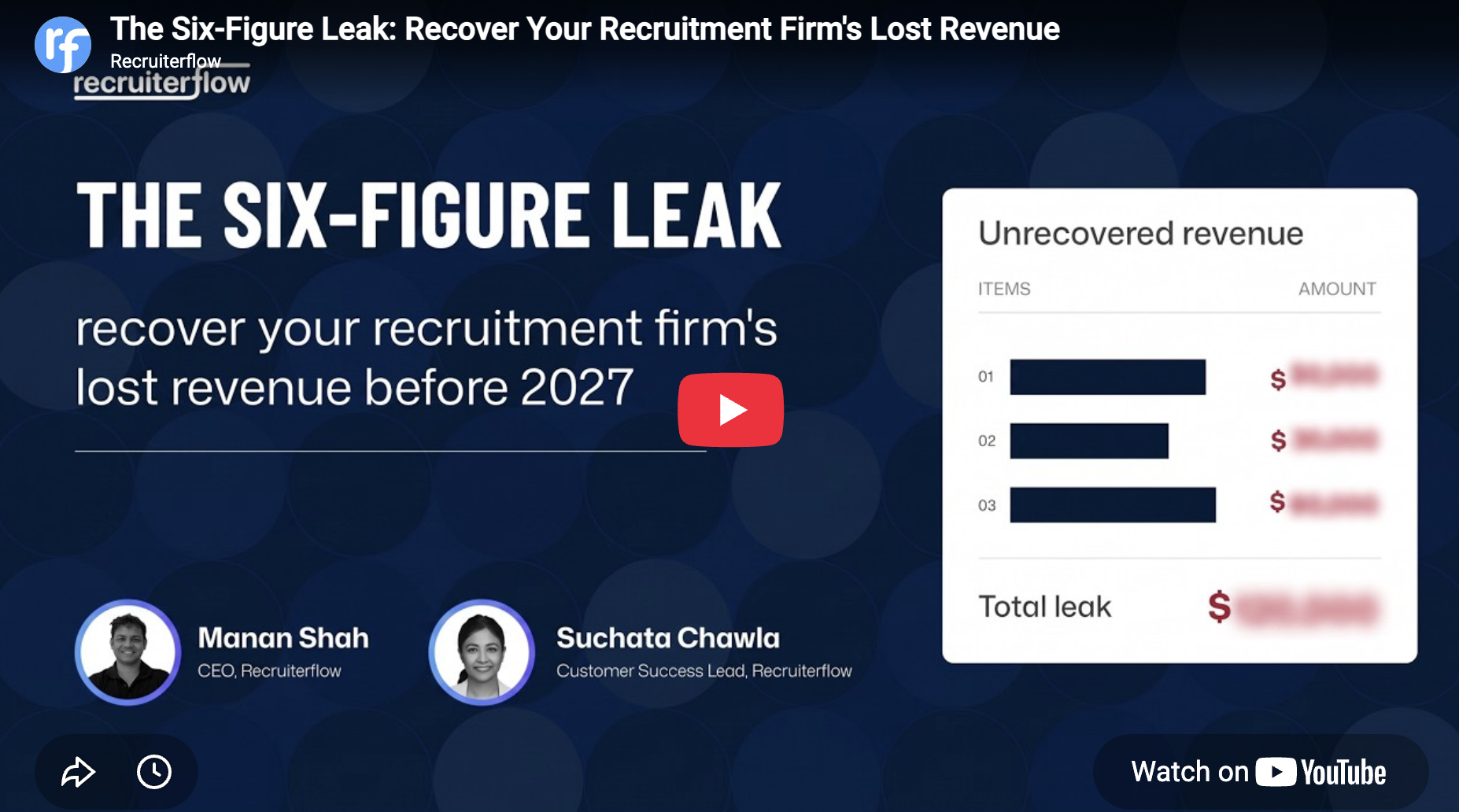
Agentic orchestration doesn’t replace the conversation. It removes the typing that follows it.
Your statement of leakage
Add it up, and one set of conservative assumptions leaves $108,750 on the table. That’s about four placements’ worth of revenue.
| Leak | Assumption | Annual cost |
|---|---|---|
| Backdoor hires | 3 a year at $25,000 fees | $75,000 |
| Searching strangers | 1 LinkedIn Recruiter seat | $15,000 |
| Admin tax | 135 hours, one recruiter | $18,750 |
| Total unrecovered | $108,750 |
Your numbers will differ. Here’s how to run them:
- Backdoor hires: annual submissions ÷ 484 × your average fee.
- Searching strangers: what you spend on external sourcing that your own database could replace.
- Admin tax: admin hours per recruiter × (revenue per recruiter ÷ 1,800) × headcount.
Close the leaks before 2027
None of these leaks waits for next year’s budget. Every quarter they stay open, the total grows.
The good news: you don’t need new clients to recover this revenue. It’s already yours. You just need to see it.
Want your own number?
Book a strategy session. We’ll price your leaks and show exactly how Recruiterflow closes each one.
The firms winning tomorrow start today.
Webinar
Abhishek holds 7+ years of experience in helping companies rank for over 1,000 commercial keywords with a data-driven approach. As the SEO lead at Recruiterflow, he drives strategies that boost organic visibility and ensure competitive growth. Outside of work, Abhishek is a dedicated father of two, finding balance between his passion for SEO and family life.
Abhishek Sharma