
Candidate Rediscovery: How to Place From the Database You Already Have
71%. That’s the share of placements that came from candidates already sitting in the CRM before the job or search even opened (Source: The Economics of Recruiting).
Yet most searches still start on LinkedIn, where firms source 283 candidates for every hire. Referrals need 20 (Source: The Economics of Recruiting). For most recruiting and search firms, the next placement is already in the database: a candidate screened for a different client a year or two ago.
This guide covers candidate rediscovery for recruiting and executive search firms: what it is, why it converts better than fresh sourcing, a 7-step process to place from the database you already have, which candidates to rediscover first, and the metrics that prove it’s working.
What is candidate rediscovery?
Candidate rediscovery is the practice of searching the candidates a recruiting or search firm already holds in its ATS and CRM to fill a new role before sourcing anyone new. It treats past finalists, previously screened candidates, and people sourced for other clients’ searches as the first channel for every job order or mandate.
It’s broader than re-engaging silver medallists, the finalists who nearly got the offer. Rediscovery searches the whole database, including candidates screened out early for one role who fit another one perfectly. It also differs from a talent pool, which is a segment you curate on purpose. Rediscovery is the search you run across everything you hold.
In a recruiting or search firm, the database holds more than past applicants. It holds every candidate from every client’s search, every placement made three years ago, and every “not right now” that has quietly become “maybe.” In executive search especially, candidates are clients and clients are candidates: the CFO you placed may be hiring a COO today.
For recruiting and search firms, the database isn’t an archive. It’s institutional knowledge, and it compounds.
Why your database is your highest-converting channel
Recruiting is a conversion business, not a volume business. Recruiterflow’s study of 2,100+ search and recruiting firms makes that hard to argue with.
It takes 213 sourced candidates to produce one hire, and only about 3% of sourced candidates ever reach client submission (Source: The Economics of Recruiting). The biggest leak sits between screening and submission, where just 11.3% of screened candidates make it through.
Rediscovered candidates skip most of that leak. They’ve already been sourced, often screened, and sometimes interviewed. Your team knows their motivations, their compensation history, and how they present to clients.
Speed pays in every model. In contingent recruiting, the first strong submission often wins the fee. In retained search, the second tranche is typically billed at shortlist delivery, so a faster shortlist brings that fee forward too.
That’s why the top 25% of firms look so different from everyone else. They add fewer candidates per recruiter than the rest (800 vs. 930), yet make 5.21 placements per recruiter against 1.38 (Source: The Economics of Recruiting). They aren’t sourcing harder. They’re converting what they already have.
That conversion gap is worth roughly $168,000 in revenue per recruiter every year (Source: The Economics of Recruiting).
Why most databases never get rediscovered
If the database converts best, why does every search still start on LinkedIn? Because most databases are full and unsearchable at the same time. Five problems keep them that way.
Search runs on job titles. A “Head of Revenue” at one company is a “VP Sales” at another. Keyword and Boolean search find exact strings and miss the people who did the same work under a different title. Boolean finds rows. It doesn’t find people.
The best signal lives outside the CV. The candidate who said she’d relocate for the right role told you on a call. The one who wants a Series B company next mentioned it in an email. If notes and call transcripts aren’t searchable, that knowledge leaves with the recruiter or consultant who captured it.
Records go stale fast. A two-year-old profile describes who someone was, not who they are. Titles, employers, compensation, and availability all drift while the record sits untouched.
Nothing tells you when someone became placeable. Most candidates in your database weren’t wrong for you. Their timing was. Without a signal that their situation changed, the right moment to call passes unnoticed.
Compliance uncertainty freezes outreach. When nobody is sure which records can still be contacted, or which candidates sit inside a client’s off-limits agreement, teams default to contacting none of them.
One point deserves a straight answer: software can’t rescue data that was never captured. If interview notes, rejection reasons, and call context were never recorded, no search tool will surface them. Rediscovery works best for firms that capture context as part of the daily workflow, not as an afterthought.
How to place from your existing database: 7 steps
Candidate rediscovery works when it runs as a process, not a fallback when LinkedIn comes up empty. Here’s the sequence top firms follow.
1. Lock the brief before you search
Agree the must-haves, the deal-breakers, and the good-to-haves with the client before you query anything, and weigh each criterion explicitly. A search built on a vague brief returns a vague shortlist. Executive search firms can go a step further and build the calibration slate, the 5–10 profiles shown to the client before any outreach, from people they already know.
2. Filter to the candidates you can contact
Remove records with expired consent, records past your retention period, and do-not-contact flags. Then apply two checks that matter more to firms than to in-house teams. Respect client off-limits agreements, and exclude candidates you placed who are still inside a guarantee period.
3. Search by evidence, not job titles
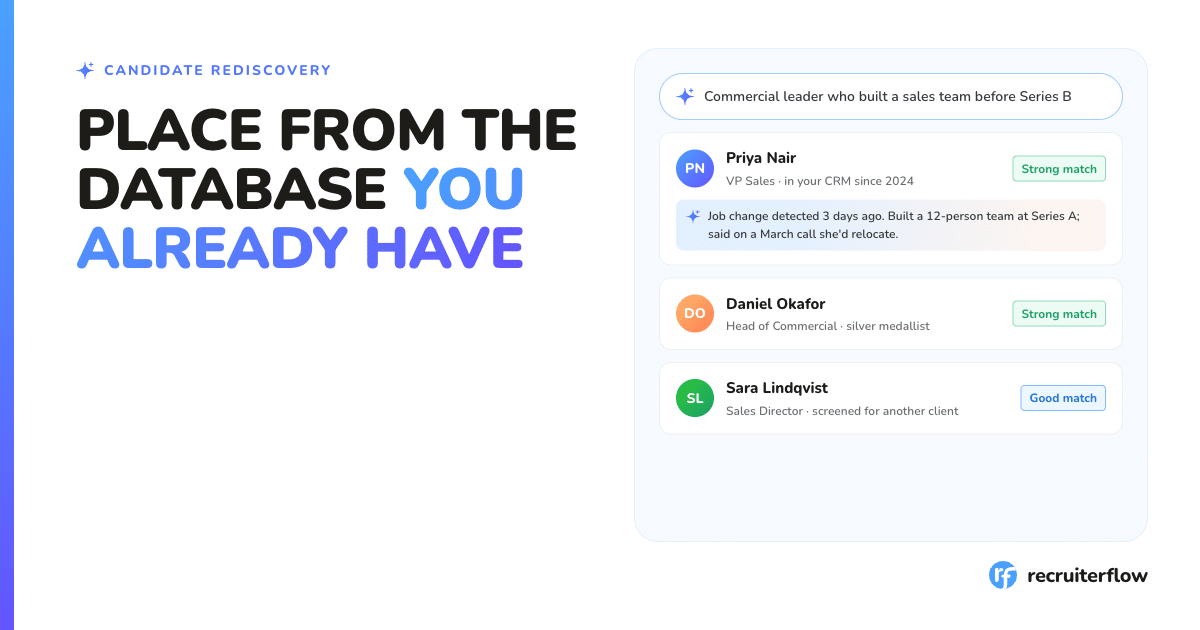
Search for the work the role needs, not the title it carries. Look for scope, industries, team size, company stage, and outcomes across CVs, call notes, emails, and transcripts. A query like “commercial leader who built a sales team from scratch at a company before its Series B” describes the person you need. No Boolean string can express it.
4. Prioritise by timing signals
The candidates most likely to move are the ones whose situation just changed. Look for recent job changes, tenure milestones around 18–24 months, funding rounds, acquisitions, layoffs, and candidates who said “not now” when the timing has since passed. Monitoring tools like AIRA Job Change Alerts flag these changes automatically instead of leaving them to chance.
The signal works in both directions. Mercury Hampton used job change alerts to discover candidates quietly hired by companies it had formally introduced them to, recovering roughly £25,000 in fees it would otherwise have lost (Source: Mercury Hampton case study). It’s a clear example of how old database contacts generate revenue.
5. Re-score against the new brief
Don’t reuse old ratings. A candidate rejected as “too senior” for one client may be exactly right for a different client’s role. In executive search, this is how byproduct placements happen. Read the past rejection reason, then judge the fit against today’s brief, not last year’s.
6. Refresh the record before outreach
Confirm the current employer, location, notice period, compensation expectations, and right to work. Outreach that mentions an old title or the wrong city tells the candidate nobody read their profile. Records that update from calls and emails automatically keep this step to minutes.
7. Re-engage with context
Reference the last conversation, explain why this role fits now, and ask whether they’re open to hearing more. A generic job alert sent to every past candidate reads as spam. A message that remembers what the candidate told you two years ago reads as a relationship. Multichannel sequences keep that follow-up consistent across email, LinkedIn, SMS, and calls. Recruiters can automate the routine touches, while executive search consultants can write every message themselves and use the cadence for coverage and visibility.
Who to rediscover first
Not every record deserves the same attention. Start with the segments where your team already holds the most context and the candidate has the most reason to talk.
| Segment | Why they convert | When to re-engage |
| Silver medallists | Already client-ready and interview-tested | As soon as a similar role or search opens |
| Late-stage withdrawals | Wanted to move; something else got in the way | 3–12 months after withdrawing |
| Rejected for a different client | Wrong fit for one brief, often right for another | Whenever the new brief matches |
| Past placements 2–3 years in | Proven relationship with your firm; often ready for the next step | At tenure milestones or a job change |
| Client-side contacts | Today’s hiring manager is often tomorrow’s candidate | When a role fits their next step |
| “Not right now” responders | Interested in principle, blocked by timing | When the stated blocker has passed |
| Referrals who didn’t convert | Arrived with trust attached | When a role matches their profile |
Most of these segments can be nurtured between searches. A six-monthly check-in with submittal-rejected candidates, a nudge when a contract or interim assignment ends in 30 days, or a note when someone changes jobs keeps them warm until the right role appears.
Metrics that prove rediscovery is working
If rediscovered placements aren’t tagged and measured, the channel stays invisible and gets dropped the moment the desk gets busy. Track these four.
Rediscovery placement share. The share of your placements that came from candidates already in your database.
\text{Rediscovery share} = \frac{\text{Placements from existing database}}{\text{Total placements}} \times 100
Six of 18 placements in a quarter is a 33% share. The benchmark to measure against is 71% (Source: The Economics of Recruiting).
Time to first submittal. How quickly you put a credible candidate in front of the client; for retained search, time to first shortlist, a core measure of search health. Firms using AIRA Job Change Alerts cut it by 34% (Source: The Economics of Recruiting).
Screen-to-submission rate, split by source. Compare rediscovered candidates against newly sourced ones. The cross-firm average is 11.3%, and the top 25% of firms run at 50.1% against 36.1% for the rest (Source: recruiting benchmarks).
Database freshness rate. The percentage of candidate records updated in the last 12 months. It’s the leading indicator for every other metric here. A stale database can’t be rediscovered, however good the search is.
How Recruiterflow turns the database into a placement channel
Every step above depends on two things: context captured in the first place, and a way to surface it when a new role or search opens. That’s the problem Recruiterflow was built around. AIRA, its intelligence layer, runs through each stage of rediscovery rather than sitting on top of it as a separate tool.
Capture. AIRA Notetaker turns calls into structured notes and updates the CRM, so the context behind every conversation is saved without extra admin.
Keep current. The AIRA CRM Update Agent fills missing or outdated fields from calls and emails. AIRA Job Change Alerts flag when candidates and contacts move roles, so stale records update themselves. Candidate and contact profiles stay in sync, so a person’s history follows them whether they’re a candidate or a client.
Surface. AIRA Search lets recruiters and consultants describe the candidate they need in plain English. It searches CVs, notes, emails, and call transcripts, then explains why each candidate matched. AIRA Matchmaker ranks the candidates already in your database against a live job.
Re-engage. Multichannel sequences carry follow-up across email, LinkedIn, SMS, and calls inside the same platform, automated where it suits the desk and fully personal where every message needs a consultant’s hand.
The results show up in the numbers. After switching to Recruiterflow, Mercury Hampton cut time-to-fill by 65%, from 106 days to 37, and increased client submissions by 164% (Source: Mercury Hampton case study). Across firms, those using AIRA Job Change Alerts see 12% higher placements on average (Source: The Economics of Recruiting).
None of this replaces the judgment of a recruiter or consultant. AIRA finds the evidence and explains it. The person decides who fits, makes the call, and closes the placement.
Frequently asked questions
What is candidate rediscovery in recruiting?
Candidate rediscovery is searching the candidates a recruiting or search firm already holds in its ATS and CRM to fill a new role before sourcing anyone new. It covers past finalists, previously screened candidates, and people sourced for other searches. Recruiters check that each record is current, then re-engage the best matches with context from earlier conversations.
What percentage of placements come from an existing candidate database?
According to Recruiterflow’s study of 2,100+ search and recruiting firms, 71% of placements came from candidates already in the CRM before the job opened. That makes the existing database the single biggest source of placements for most firms. Top-quartile firms also add fewer new candidates per recruiter than the rest, yet place far more.
How do recruiting and search firms find the right candidates in their own database?
They search by evidence rather than job titles: skills, scope, company stage, and outcomes across CVs, notes, emails, and call transcripts. Natural language search tools such as AIRA Search let recruiters and consultants describe the candidate in plain English instead of writing Boolean strings. Timing signals, like a recent job change, help decide who to call first.
Can rediscovered candidates be used in an executive search calibration meeting?
Yes, and they often make the strongest calibration profiles. Because the team already knows them, consultants can discuss each candidate in depth while the client stack-ranks the slate. That feedback sharpens the brief before any outreach begins.
How often should firms re-engage past candidates?
Re-engage when there’s a reason: a matching role, a job change, a tenure milestone, or a passed timing blocker. Between searches, light-touch nurture every three to six months keeps strong candidates warm; for senior executives, a personal check-in every six to twelve months is usually enough.
Can you re-contact past candidates under GDPR?
It depends on the consent and privacy notice under which the data was collected, and on your retention policy. Under GDPR, personal data must be used for its stated purposes and kept no longer than necessary. Client off-limits agreements apply on top of that, so confirm both before running a rediscovery campaign.
What should candidate rediscovery software do?
It should search notes, emails, and transcripts as well as CVs, and match by meaning rather than exact keywords. It should keep records current automatically, flag when candidates change jobs, and explain why each candidate matched. Recruiterflow’s AIRA covers each of these inside one platform built for recruiting and executive search firms.
Your next placement is already in your database
The firms pulling ahead aren’t sourcing more. They’re finding, faster, the candidates they already know, and calling them at the moment those candidates are ready to move.
See how AIRA Search and Job Change Alerts turn your database into your highest-converting channel. Book a personalised Recruiterflow demo.
Recruitment

