
Recruiting Platforms With Owned People Data & Enrichment
Which recruiting platforms have built-in people data and enrichment?
Recruiterflow, Pin, SeekOut, and hireEZ offer recruiting workflows that combine people data with enrichment, although their database models differ.
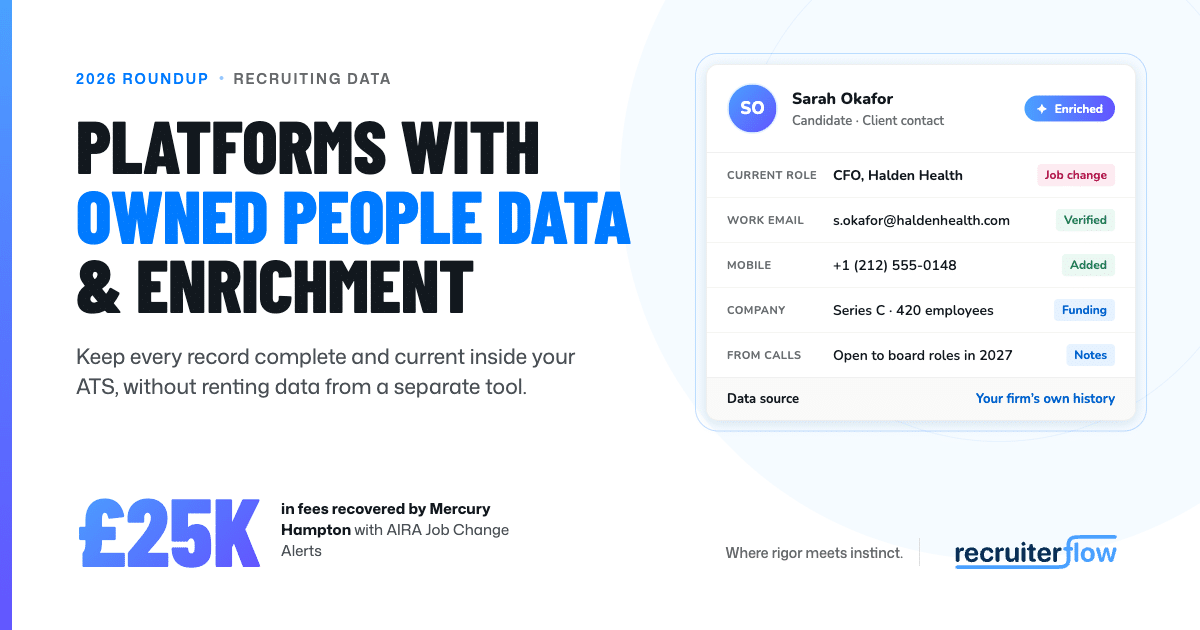
Recruiterflow combines your agency’s candidate and client database with built-in enrichment, helping recruiters find contact details, track job changes, and update profiles inside their ATS and CRM. It brings current information together with the conversations, notes, and placement history your team has already captured.
That combination matters. A candidate’s current job title tells you where they work. Your agency’s records tell you what they want next, which opportunities they’ve considered, and who on your team knows them.
An external people database can help you discover someone new. Your own database gives you the context to start a more relevant conversation. Enrichment helps keep that context connected to accurate, current information.
This guide explains how owned recruiting data and enrichment work together, what to look for in a platform, and how the available options compare.
What does “owned people data” mean for a recruiting firm?
Owned data is everything your firm has organically captured over time: CVs, interview notes, logged calls, email threads, and past placements, structured and automatically enriched. Unlike rented third-party contact lists, this first-party data is a unique, proprietary dataset your competitors cannot buy.
What is data enrichment?
Data enrichment is the process of adding or updating information on records you already hold, using additional sources. In recruiting, that means filling gaps in candidate and client profiles and correcting fields that have gone out of date. Contact data enrichment is the most common form: verified emails and phone numbers added to a person’s record.
Enrichment and sourcing do different jobs. Sourcing finds people who aren’t in your database yet. Enrichment improves the records of people who already are.
What gets enriched in a recruiting database:
- Contact details: verified work emails and phone numbers for candidates and client contacts.
- Career data: current title and employer, refreshed when someone moves.
- Job changes: a flag when a candidate changes jobs or a client contact moves into a new hiring seat.
- Company context: funding stage, investors, headcount and industry for the employers on a record.
- Activity data: profile fields filled from what candidates and clients say on calls and in emails.
- Duplicates: one person, one record, so enriched data doesn’t split their history across two profiles.
First-party vs third-party people data
First-party data wins on exclusivity and context. Third-party data wins on reach into people you have never met. Most firms need both, in that order.
| Factor | First-party data (your ATS and CRM, enriched) | Third-party data (licensed people databases) |
|---|---|---|
| Exclusivity | Only your firm holds your notes, calls and placement history | The same profiles are sold to every subscriber, including your competitors |
| Freshness | As current as your enrichment and job change monitoring keep it | As current as the vendor’s refresh cycle, which you don’t control |
| Context depth | Motivations, compensation, past interviews, who introduced whom | Titles, employers, skills and contact details |
| Cost model | Usually part of the platform plan, sometimes with per-lookup credits for contact data | Per seat, per credit or per API call, billed on top of your ATS |
| Compliance | You know where each record came from and when you collected it | You inherit the vendor’s sourcing, and you still owe candidates a notice |
| Best use | Rediscovery, business development, relationship-led searches | New markets and bulk list building |
How built-in enrichment works inside an ATS or CRM
Instead of relying on manual data entry or external Chrome extensions, built-in CRM data enrichment automatically updates candidate and client records in the background. A strong CRM will natively enrich:
- Contact Information: Automatically finds and validates missing personal emails and direct phone numbers for candidate matching and outreach.
- Current Career Role: Updates job titles, promotions, and current employer details to prevent you from reaching out with outdated context.
- Company Context: Appends firmographic data, such as company size, recent funding stages, and investors (often aggregating from sources like Crunchbase or CrustData), helping you identify high-growth accounts.
- Job Change Alerts: Automatically flags when a past candidate leaves their company or gets promoted, signaling a prime time to reach out.
Do you still need a separate enrichment tool?
Sometimes, mostly when the work is about volume or engineering. People Data Labs, Apollo, Cognism, ZoomInfo and Crunchbase sell people and company data, and most of them build for sales and revenue teams first.
If you are looking for a People Data Labs alternative as a recruiter, start with a narrower question: do you need raw data, or current records inside the system your team already works in?
Keep a standalone provider when:
- You are entering a sector or region where your database has almost no coverage.
- You need enriched data in a warehouse or your own product through an API.
- You run large business development lists that never touch your candidate records.
Built-in enrichment is usually enough when:
- Recruiters copy contacts from a data tool into the ATS by hand.
- Most lookups are for people already in your CRM.
- Nobody can say which tool last changed a field.
If most of your placements come from people you already hold, a second subscription mostly re-buys data on your own candidates.
Recruiterflow covers the middle ground inside the platform. AIRA Source searches external profiles without leaving the ATS, leaves out candidates already in your database, and only uses credits when you look up an email or phone number. For the wider picture, see our talent sourcing strategy guide and these free resume search options.
Recruiting platforms with built-in people data and enrichment in 2026
Modern recruiting teams are dropping separate subscriptions for tools like ZoomInfo, Apollo, Cognism, or People Data Labs in favor of platforms that merge the ATS, CRM, and data layers into a single talent graph.
Recruiterflow
- Data source: Owned + built-in proprietary enrichment
- Best for: Search firms and staffing agencies wanting autonomous data maintenance. Recruiterflow features a built-in Update Field Agent that auto-fills CRM data directly from calls and emails. It includes company enrichment (funding stage and investors via CrustData) and proactive Job Change Alerts. When data updates, the talent graph re-indexes within minutes, allowing for instant candidate rediscovery.
Loxo
- Data source: Licensed (proprietary global database) + Owned
- Best for: Agencies that want a massive built-in directory of candidates alongside their ATS, acting as a direct replacement for third-party data platforms.
Pin
- Data source: Licensed + Owned
- Best for: In-house talent acquisition teams focused on deep funnel analytics and AI-driven candidate sourcing from a natively integrated talent pool.
SeekOut
- Data source: Licensed (public profile aggregation)
- Best for: Enterprise recruiting teams executing complex technical, healthcare, or diversity sourcing strategies.
hireEZ
- Data source: Licensed
- Best for: Outbound-heavy teams looking for outbound campaign automation deeply tied to a massive external candidate database.
Bullhorn (with Amplify/Add-ons)
- Data source: Owned (Enrichment requires add-ons/marketplace partners)
- Best for: Large enterprise staffing firms that prefer to build a custom tech stack via integrations with third-party data enrichment platforms.
(Note: While standalone data enrichment platforms like People Data Labs, Cognism, Apollo, and ZoomInfo provide excellent raw data, using them requires constant exporting/importing or heavy API management to keep your recruiting CRM updated.)
How to evaluate data quality and compliance
When selecting a tool for candidate data enrichment, use this checklist to ensure you are getting actionable, legal data:
- Freshness & Data Decay: Does the platform offer live enrichment (updating records at the moment of search) or batch updates? Candidate data decays quickly; titles and emails must be routinely refreshed.
- Coverage: Does the enrichment provider specialize in your geographic region and industry? (e.g., Cognism is historically strong in Europe, while others dominate North America).
- GDPR and CCPA Compliance: Is the data legally sourced? Under GDPR Article 14 (which governs personal data not obtained directly from the data subject), your firm must provide the candidate with privacy information within a reasonable period (usually within one month or upon first contact) detailing what data you hold and where you got it. Ensure your platform helps automate these compliance notices.
- Source Transparency: Does the platform clearly state whether data is aggregated from public web scraping, proprietary partnerships, or user-contributed networks?
CRM data enrichment best practices for recruiting firms
- Search your own database before you source externally.
- Enrich on triggers: a new job order, a job change, a planned outreach. One-off bulk runs start ageing the next day.
- Record the source of every record and every enriched field.
- Set a retention rule for candidates you no longer have a reason to keep, and apply it.
This section is general information. Take legal advice for the jurisdictions you recruit in.
FAQs
What is the difference between data enrichment and a people database?
A people database is a collection of profiles you search to find new people. Data enrichment adds or updates fields on records you already hold, such as a new email, title or employer. Most recruiting firms need enrichment every day and an external database only when their own records run thin.
How fast does candidate data go out of date?
Fast enough to matter every quarter. In January 2026, the median US worker had been with their employer for 4.1 years, and workers aged 25 to 34 for 3.0 years. One job move can break an email, a title and a company field at once, which is why continuous job change monitoring outperforms an annual clean-up.
Is enriching candidate data GDPR compliant?
It can be, when you have a lawful basis for processing and you give candidates the Article 14 notice for data you didn’t collect from them. That notice covers the source and their rights, within one month or at first contact. Ask vendors where their data comes from, and take legal advice for your jurisdictions.
Do I still need LinkedIn Recruiter if my ATS has enrichment?
Possibly, for messaging and for searching people who aren’t in your database. Enrichment keeps the records you hold current, and LinkedIn remains a sourcing channel. If your CRM is reliable, run every new search there first and use LinkedIn for the gaps.
How much does data enrichment cost for a recruiting firm?
Costs follow three models: per seat, per credit or lookup, and per API call. Standalone providers bill on top of your ATS. In Recruiterflow, searching AIRA Source is free and each email or phone lookup uses 2 AIRA credits. Compare cost per usable contact, bounced emails included.
Keep your database current without a separate data tool
Mercury Hampton, a UK engineering and industrial recruitment firm, ran AIRA Job Change Alerts across its whole database. Two alerts surfaced candidates hired by companies the firm had already introduced them to, and recovered roughly £25,000 in fees.
Recruiterflow is the AI-native recruiting software that keeps that loop running inside one ATS and CRM: built-in enrichment, AIRA Job Change Alerts and external reach through AIRA Source, all on the same record. Your consultants keep the judgment calls. AIRA keeps the data behind them current.
The only software to future-proof your search business. See it on your own database.

Abhishek holds 7+ years of experience in helping companies rank for over 1,000 commercial keywords with a data-driven approach. As the SEO lead at Recruiterflow, he drives strategies that boost organic visibility and ensure competitive growth. Outside of work, Abhishek is a dedicated father of two, finding balance between his passion for SEO and family life.
Abhishek Sharma